Winter Solstice – 2015

Globe Liz

As we approach the shortest and darkest day of the year on the 21st, the Solstice, here’s a little ditty from the Bard. His oft quoted ‘Winter’ song ends the play Love’s Labour’s Lost.

WHEN icicles hang by the wall,

  And Dick the shepherd blows his nail,

And Tom bears logs into the hall,

  And milk comes frozen home in pail,

When blood is nipped, and ways be foul,

Then nightly sings the staring owl,

            To-whoo;

To-whit, to-whoo, a merry note,

While greasy Joan doth keel the pot.


When all aloud the wind doth blow,

  And coughing drowns the parson’s saw,

And birds sit brooding in the snow,

  And Marian’s nose looks red and raw,

When roasted crabs hiss in the bowl,

Then nightly sings the staring owl,

            To-whoo;

To-whit, to-whoo, a merry note,

While greasy Joan doth keel the pot.


–from Love’s Labour’s Lost, Act V, Scene ii

Not everything Shakespeare wrote needs to be profound on seven different levels, requiring a PhD in British Literature to decipher. This simple song (and yes, it’s been put to music by several composers) is pretty straightforward, singing about the discomforts of winter, and the singular joy of fellowship with family and friends, the comfort of good food indoors, out of the wind and snow.

Performances of Shakespeare’s plays in his lifetime–especially those through his early career of mostly comedies and histories–often ended with seeming impromptu songs or ditties. Not so impromptu; they were practiced and repeated. Alas, many of these are lost, never having been included with the texts in the First Folio.

Oftentimes the chief clown and dancer of the Lord Chamberlain’s Men’s, Will Kempe, led these songs. After about 1599 or so, much of these show-ending numbers ended. Kempe had a falling out with The Lord Chamberlain’s Men, and Shakespeare began his run of great tragedies. Perhaps it just didn’t seem right to dance a jig after the stage was overrun with blood.   Anyhow, today we have a small literary tragedy: that we don’t have a lot of these songs, or the music they were originally performed with. The curious ending of the Love’s Labour’s Lost, though, included two of these. I’ll save the other for a different season.  

Happy Solstice!

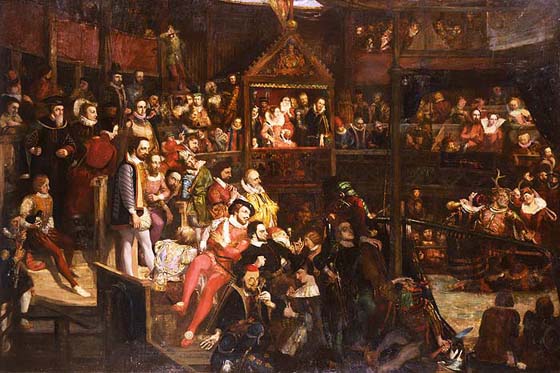
The image is of a painting by David Scott, circa 1840. It shows Queen Elizabeth I at the Globe Theatre–a bit of fantasy. The Queen never attended public performances.

Sunday Sonnet – 13 December 2015

Globe - 1

Shakespeare’s metaphor for Sonnet 23 encompasses two of The Bard’s prime avocations: Acting and poetry.  

23

As an unperfect actor on the stage
Who with his fear is put besides his part,
Or some fierce thing replete with too much rage,
Whose strength’s abundance weakens his own heart.
So I, for fear of trust, forget to say
The perfect ceremony of love’s rite,
And in mine own love’s strength seem to decay,
O’ercharged with burden of mine own love’s might.
O, let my books be then the eloquence
And dumb presagers of my speaking breast,
Who plead for love and look for recompense
More than that tongue that more hath more express’d.
O, learn to read what silent love hath writ:
To hear with eyes belongs to love’s fine wit.

The Poet tells his young love (the Young Man) that like an unpracticed actor on the stage who doesn’t yet know his lines, he doesn’t know what to say:

As an unperfect actor on the stage

to…

So I, for fear of trust, forget to say

The perfect ceremony of love’s rite.

Shakespeare also throws in a comparison to an animal that’s so fierce it can’t articulate its own heart. But by the end of the sonnet, the Poet gets back to the point. Instead of taking me for what I say (like the unpracticed actor), take me for what I write:

O, let my books be then the eloquence

I find this Sonnet really interesting from our modern perspective. Because now all we can really know about Shakespeare are what he’s left us in his writing. It’s almost as if the Poet is talking both to the Young Man, and to future generations: What really matters is what’s written down. Related to this, we don’t really know how Elizabethan actors sounded on stage. Yes, there have been some recent breakthroughs on Elizabethan pronunciation, clued by some of Shakespeare’s own puns. The Globe Theatre in London now offers some performances in what they believe is close to the original dialect. But in the end, it’s a bit of guesswork. Not with what’s written.  

So ultimately, the lesson the Poet gives the Young Man is this: anything not so eloquent I might say is evanescent; but what I’ve written down in the words of this sonnet–and in any of my books–are what’s true and everlasting.

The image is of the actual stage of the reconstructed Globe Theatre, which I was lucky enough to visit in 2010. We believe this is very much what it looked like when Shakespeare stood upon it.

Sunday Sonnet – 06 December 2015

sonnet 14

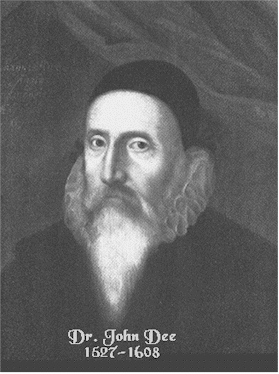
Astrologers enjoyed good business in Elizabethan times. We can never know if Shakespeare ever employed one or even believed in their powers of divination, but he certainly knew of them and knew something of the prognosticator’s art.

14

Not from the stars do I my judgment pluck;
And yet methinks I have astronomy,
But not to tell of good or evil luck,
Of plagues, of dearths, or seasons’ quality;
Nor can I fortune to brief minutes tell,
Pointing to each his thunder, rain and wind,
Or say with princes if it shall go well,
By oft predict that I in heaven find:
But from thine eyes my knowledge I derive,
And, constant stars, in them I read such art
As truth and beauty shall together thrive,
If from thyself to store thou wouldst convert;
Or else of thee this I prognosticate:
Thy end is truth’s and beauty’s doom and date.

In this sonnet the Poet compares the Young Man’s eyes to stars, and claims, like an astrologer, to be able to read in them the future: ‘But from thine eyes my knowledge I derive’. This sonnet comes so close to being a more traditional Elizabethan sonnet: a vivid metaphor, evocative of all of creation–thunder, wind and rain, the fates of princes, the constancy of stars–all kinds of romantic mush. It’s all here. But rather then simply comparing the Young Man to the beauty of heaven, or to the mysterious arts of astrology, the sonnet has a specific agenda: to urge the Young Man to procreate, lest his beauty be lost: ‘If from thyself to store thou wouldst convert’….to…’Thy end is truth’s and beauty’s doom and date.’

In these early sonnets, the Poet was still trying to convince the Young Man to marry and sire children. There’s circumstantial evidence that Lord Burghley, guardian to the Earl of Southampton and Elizabeth’s Secretary of State, commissioned Shakespeare to write sonnets to the Earl, urging him to marry. If that’s true, Burghley’s best intentions eventually changed The Poet and the Young Man into something more romantic and more provocative.  This vivid and romantic sonnets certainly shows signs of that growing change.

The image is of John Dee, Queen Elizabeth’s astrologer.

Sunday Sonnet – 29 November 2015

Will_Kemp_Elizabethan_Clown_JigOne of the amazing things about Shakespeare–and one of the things that has led to the conspiracy theories that a glove-maker’s son from the country couldn’t have possibly written such a vast and wide ranging body of work–is the vast sweep of the Poet’s knowledge: law, language (English, French, Latin), geography, horticulture, the royal court, the lives of commoners, the military, all manner of avocations and professions. And, as shown in Sonnet 8, musicianship:

8

Music to hear, why hear’st thou music sadly?

Sweets with sweets war not, joy delights in joy:

Why lov’st thou that which thou receiv’st not gladly,

Or else receiv’st with pleasure thine annoy?

If the true concord of well-tuned sounds,

By unions married, do offend thine ear,

They do but sweetly chide thee, who confounds

In singleness the parts that thou shouldst bear.

Mark how one string, sweet husband to another,

Strikes each in each by mutual ordering;

Resembling sire and child and happy mother,

Who, all in one, one pleasing note do sing:

   Whose speechless song being many, seeming one,

   Sings this to thee: ‘Thou single wilt prove none.’

Number 8 comes from early in the Young Man sonnets, when Shakespeare was possibly being paid by Lord Burghley to try and convince the young Earl of Southampton to marry–by writing Southampton sonnets! Southampton, by all accounts, adored verse, and back then trading verse was like trading iPod tracks today.

Here Shakespeare contrasts harmony and chords–‘the true concord of well-tuned sounds / by unions married’–against the sounds of single notes or parts, ‘who confounds / In singleness the parts that thou shouldst bear.’ A single man is like a single note. But a family is like the delight of musical chords.

Resembling sire and child and happy mother,

Who, all in one, one pleasing note do sing

Another sonnet which illustrates that Shakespeare must’ve loved music is one of the later sonnets, Number 128, where the Poet finds the Dark Lady playing on the virginal (harpsichord).

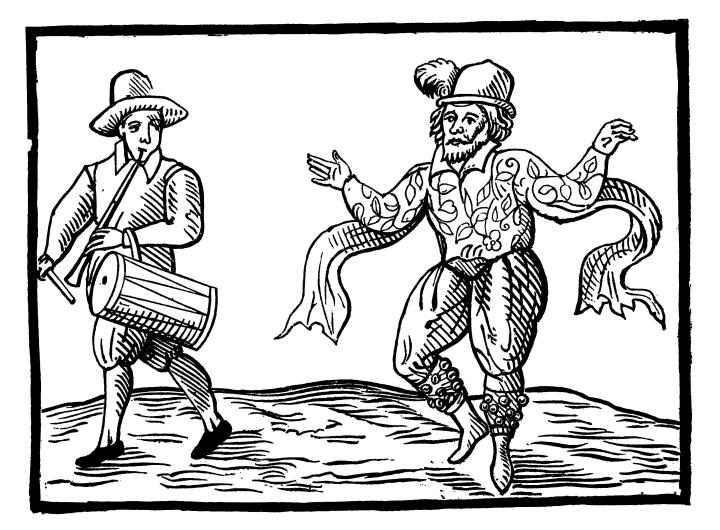
Music played an important part in Elizabethan Theatre. During the early years of Shakespeare’s career (till about 1600), many of his plays’ performances ended with impromptu musical numbers. Shakespeare’s fellow player, Will Kempe, was an accomplished dancer and singer, and many of Shakespeare’s comedies contain songs (which we no longer have the music for, just the lyrics).  

The image is an Elizabethan woodcut of Will Kempe. Kempe was one of Shakespeare’s fellow Lord Chamberlain’s Men.


Sunday Sonnet – 22 November 2015

MaryFitton

The events in our country today bring to mind for me one of Shakespeare’s sonnets, where the moral character of an individual has nothing to do with the color of his or her skin. The Elizabethans were unapologetic racists, and certainly Shakespeare was a product of his time. Yet somehow he saw past that enough to write ‘Othello’ and to address 28 of his sonnets to a lady of dark complexion, with whom the Poet is romantically and sexually entwined. As Sonnet 131 makes clear, the public perception is that she’s ugly because she isn’t white.   

131

Thou art as tyrannous, so as thou art,
As those whose beauties proudly make them cruel;
For well thou know’st to my dear doting heart
Thou art the fairest and most precious jewel.
Yet, in good faith, some say that thee behold
Thy face hath not the power to make love groan:
To say they err I dare not be so bold,
Although I swear it to myself alone.
And, to be sure that is not false I swear,
A thousand groans, but thinking on thy face,
One on another’s neck, do witness bear
Thy black is fairest in my judgment’s place.
In nothing art thou black save in thy deeds,
And thence this slander, as I think, proceeds.

The Poet disagrees. The Dark Lady not being white is not what makes her ‘dark.’ To the contrary, ‘to my dear doting heart / Thou art the fairest and most precious jewel.’ It’s only outsiders who dare to say that ‘thy face hath not the power to make love groan.’   (Making ‘love groan’ was the Elizabethan way of saying your feeling of romantic emotions were so great as to be painful.)

No, it’s not the Dark Lady’s appearance that makes her bad, its her deeds: ‘In nothing art thou black save in thy deeds.’

A Poet from a regressive, racist society four centuries ago was able to judge people by their deeds, not their appearances, something many of us in our so-called enlightened era are unable to do.

‘Blackamoor’ servants were not uncommon in Elizabeth’s police state of England–there were almost 400 of them by one estimate. In 1596 Elizabeth signed a proclamation expelling all “Negroes and blackamores” from England, but the proclamation had no teeth, as it did not apply to any blackamoors employed or enslaved. But what it does show is that the Elizabethans were indeed racist.

Thus it was crazy and a bit dangerous for Shakespeare to: 1) in 1594 to make one his highly intelligent and literate character Aaron from Titus Andronicus a Moor; 2) in 1604 to make the tragic protagonist of Othello a Moor–one of the greatest tragedies ever written in history, and 3) to pen 38 sonnets to the Dark Lady, which appeared in print in 1609. Several of the Dark Lady sonnets describe her complexion as dark.

However, this image of Mary Fitton has remained popular, one of Elizabeth I’s maids of honor. To this very day some insist she was Shakespeare’s Dark Lady. I wonder why she’s such a favorite?


Sunday Sonnet – 15 November 2015

Romeo_and_juliet_brown

If a cheater or adulterer should ever have the chutzpah to beg for forgiveness, he or she might do well to quote Sonnet 110.   Here we find a very eloquent argument laying out admittance of infidelities, acknowledgement of bad character, and a fervent assurance that the recipient of this Sonnet–the Young Man–is the best love the Poet’s ever known. Please take me back!

110

Alas, ’tis true I have gone here and there
And made myself a motley to the view,
Gored mine own thoughts, sold cheap what is most dear,
Made old offences of affections new;
Most true it is that I have look’d on truth
Askance and strangely: but, by all above,
These blenches gave my heart another youth,
And worse essays proved thee my best of love.
Now all is done, have what shall have no end:
Mine appetite I never more will grind
On newer proof, to try an older friend,
A god in love, to whom I am confined.
Then give me welcome, next my heaven the best,
Even to thy pure and most most loving breast.

If the 154 sonnets can be taken as any kind of narrative, and if their numbering is indeed anything close to what Shakespeare intended (their original publication occurred without Shakespeare’s permission), then this plea for forgiveness works for a while: the Young Man does seem to take the Poet back, and things sort of progress to the one of the most stunning of all the sonnets, number 116.   But it is late in the Young Man sequence of sonnets, and soon the verses will veer off toward the Dark Lady. The long and short of it this: the plea for forgiveness is more about the Poet than the Young Man.

Truth and proving one’s true intentions are the big question here. The Poet was untruthful, and the idea of truth is raised multiple times as well as a plea to let the Poet prove it:

“Alas, ‘tis true…”

“Most true it is that I have look’d on truth”

“And worse essay proved thee my best of love.”

“I never more will grind / On newer proof…”

My modern advice to all lovers is to stay true to your “most most loving breast.”   Leave the agony of fidelity to the Poets. Of course, people don’t, which is another reason why these very old verses still speak to us today.  

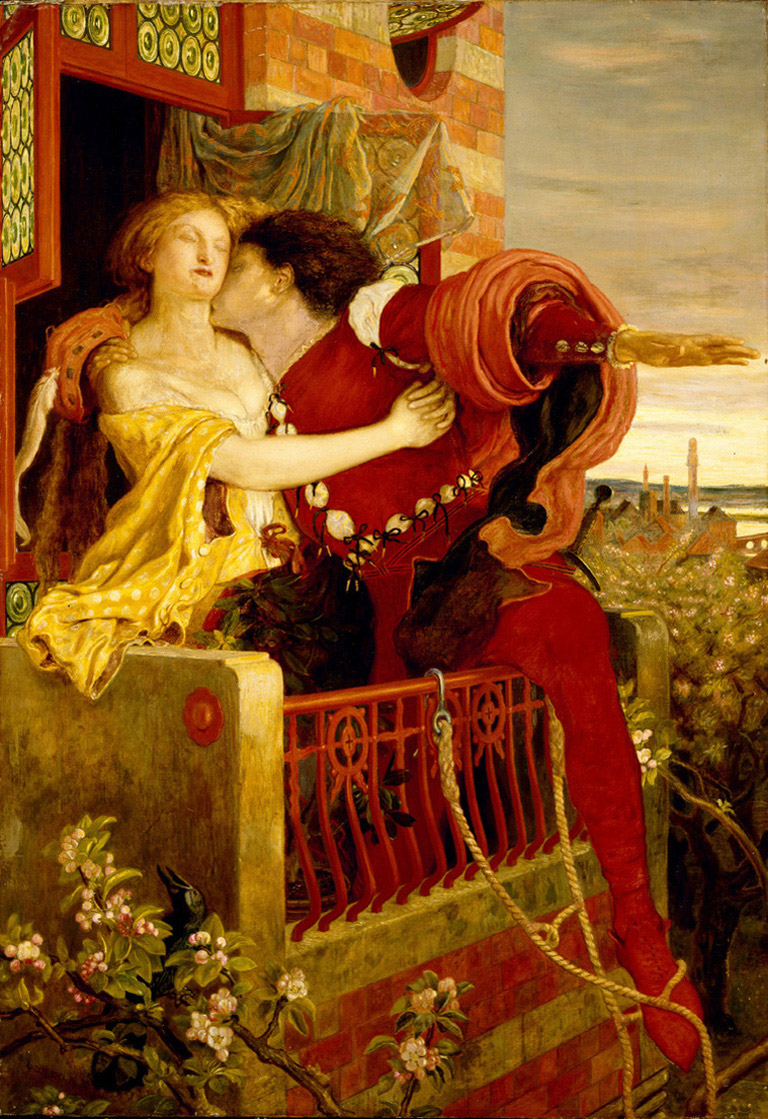
The image is the Pre-Raphaelite painter Ford Madox Brown’s depiction of ‘Romeo and Juliet, c. 1870.   It appears that with Shakespeare, whenever love was free of any infidelity, the lover themselves were doomed.

Happy Friday the Thirteenth from Edgar A. Poe!

Poe Mad - 1

Today’s the day when those of with triskaidekaphobia fear the worst. There’s no evidence Poe suffered from this bizarre malady, but suffer he did in his short life. One of the few pleasures Poe enjoyed was scaring the hell out of the rest of us. In celebration of Friday the Thirteenth, I’d like to share some of my favorite Poe horrors.

Note, if some of these now might make you laugh, it’s good to remember that Poe was writing this stuff in the first half of the 1800’s, a time much more straight-laced than our own. He shocked readers, amazed them, and on several occasions publishers even refused to print some of the madness Mr. Poe dreamt up.

The insane narrator maims his beloved pet cat in ‘The Black Cat’:

The fury of a demon instantly possessed me. I knew myself no longer. My original soul seemed, at once, to take its flight from my body and a more than fiendish malevolence, gin-nurtured, thrilled every fibre of my frame. I took from my waistcoat-pocket a pen-knife, opened it, grasped the poor beast by the throat, and deliberately cut one of its eyes from the socket! I blush, I burn, I shudder, while I pen the damnable atrocity.

The insane narrator rips out the teeth of his beloved while she’s still alive in ‘Berenice’:

He pointed to garments;—they were muddy and clotted with gore. I spoke not, and he took me gently by the hand: it was indented with the impress of human nails. He directed my attention to some object against the wall. I looked at it for some minutes: it was a spade. With a shriek I bounded to the table, and grasped the box that lay upon it. But I could not force it open; and in my tremor, it slipped from my hands, and fell heavily, and burst into pieces; and from it, with a rattling sound, there rolled out some instruments of dental surgery, intermingled with thirty-two small, white and ivory-looking substances that were scattered to and fro about the floor.

The insane narrator murders his landlord, then realizes, in a passing fit of sanity, that he has a body to dispose of in ‘The Tell-Tale Heart’:

If still you think me mad, you will think so no longer when I describe the wise precautions I took for the concealment of the body. The night waned, and I worked hastily, but in silence. First of all I dismembered the corpse. I cut off the head and the arms and the legs.

The quite sane (sorry), August Dupin, detective extraordinaire, investigates a gruesome murder in ‘The Murders in the Rue Morgue’:

Of Madame L’Espanaye no traces were here seen; but an unusual quantity of soot being observed in the fire-place, a search was made in the chimney, and (horrible to relate!) the corpse of the daughter, head downward, was dragged therefrom; it having been thus forced up the narrow aperture for a considerable distance. The body was quite warm. Upon examining it, many excoriations were perceived, no doubt occasioned by the violence with which it had been thrust up and disengaged. Upon the face were many severe scratches, and, upon the throat, dark bruises, and deep indentations of finger nails, as if the deceased had been throttled to death.

The insane narrator wreaks revenge on Fortunato by walling him up in a catacomb so his victim can slowly starve to death in ‘The Cask of Amontillado’:

“For the love of God, Montressor!”

“Yes,” I said, “for the love of God!”

But to these words I hearkened in vain for a reply. I grew impatient. I called aloud—

“Fortunato!”

No answer. I called again—

“Fortunato!”

No answer still. I thrust a torch through the remaining aperture and let it fall within. There came forth in return only a jingling of the bells. My heart grew sick—on account of the dampness of the catacombs. I hastened to make an end of my labor. I forced the last stone into its position; I plastered it up. Against the new masonry I re-erected the old rampart of bones. For the half of a century no mortal has disturbed them. In pace requiescat! 

And finally, the pathologically neurotic narrator obsesses on his greatest fear–to be buried alive–in ‘The Premature Burial’. Of course, by story’s end, he is buried alive.

It may be asserted, without hesitation, that no event is so terribly well adapted to inspire the supremeness of bodily and of mental distress, as is burial before death. The unendurable oppression of the lungs—the stifling fumes from the damp earth—the clinging to the death garments—the rigid embrace of the narrow house—the blackness of the absolute Night—the silence like a sea that overwhelms—the unseen but palpable presence of the Conqueror Worm—these things, with the thoughts of the air and grass above, with memory of dear friends who would fly to save us if but informed of our fate, and with consciousness that of this fate they can never be informed—that our hopeless portion is that of the really dead—these considerations, I say, carry into the heart, which still palpitates, a degree of appalling and intolerable horror from which the most daring imagination must recoil. We know of nothing so agonizing upon Earth—we can dream of nothing half so hideous in the realms of the nethermost Hell.

Veteran’s Day Shakespeare Quote – 11 November 2015

Sir-John-Falstaff-Brian-Mani

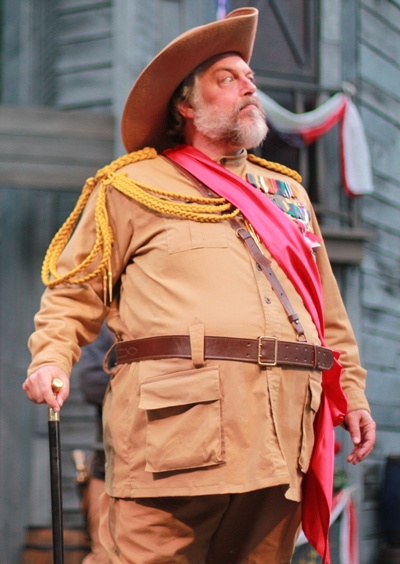
Today is Veteran’s Day in the United States, where we remember and honor the sacrifices of our veterans. In Elizabethan times, they had veterans and conscripts too, and as poorly as veterans are treated today, it was even worse back then. Shakespeare realized this, and used the deplorable practice of forced conscription into Elizabeth’s army to highlight Falstaff’s immoral activities. In his first Henry history play, Shakespeare has his villainous and corpulent Sir John Falstaff conscript a haggard bunch of ‘pitiful rascals’, only so that he himself can collect the conscription money.

PRINCE HENRY

I think, to steal cream indeed, for thy theft hath

already made thee butter. But tell me, Jack, whose

fellows are these that come after?

FALSTAFF

Mine, Hal, mine.

PRINCE HENRY

I did never see such pitiful rascals.

FALSTAFF

Tut, tut; good enough to toss; food for powder, food

for powder; they’ll fill a pit as well as better:

tush, man, mortal men, mortal men.

WESTMORELAND

Ay, but, Sir John, methinks they are exceeding poor

and bare, too beggarly.

FALSTAFF

‘Faith, for their poverty, I know not where they had

that; and for their bareness, I am sure they never

learned that of me.

PRINCE HENRY

No I’ll be sworn; unless you call three fingers on

the ribs bare. But, sirrah, make haste: Percy is

already in the field.

FALSTAFF

What, is the king encamped?

WESTMORELAND

He is, Sir John: I fear we shall stay too long.

FALSTAFF

Well,

To the latter end of a fray and the beginning of a feast

Fits a dull fighter and a keen guest.

Exeunt 

–from Henry IV Part I, Act IV, scene ii

The image is of American Players Theatre’s Brian Mani in the role of Falstaff–dressed up, of course, in military regalia that doesn’t deserve to wear.

Sunday Sonnet – 08 November 2015

sonnet 65

Only Poetry can defeat the ravages of Time. Shakespeare fervently asserts this in Sonnet 65, as he does so often in so much of his work.   Do you doubt him? You shouldn’t. The remains of the Elizabethan era, over four centuries gone, has left us only vestiges of its glory: London burned, obliterating most of its physical relics; every breathing soul dust in the Earth; its spoken language elusive–we’ll never know for certain how Elizabethan English really sounded; and we can only guess at what the stink of daily must’ve been. But the Poet’s love for his Young Man? Why, this sonnet is as brilliant and perfectly preserved as the day Shakespeare fixed its last iamb:

65

Since brass, nor stone, nor earth, nor boundless sea,
But sad mortality o’er-sways their power,
How with this rage shall beauty hold a plea,
Whose action is no stronger than a flower?
O, how shall summer’s honey breath hold out
Against the wreckful siege of battering days,
When rocks impregnable are not so stout,
Nor gates of steel so strong, but Time decays?
O fearful meditation! where, alack,
Shall Time’s best jewel from Time’s chest lie hid?
Or what strong hand can hold his swift foot back?
Or who his spoil of beauty can forbid?
O, none, unless this miracle have might,
That in black ink my love may still shine bright.

The intensity of the Poet’s emotions come through–through four hundred years. Simple black ink is able to capture and hold the despair Shakespeare felt against destroyer Time–how it ravages both love and life.

I wonder what Shakespeare might think if he knew that folks, four centuries later, were still reading his works. Would he be surprised?

The image comes from a photo of Kenilworth Castle, in ruins of course. This castle was owned by Robert Dudley, the great love of Queen Elizabeth, whom she was never able to marry.

Sunday Sonnet – 01 November 2015

Globe_Theatre_Buehne

In composing his 154 Sonnets, Shakespeare upended the whole Renaissance ideal of Romantic Poetry. Yes, Shakespeare wrote about unrequited love, a love marked with rhetorical hyperbole, lovers addicted to love, love as pain (which popular music still hasn’t given up on), and the object of love being an idealized lady.

However, with Shakespeare, that love is tainted with betrayal, the idealized lady is a ‘dark’ lady, and the passion felt is not always heterosexual. In Sonnet 21, the Poet is writing to his beloved Young Man, warning him of a rival poets, rivals who employ inflated rhetoric and outrageous conceits. Shakespeare claims to simply write the bare truth:

21

So is it not with me as with that Muse
Stirr’d by a painted beauty to his verse,
Who heaven itself for ornament doth use
And every fair with his fair doth rehearse
Making a couplement of proud compare,
With sun and moon, with earth and sea’s rich gems,
With April’s first-born flowers, and all things rare
That heaven’s air in this huge rondure hems.
O’ let me, true in love, but truly write,
And then believe me, my love is as fair
As any mother’s child, though not so bright
As those gold candles fix’d in heaven’s air:
Let them say more than like of hearsay well;
I will not praise that purpose not to sell.

If you can home in a few key phrases, the sonnet because pretty clear:

  • ‘Painted beauty’–women wearing too much makeup.
  • ‘Making a couplement of proud compare’–outrageous conceits
  • ‘That heaven’s air in this huge rondure hems’–outrageous hyperbole (rondure means ‘sphere’)
  • ‘With sun and moon, with earth and sea’s rich gems’–idolizing your beauty
  • ‘O let me, true in love, but truly write’–my verse speaks only truth
  • ‘I will not praise that purpose not to sell’–I’m not selling you anything

The idea of the ‘rival poet’ makes its return later on Shakespeare’s sonnets. As usual, the theme of any particular sonnet is not insular; these 154 verses all interconnect.   And despite Shakespeare’s insistence that he doesn’t indulge in hyperbolic metaphors, he certainly does it elsewhere! But at least when the Bard does it, he crafts metaphor, simile and imagery more beautifully and eloquently than other rival Elizabethan poet.

The image of the reconstructed Globe Theatre in London, whom Shakespeare himself had a hand in designing. The ceiling of the main stage’s roof shows off the Renaissance idea of Heaven, something Poets apparently employed a little bit too often.