Midweek Shakespearean Post – 10 February 2016

Station Eleven

The pair of novels I’m writing spawned this website: literary fiction mashed up with a bit of science fiction and a bit of mystery: Edgar A. Poe and William Shakespeare. So when a new novel comes along that mashes up genres and starts getting attention, it gets my attention. I just read Station Eleven by Emily St. John Mandel, and if my novels can be only half as good as Ms. Mandel’s, I can die happy.

Shakespeare, post-apocalyptic science fiction, a graphic novel, troubled but inspiring female protagonists, religious fanaticism, an intricate web of interconnecting characters, twists of time and even a Star Trek meme, populate this adventure. That makes it seem like a jumble: it’s not. Station Eleven is an elegiac and carefully constructed rumination on the meaning of Art.

Unlike the too-often utilized post-apocalyptic subgenre, this is book confounds your expectations. It doesn’t hustle along like a Hollywood blockbuster, it takes its time. Page one opens on stage with a production of King Lear. From that point the novel takes you through time and space, before and after a swine-flu mutation obliterates humanity, and all around the globe, into the hearts, hopes and fears of a tableau of characters.

Not to give anything away, but the novel ends where it begins. On the way, if you’re patient with the careful unraveling of events, Mandel rewards you with a series of illuminating connections. Now that I’ve turned the last page, some of these connections seem almost too fantastic to believe: but when you’re in the weave of her fictional dream, these couplings seem amazing, enlightening and uplifting.

Uplifting. A post-apocalyptic novel that’s uplifting! That’s one of the main miracles of this book. And as it’s happening, you completely believe it and buy it.

Take a chance and read this novel. What a wonderful mash up of genres, what a wonderful and poetic journey.


Sunday Sonnet – 31 January 2016

Sonnet_144_Two_Loves

Early hints of the Dark Lady! This sonnet falls into the latter section of verses written to the Poet’s beloved Young Man. The poem’s full of chaos and a raft of competing images. But in the mix, if you look for it, you can find hints of a Dark Lady….

119

What potions have I drunk of Siren tears,
Distill’d from limbecks foul as hell within,
Applying fears to hopes and hopes to fears,
Still losing when I saw myself to win!
What wretched errors hath my heart committed,
Whilst it hath thought itself so blessed never!
How have mine eyes out of their spheres been fitted
In the distraction of this madding fever!
O benefit of ill! now I find true
That better is by evil still made better;
And ruin’d love, when it is built anew,
Grows fairer than at first, more strong, far greater.
So I return rebuked to my content
And gain by ill thrice more than I have spent.

This sonnet more or less continues an argument started in the previous sonnet: that is, the Poet has philandered with a woman, and now he’s sorry and begs forgiveness from the Young Man. With whom did he philander? There are hints it’s the Dark Lady:

‘Siren tears, distill’d from limbecks foul as hell within.’ Sirens are female (and this is rare instance in the Young Man sonnets where Shakespeare makes an explicit reference to gender) and a limbeck is a vessel used in distillation. An argument can be made that the Poet is likening the limbeck’s shape to the vessel of a vagina. Looking forward to the Dark Lady sonnets, there are references to her being as dark as hell as well as her foulness (from which the Poet eventually contracts venereal disease).

Specifically, Sonnet 144 of the Dark Lady poems brings together two lovers: an unnamed Angel and the Dark Lady (see bottom of this post). The images withing these two sonnets connect them, as well as the juxtaposition of ‘so blessed’ and ‘better angel’ against ‘siren tears…as foul as hell’ and ‘to hell my female evil.’

It’s misogynistic, ugly, yet compelling, confusing, exciting, provocative. I can forgive Shakespeare, he was Elizabethan, a product of his age. Yet, as an Elizabethan, he was quite daring for even writing these. There are very plausible reasons why Shakespeare never sought publication of these sonnets: their suggestive if not outrageous narratives of homoerotic and multiracial love affairs were so outside Elizabethan norms, it would’ve been risky for the financially successful Mister Shakespeare to publish them. (Instead, someone else stole them and published them. They were a hit.)  

Here’s Sonnet 144 from the Dark Lady sequence. Read them both, and see what you think.

144

Two loves I have of comfort and despair,
Which like two spirits do suggest me still:
The better angel is a man right fair,
The worser spirit a woman colour’d ill.
To win me soon to hell, my female evil
Tempteth my better angel from my side,
And would corrupt my saint to be a devil,
Wooing his purity with her foul pride.
And whether that my angel be turn’d fiend
Suspect I may, but not directly tell;
But being both from me, both to each friend,
I guess one angel in another’s hell:
Yet this shall I ne’er know, but live in doubt,
Till my bad angel fire my good one out.

The image is of Isac Friedlander’s 1931 wood engraving entitled ‘Sonnet 144 Two Loves.’ Perhaps it can apply to both Sonnets 144 and 119.

Sunday Sonnet – 24 January 2016

kate fleetwood

Shakespeare wrote in an era where women were considered property. However, if one looks at the trajectory of his plays from his first in1589 to his later plays in the 1600’s, his female characters become more complex, more powerful and, indeed, more fully human. It’s in this deeply sexist society that Shakespeare began to break away from the Elizabethan norm. So too his Sonnets (published in 1603), specifically in the Poet’s love affair with the Dark Lady, where the Poet finds himself ensnared into a relationship with a woman who has become utterly and completely more powerful than him:

150

O, from what power hast thou this powerful might
With insufficiency my heart to sway?
To make me give the lie to my true sight,
And swear that brightness doth not grace the day?
Whence hast thou this becoming of things ill,
That in the very refuse of thy deeds
There is such strength and warrantize of skill
That, in my mind, thy worst all best exceeds?
Who taught thee how to make me love thee more
The more I hear and see just cause of hate?
O, though I love what others do abhor,
With others thou shouldst not abhor my state:
If thy unworthiness raised love in me,
More worthy I to be beloved of thee.

In this Sonnet, the Dark Lady excels in all things bad; her dominion over the Poet remains despite all her flaws. But he doesn’t hate her–he loves her! His sonnet argues that her unworthiness has made him love her, and because of that he’s the one who deserves her love in return. Her power over him is so strong, that he would even disbelieve it’s light during the day: ‘To make me give the lie to my true sight / And swear that brightness doth not grace the day?’ Moreover, she executes her evil actions so skillfully, he thinks them better than anyone else’s good acts:

That in the very refuse of thy deeds
There is such strength and warrantize of skill
That, in my mind, thy worst all best exceeds?

Personally, when I read this sonnet (and some of the other Dark Lady sonnets), I can’t help but think of Lady Macbeth (Macbeth, written in about 1606). One of Lady Macbeth’s most astonishing speeches is about a society where her femininity has no power. So she must calls upon the spirits to be to ‘unsex’ her:

Come, you spirits

That tend on mortal thoughts, unsex me here,

And fill me from the crown to the toe top-full

Of direst cruelty. Make thick my blood.

Stop up the access and passage to remorse,

That no compunctious visitings of nature

Shake my fell purpose, nor keep peace between

The effect and it! Come to my woman’s breasts,

And take my milk for gall, you murd’ring ministers,

Wherever in your sightless substances

You wait on nature’s mischief. Come, thick night,

And pall thee in the dunnest smoke of hell,

That my keen knife see not the wound it makes,

Nor heaven peep through the blanket of the dark

To cry “Hold, hold!”

Macbeth, Act I, Scene v

So magnificent, what an incredible speech.

And what an amazing writer. Shakespeare was somehow able to see beyond the patriarchal constrictions of the Elizabethan world, and dared to imagine what it must be like to be a woman; that is, powerless.

The image is of the amazing Kate Fleetwood as Lady Macbeth from the 2010 film.

Sunday Sonnet – 17 January 2016

The_Old_Globe

In composing his sonnets, Shakespeare remained wisely circumspect about any specific references to his own life (lots of dangerous stuff goes in the sonnets)–to the point of not even publishing the verses himself. But in Sonnet 111, he gives a hint of a reference to his own life as an actor and why, perhaps he chose that profession:

111

O, for my sake do you with Fortune chide,
The guilty goddess of my harmful deeds,
That did not better for my life provide
Than public means which public manners breeds.
Thence comes it that my name receives a brand,
And almost thence my nature is subdued
To what it works in, like the dyer’s hand:
Pity me then and wish I were renew’d;
Whilst, like a willing patient, I will drink
Potions of eisel ‘gainst my strong infection
No bitterness that I will bitter think,
Nor double penance, to correct correction.
Pity me then, dear friend, and I assure ye
Even that your pity is enough to cure me.

The Young Man apparently blames bad luck–‘Fortune’–for forcing the Poet into such an ignoble profession as ‘public means.’ What does this mean? Some critics and scholars, though not all, believe it’s a reference to Will’s profession as an actor–and that he went into a life of acting to avoid a lot of other awful possibilities for employment in the Elizabethan world. However, though lucrative, acting was not considered a reputable profession in Elizabethan England: women weren’t allowed to act, actors were considered vagrants unless they were licensed under the patronage of a noble (hence Shakespeare’s ‘Lord Chamberlain’s Men’), and the Puritans considered all stagecraft to be the work of the Devil.

Members of the theatre crowd were notorious. ‘Public means’ breeds ‘public manners’, a reference to the ill behavior and bad reputation of theatre rascals, a reputation that’s tainted the Poet: ‘Thence comes it that my name receives a brand.’ If you dig into Shakespeare’s life, you’ll know that after he gained some wealth (by becoming part owner in the actual theatre company he wrote for), he labored mightily to acquire a Coat of Arms for the Shakespeare name, thereby gaining the respect and social station that comes only of being a ‘Gentleman’.

So yes, I know, not everyone agrees that the Sonnets were autobiographical, but there’s some compelling biographical hints in Sonnet 111. Certainly the Young Man would look down on the Poet’s social station as an actor if the Young Man was indeed the 3rd Earl of Southampton, a nobleman. There’s ample circumstantial evidence that the Earl was the Young Man.

The sonnet takes an interesting turn with ‘Potions of eisel ‘gainst my strong infection’ (eisel is vinegar). One of the common dangers of ‘public manners’ was the pox, otherwise known as venereal disease. Venereal disease is revisited in later sonnets with the Dark Lady, and in those there’s little left to the imagination (see numbers 153 & 154). Did Shakespeare at some point in his life contract syphilis?   There’s evidence outside of this sonnet that he did, and if that’s the case, then Sonnet 111 teases us with a couple of compelling glimpses into what might’ve been events in the Bard’s life.

The image comes from a section of Wenceslas Hollar’s 1642 drawing of London, here showing Shakespeare’s rebuilt Globe Theatre.  

Sunday Sonnet – 10 January 2016

feathers elizabeth

Even a genius like Shakespeare can’t always hit a home run. But even his run-of-the mill sonnets exhibit all the best qualities of great verse, and if he had not written some of his scintillating treasures, we’d probably still be forcing high school students to read ones like 81. Sonnet 81 is included with ‘Rival Poet’ sequence, though the rival really doesn’t show up here. What is mentioned is the immortality of verse, and how only Art can make us humans mortal.

81

Or I shall live your epitaph to make,
Or you survive when I in earth am rotten;
From hence your memory death cannot take,
Although in me each part will be forgotten.
Your name from hence immortal life shall have,
Though I, once gone, to all the world must die:
The earth can yield me but a common grave,
When you entombed in men’s eyes shall lie.
Your monument shall be my gentle verse,
Which eyes not yet created shall o’er-read,
And tongues to be your being shall rehearse
When all the breathers of this world are dead;
You still shall live–such virtue hath my pen–
Where breath most breathes, even in the mouths of men.

The really cool part of this sonnet is when the Poet tells his Young Man that the Poet’s verse is so darn good, that it’ll not immortalize the Poet, but immortalize the Young Man:

…I, once gone, to all the world must die:
The earth can yield me but a common grave,
When you entombed in men’s eyes shall lie.
Your monument shall be my gentle verse…

Ironically, today we know who Shakespeare is, but there are only theories as to whom the Young Man might’ve been.

The best part of this sonnet, I think, doesn’t get the attention it deserves, and that’s the final couplet. By the end of the Sonnet, the Poet has already made clear how great he thinks his verse is, and how that verse will immortalize his Young Man beyond the grave. Then final image, tying the act of composing with a mortal man’s dying breath. You see, a common practice in Elizabethan England was to use a feather held to the lips of the dying, to see if breath still fluttered, or if they had finally died.

You still shall live–such virtue hath my pen–
Where breath most breathes, even in the mouths of men.

This famous 1575 image of Queen Elizabeth, artist unknown, is just one example of the importance of feathers in Elizabethan life: fashion, quills for pens (pens being a personal favorite of Shakespeare’s), fans (fans being a personal favorite of Elizabeth’s), and for testing the breath of the dying.


Sunday Sonnet – 03 January 2016

Elizabeth-I-039-s-Navy-Was-Years-Ahead-of-Its-Time-2

Trysts, betrayals, heterosexual and bisexual romancing, profound expressions of undying love summarily cast aside and–love triangles! Shakespeare’s sonnets have it all. Sonnets 79 through 86 tell of a rival Poet vying for the love of the Young Man.

80

O, how I faint when I of you do write,
Knowing a better spirit doth use your name,
And in the praise thereof spends all his might,
To make me tongue-tied, speaking of your fame!
But since your worth, wide as the ocean is,
The humble as the proudest sail doth bear,
My saucy bark inferior far to his
On your broad main doth wilfully appear.
Your shallowest help will hold me up afloat,
Whilst he upon your soundless deep doth ride;
Or being wreck’d, I am a worthless boat,
He of tall building and of goodly pride:
Then if he thrive and I be cast away,
The worst was this; my love was my decay.

When the Poet realizes that a rival has entered the scene, he right away admits the rival is a better poet, but in so admitting that, displays his own formidable skill at poetry and creating metaphor. In this, it’s nautical:  

  • ‘since your worth, wide as the ocean is’ – your worth is wide as the ocean
  • ‘the humble as the proudest sail doth bear’ – you bear both humble and proud suitors
  • ‘my saucy bark inferior to his’ – my brazen love is less than the rival poet’s (a ‘bark’ is a boat)
  • ‘your broad main’ – your circle
  • ‘your shallowest help will hold me up afloat’ – your slightest attention to me keeps me hoping
  • ‘upon your soundless deep doth ride’ – the rival poet enjoys your deep affection
  • ‘or being wreck’d, I am a worthless boat’ – if I lose your favor, it’s because I’m worthless
  • ‘I be cast away’ – I’ll be marooned

This rivalry goes on for eight whole sonnets, where the Poet protests too much at how the rival’s poetry leaves the Poet ‘tongue-tied’. Yet, though inferior he supposedly may be, the Poet continues showing off, writing circles around anything that would be written for the next 400 years. It’s all a kind of game, I think. Perhaps there were actual events that led to this rival poet sequence–an actual competitor for the Young Man’s affection that Will Shakespeare himself was involved with. If so, then Shakespeare’s response was to write his way out of it.    

But isn’t that how Shakespeare solved everything? He wrote his way out of it. He wrote his way to success, in his plays and other verse. Wrote his way contemporary literary acclaim, wrote his way into Queen Elizabeth’ Court, to wealth and, finally, immortality.

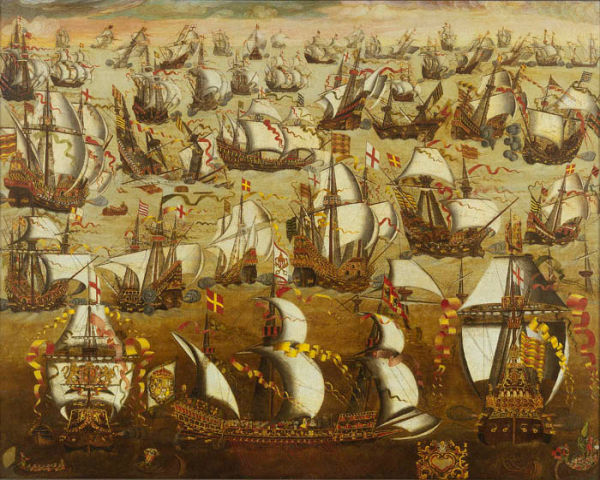
The painting, circa 1700, by an unknown artist, is of the Spanish Armada being defeated by Elizabeth’s superior navy–you know, the Spanish Armada of goodly pride inferior to the saucy barks the British built.

Year’s End Shakespearean Quote – 30 December 2015

macbeth fassbender

As we near Year’s End, time is on our minds. Shakespeare was obsessed with time, and in his great tragedy, which came late in his career, Macbeth obsesses on it too:

Macbeth:

If it were done, when ’tis done, then ’twere well

It were done quickly. If th’ assassination

Could trammel up the consequence, and catch

With his surcease, success: that but this blow

Might be the be-all and the end-all—here,

But here, upon this bank and shoal of time,

We’d jump the life to come.

Macbeth, Act I, Scene vii

Macbeth’s ruminations involve his and Lady Macbeth’s plans to assassinate the King of Scotland. But aren’t there always unintended consequences?

Thus we have that lovely line ‘upon this bank and shoal of time’, where Macbeth wonders about this life and the next life. He’s on the verge of venturing into a kind of beyond. A shoal is a shallow, and a bank is a sand bank; to cross those shallows will take you into the ocean’s depths–from this life to the next life. Shakespeare begins his nautical imagery earlier in the speech with ‘trammel’ and ‘catch.’ A trammel in Elizabethan times was a fishing net. What’s really neat, though, is that trammel was also a word used to describe the binding up of a corpse!  

Finally, with ‘be-all’ and ‘end-all’, Macbeth frets that his assassination of the King (this being the first ever recorded use of the word ‘assassination’) might not be the final act–but rather a catalyst to set off a string of unintended consequences.

Such a lovely little soliloquy, so simple on its face, but deep with imagery and foreshadowing. And if you read the entire play–or watch one of the several movie versions–you’ll see that Macbeth is thick with references to time.   Shakespeare abhorred time, and how it slowly destroys everything we humans love. In the end, though, Shakespeare won: his plays and poetry have outlasted time, venturing well beyond the bank and shoal of anything any Elizabethan could’ve imagined.

The image is of Michael Fassbender as Macbeth in the latest film version of Shakespeare’s masterpiece.  


Sunday Sonnet – 27 December 2015

Shakespeare's grave

The central conceit of Sonnet 31 is strange, almost supernatural, and creepy.   By this point in the sonnet sequence, the Poet has fallen in love with the Young Man and now sees in this fair youth the loving essence of every old lover the Poet has ever had–to the point of likening the Young Man to a grave:

31

Thy bosom is endeared with all hearts,
Which I by lacking have supposed dead,
And there reigns love and all love’s loving parts,
And all those friends which I thought buried.
How many a holy and obsequious tear
Hath dear religious love stol’n from mine eye
As interest of the dead, which now appear
But things removed that hidden in thee lie!
Thou art the grave where buried love doth live,
Hung with the trophies of my lovers gone,
Who all their parts of me to thee did give;
That due of many now is thine alone:
Their images I loved I view in thee,
And thou, all they, hast all the all of me.

‘Thou art the grave where buried love doth live’ – you’re a grave where dead loves return to life

‘many a holy and obsequious tear / Hath dear religious love stol’n from mine eye / As interest of the dead, which now appear’ – I’ve shed tears at funerals for old loves I believed dead, only to find them in you

It’s pretty crazy. But when you consider the Elizabethan world and its life expectancy–plague, disease, bad nutrition, horrific medicine–and the middle-age of the Poet in love with a younger man, perhaps this grave and resurrection analogy isn’t so out of place.

And in the final couplet, the Poet says something beautiful and eloquent: That the Young Man embodies all of the loves the Poet’s ever known, and in that the Young Man has all of the Poet:

Their images I loved I view in thee,
And thou, all they, hast all the all of me.

Shakespeare was a genius at bringing together opposites: tragedy and comedy residing check to check in his plays; seemingly disparate themes and notions not colliding, but coalescing into one. The despair of the grave becoming the joy and solace of great love.

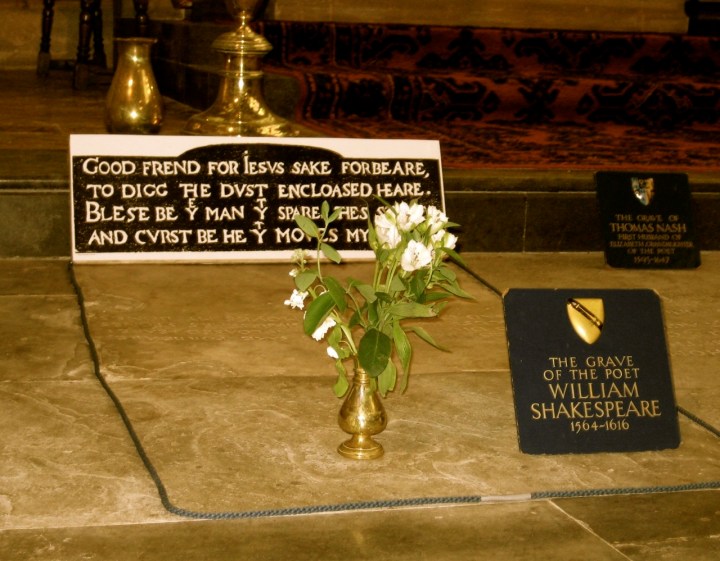
The image is of Shakespeare’s own grave at Holy Trinity Church in Stratford-upon-Avon.  Photo taken by Yours Truly.  

Sunday Sonnet – 20 December 2015

Sonnet 149

One of the many amazing things about Shakespeare’s sequence of 154 sonnets is that taken together and in the order numbered (a numbering Shakespeare never publically contested after they were published without his permission) is the sense of narrative. These sonnets tell a tale. Near the end, things come to a head. In the 149th sonnet, the Poet complains with a kind of emotional madness against the Dark Lady:

149

Canst thou, O cruel! say I love thee not,
When I against myself with thee partake?
Do I not think on thee, when I forgot
Am of myself, all tyrant, for thy sake?
Who hateth thee that I do call my friend?
On whom frown’st thou that I do fawn upon?
Nay, if thou lour’st on me, do I not spend
Revenge upon myself with present moan?
What merit do I in myself respect,
That is so proud thy service to despise,
When all my best doth worship thy defect,
Commanded by the motion of thine eyes?
But, love, hate on, for now I know thy mind;
Those that can see thou lovest, and I am blind.

This sonnet is basically a take-down of everything that’s wrong with the Poet and Dark Lady’s relationship; it’s so dysfunctional it could be a popular movie today:

  • You are so cruel – ‘O cruel!’
  • You claim I don’t love you even though I take sides against myself – ‘When I against myself with thee partake?’
  • I think of you and never of myself – ‘Do I not think on thee, when I forgot / Am of myself’
  • Anyone who hates you is no friend of mine – ‘Who hateth thee that I do call my friend?’
  • If you scowl at me, I punish myself – ‘if thou lour’st on me, do I not spend / Revenge upon myself with present moan?’
  • The best in me worships the worst in you – ‘all my best doth worship thy defect’
  • Go ahead and keep hating me, because you love people who can see, and I’m blind:

But, love, hate on, for now I know thy mind;
Those that can see thou lovest, and I am blind.

There’s no grand metaphor here, and this is actually one of the more conventional sonnets of Shakespeare’s radical collection. What makes this one so different from the typical Petrarchan romantic sonnet is there’s no final ‘turn’ to reconciliation at the end, merely a confirmation of how ugly and deplorable this whole mess has become.  

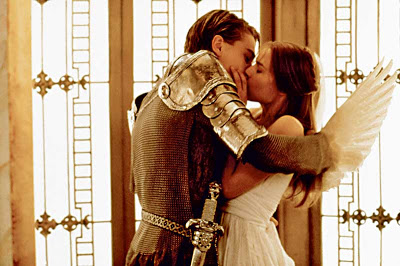
The image is of Romeo and Juliet kissing is from the 1996 film. Romantic, right? Judging from Shakespeare’s Sonnets, including the one above, and what he did to the happies couples in (a clue: they were farcical, doomed or evil), Shakespeare doesn’t seem to much believe in the idea of Romantic love.

Winter Solstice – 2015

Globe Liz

As we approach the shortest and darkest day of the year on the 21st, the Solstice, here’s a little ditty from the Bard. His oft quoted ‘Winter’ song ends the play Love’s Labour’s Lost.

WHEN icicles hang by the wall,

  And Dick the shepherd blows his nail,

And Tom bears logs into the hall,

  And milk comes frozen home in pail,

When blood is nipped, and ways be foul,

Then nightly sings the staring owl,

            To-whoo;

To-whit, to-whoo, a merry note,

While greasy Joan doth keel the pot.


When all aloud the wind doth blow,

  And coughing drowns the parson’s saw,

And birds sit brooding in the snow,

  And Marian’s nose looks red and raw,

When roasted crabs hiss in the bowl,

Then nightly sings the staring owl,

            To-whoo;

To-whit, to-whoo, a merry note,

While greasy Joan doth keel the pot.


–from Love’s Labour’s Lost, Act V, Scene ii

Not everything Shakespeare wrote needs to be profound on seven different levels, requiring a PhD in British Literature to decipher. This simple song (and yes, it’s been put to music by several composers) is pretty straightforward, singing about the discomforts of winter, and the singular joy of fellowship with family and friends, the comfort of good food indoors, out of the wind and snow.

Performances of Shakespeare’s plays in his lifetime–especially those through his early career of mostly comedies and histories–often ended with seeming impromptu songs or ditties. Not so impromptu; they were practiced and repeated. Alas, many of these are lost, never having been included with the texts in the First Folio.

Oftentimes the chief clown and dancer of the Lord Chamberlain’s Men’s, Will Kempe, led these songs. After about 1599 or so, much of these show-ending numbers ended. Kempe had a falling out with The Lord Chamberlain’s Men, and Shakespeare began his run of great tragedies. Perhaps it just didn’t seem right to dance a jig after the stage was overrun with blood.   Anyhow, today we have a small literary tragedy: that we don’t have a lot of these songs, or the music they were originally performed with. The curious ending of the Love’s Labour’s Lost, though, included two of these. I’ll save the other for a different season.  

Happy Solstice!

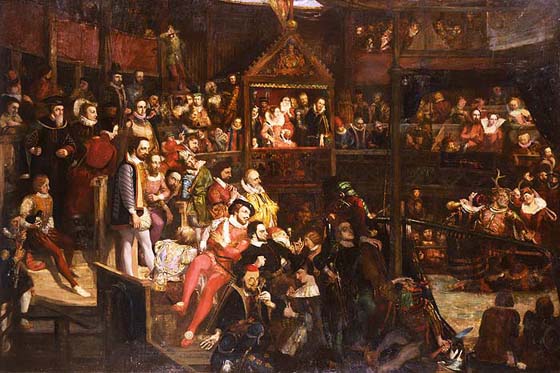
The image is of a painting by David Scott, circa 1840. It shows Queen Elizabeth I at the Globe Theatre–a bit of fantasy. The Queen never attended public performances.