Sunday Sonnet – 15 March 2015

116 original

I attended the wedding yesterday of a young friend. The ceremony she and her newly minted husband wrote themselves, full of style, panache and sweetness. There’s wasn’t much old or traditional in their ceremony or reception–or was there? Of course there was: The love of true minds–a kind of love they promised one another which is never perfect but the most beautiful thing in the world. It’s complicated, and never in the course of human Art has that kind of love been better expressed than in Will Shakespeare’s Sonnet 116: 

Let me not to the marriage of true minds
Admit impediments. Love is not love
Which alters when it alteration finds,
Or bends with the remover to remove:
O no; it is an ever-fixed mark, 
That looks on tempests, and is never shaken;
It is the star to every wandering bark,
Whose worth’s unknown, although his height be taken.
Love’s not Time’s fool, though rosy lips and cheeks 
Within his bending sickle’s compass come; 
Love alters not with his brief hours and weeks, 
But bears it out even to the edge of doom.
   If this be error and upon me proved,
   I never writ, nor no man ever loved. 

There is such a timeliness beauty, eloquence and truth to this sonnet–so perfect in its realization of the Elizabethan sonnet form, so infinitely depthless in its meanings and cross-meanings, so breathtaking in its imagery–that it’s never been matched by another poet. And yet–if one knows nothing of poetry, if one finds Shakespeare intimidating–even a cursory read or listen to these lines can raise your spirits and thrill your heart with its lyrical beauty. 

Read it aloud today with someone you love.

And to my young friends, congratulations. 

The image is the Elizabethan text of Sonnet 116, printed with the font and characters common to that era.

Sunday Sonnet – 01 March 2015

anne_hathaways_cottage

Shakespeare loved puns. But not all of his puns had to be humorous. In this melancholy and desolate sonnet, he endows the word ‘love’ with at least five or six shades of meaning: The Poet’s love for his lover; his lover’s love for him; the two actual different lovers themselves (besides the Poet himself); lust, or the carnal act of love-making; and the generic attribution referring all lovers in the word. For in this sonnet we find a love triangle mixed into the tangle of the emotions and betrayals:

40

Take all my loves, my love, yea, take them all;
What hast thou then more than thou hadst before?
No love, my love, that thou mayst true love call;
All mine was thine before thou hadst this more.
Then if for my love thou my love receivest,
I cannot blame thee for my love thou usest;
But yet be blamed, if thou thyself deceivest
By wilful taste of what thyself refusest.
I do forgive thy robbery, gentle thief,
Although thou steal thee all my poverty;
And yet, love knows, it is a greater grief
To bear love’s wrong than hate’s known injury.
Lascivious grace, in whom all ill well shows,
Kill me with spites; yet we must not be foes. 

Why on earth would Shakespeare decide to play on one word, weaving it through in all kinds of different confusing ways? Just about everything Shakespeare did was intentional. Any us who’ve ever been in throes of a new love affair, are experiencing trouble in an established relationship or, sadly, are involved in the betrayal of love, roil about with a sense of confusion and despair. Our emotions are very mixed.

In the end the Poet seems to eek out a half-hearted and woefully inadequate solution to this: 

Lascivious grace, in whom all ill well shows,
Kill me with spites; yet we must not be foes. 

Your betrayal is going to ruin me, but let’s still remain friends. 

The image is a photograph of Anne Hathaway’s cottage. Anne was Shakespeare’s wife, and evidence shows that Will and Anne were estranged for years. It was very likely an unhappy love.  

Sunday Sonnet – 08 February 2015

Tennant

The delicious and dark eroticism of the Dark Lady sonnets reaches its peak, I think, in Number 132.   Oh, how the Poet loves and lusts for the Dark Lady, though she doesn’t love him.   That unrequited love is epitomized in Shakespeare’s pun of the words ‘morning’ and ‘mourning.’ And what of the Elizabethan perception of female beauty? Plain and simple, it was misogynistic and racist. Will Shakespeare turns that on its head: for the Poet, black is sublimely beautiful, and this beautiful woman is more powerful than the Poet himself. 

132

Thine eyes I love, and they, as pitying me,
Knowing thy heart torments me with disdain,
Have put on black and loving mourners be,
Looking with pretty ruth upon my pain.
And truly not the morning sun of heaven
Better becomes the grey cheeks of the east,
Nor that full star that ushers in the even
Doth half that glory to the sober west,
As those two mourning eyes become thy face:
O, let it then as well beseem thy heart
To mourn for me, since mourning doth thee grace,
And suit thy pity like in every part.
Then will I swear beauty herself is black
And all they foul that thy complexion lack. 

So odd, so strange that these sonnets were written in the Elizabethan era–the late 1500’s and the very earliest years of the new century. As I’ve said before, Will Shakespeare never published these sonnets–they were printed without his permission. Little wonder. What was going that he should write such dangerous stuff–verses that were surely shocking in their time? 

It all makes me wonder–and believe–that there was more than just imagination behind all the sonnets to the ‘Young Man’ (homoerotic and very much against he the law), and more than imagination behind all the sonnets to this magnificently dark and angry and beautiful ‘Dark Lady.’ 

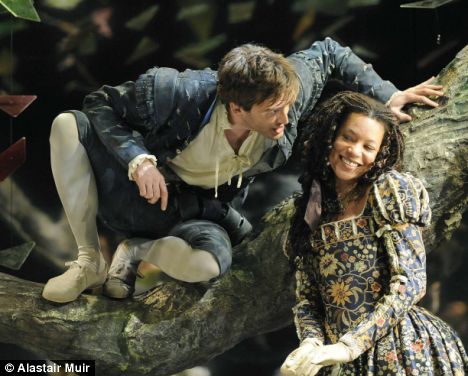
The image is of David Tennant and Nina Sosanya in a Royal Shakespeare Company production of As You Like It. They look lovely together, don’t they? If the Dark Lady sonnets were indeed autobiographical, might there once have been a scene like this played out in Shakespeare’s own life? We’ll never know for certain.

Sunday Sonnet – 01 February 2015

Mary Fitton

What makes the Elizabethan Sonnet form so great? Why do modern readers have to care, and why do modern students have to suffer through them? Well, simply put, as one of my friends quipped, ‘The sonnet is the cathedral of the written word.’ Just as cathedrals–in terms of architecture–are supreme examples of that art, so too sonnets. For example, let’s look at one of my favorites. I’ve inserted spaces between each ‘quatrain’ and the final ‘couplet’: 

138

When my love swears that she is made of truth
I do believe her, though I know she lies,
That she might think me some untutor’d youth,
Unlearned in the world’s false subtleties.
Thus vainly thinking that she thinks me young,
Although she knows my days are past the best,
Simply I credit her false speaking tongue:
On both sides thus is simple truth suppress’d.
But wherefore says she not she is unjust?
And wherefore say not I that I am old?
O, love’s best habit is in seeming trust,
And age in love loves not to have years told:
Therefore I lie with her and she with me,
And in our faults by lies we flatter’d be.

This is one of Will Shakespeare’s Dark Lady sonnets, and he uses this sonnet–and its intricate construction–to illustrate the complicated and paradoxical love/hate relationship he has with the Dark Lady. Let’s look at the quatrains–each section of four lines. I’m summarizing what each quatrain pretty much says, stripping out the lovely poetics (which, I know, is a crime):

First quatrain: When my mistress claims she’s truthful, I only pretend to believe her. 

Second quatrain: She pretends I’m a young man, but we both know I’m past my prime 

Third quatrain: So why doesn’t she say I’m old, and why don’t I say she’s a liar? Because it’s easiest to love someone who seems trustworthy. 

Final couplet: So we have sex with each other, and continue lying to each other. And these two points are tied together with a pun on the word ‘lying.’ 

So the basic structure of the Elizabethan sonnet is 14 lines, three quatrains and a couplet. The first two quatrains set out the argument. And then the third quatrain typically presents ‘a turn’ or flip in the argument. And then the couplet is either a resolution or conclusion–often couched in a really clever verbal construction (in this case, the pun on ‘lying’). 

This basic structure is married into rhymed and metered lines. Iambic pentameter: ten syllables with a syllabic rhythm. And the fourteen lines are rhymed like this:

A

B

A

B


C

D

C

D


E

F

E

F


G

It’s hard as hell to write a sonnet that 1) follows these rules; 2) makes the rules work toward the final goal of the sonnet and 3) actually sounds and reads beautifully. Shakespeare did it 154 times.

And this sonnet? Don’t you recognize it? It’s what so many of us have experienced in our own lives, at one time or another, in a relationship we’d rather forget.   Most of Shakespeare’s sonnets–angry and happy alike–speak to things we still experience today, 400 years later. So, so many reasons to cherish these great poems. Not only for their incredible intricacy, but for their universal appeal–four centuries later.  

The image is a painting of Mary Fitton, one of several reputed candidates for Shakespeare’s never-identified Dark Lady. The evidence is scant at best, and we’ll never know.

Sunday Sonnet – 25 January 2015

Shakespeare's grave

Shakespeare was obsessed with Time. He saw what the ravages of time did to those he knew and loved. His own son Hamnet died at the age of eleven. In Elizabethan times, death was all around: plague, pestilence, violence, war and the Elizabethan judicial system.   Perhaps in no other sonnet does the destructive power of Time enjoy such concrete imagery as in Sonnet 60:

Like as the waves make towards the pebbled shore,
So do our minutes hasten to their end;
Each changing place with that which goes before,
In sequent toil all forwards do contend.
Nativity, once in the main of light,
Crawls to maturity, wherewith being crown’d,
Crooked elipses ‘gainst his glory fight,
And Time that gave doth now his gift confound.
Time doth transfix the flourish set on youth
And delves the parallels in beauty’s brow,
Feeds on the rarities of nature’s truth,
And nothing stands but for his scythe to mow:
And yet to times in hope my verse shall stand,
Praising thy worth, despite his cruel hand.

There’s so much going on here. The imagery of time: waves on pebbled shore as minutes. The powerful language of struggle: toil, fight, confound, delves, scythe. The journey of human life set down: nativity to maturity. Time as gift-giver and the gift-taker. And finally, the triumph of Art, which is the only thing we have that can defeat time: ‘in hope my verse shall stand.’

Here’s the thing about this Sonnet: To read, study and understand this single ‘Young Man’ sonnet is to understand much of Shakespeare: so many of the chief themes worked out in his plays and poetry are all here: The universal struggle against time’s destruction, and the only way to defeat it–to create Art. In Shakespeare’s case, to write. 

The image is of Will Shakespeare’s grave in Holy Trinity Church in Stratford-upon-Avon. I took this photo when I visited several years ago. Notice how Shakespeare is identified as “Poet.” The was his greatness, and how, in the end, he defeated time.

Sunday Sonnet – 18 January 2015

Chang

‘You’ or ‘Thou’? Elizabethan language, for all its poetic beauty and metaphoric phrasing, can be a bit of a drag for us modern readers. One strangeness you may have noticed is the seeming interchangeability of ‘You’ and ‘Thou’. Sonnet 13 is an excellent example of one difference between them: You was often reserved for intimacy. 

13

O, that you were yourself! but, love, you are
No longer yours than you yourself here live:
Against this coming end you should prepare,
And your sweet semblance to some other give.
So should that beauty which you hold in lease
Find no determination: then you were
Yourself again after yourself’s decease,
When your sweet issue your sweet form should bear.
Who lets so fair a house fall to decay,
Which husbandry in honour might uphold
Against the stormy gusts of winter’s day
And barren rage of death’s eternal cold?
O, none but unthrifts! Dear my love, you know
You had a father: let your son say so. 

Here, Shakespeare uses ‘You’ almost as much as he uses the name ‘Will’ much, much later in the Dark Lady sonnets: repeated use, multiple meanings and as integral part of the rhythm of the verse.

The Elizabethan subtleties of ‘You’ and ‘Thou’ are difficult to grasp (I have trouble with it all the time). English was transitioning into true Modern English, and Thou would soon be making its way out. There were instances when ‘Thou’ was appropriate (certainly it was more formal–but there were instances in very intimate settings where Thou might be used–it could encompass an accusatory or sarcastic complexion). But ‘You’ was definitely more intimate, and certainly appropriate here: The Poet urges his Young Man to procreate so that his beauty might be preserved. The Poet reminds the Young Man of how much he enjoyed his father’s guidance–would not the Young Man enjoy giving that to his son?

Unfortunately, the Earl of Southampton (or–insert your historical Young Man of choice) was too vain and selfish a creature to really be convinced by this pretty lame argument.   However, despite its inability to close the sale, Sonnet 13’s imagery of ‘so fair a house fall to decay’ or ‘stormy gusts of winter’s day’ certainly convinces readers four centuries later of one thing: Shakespeare wrote beautiful verse.   And he knew the difference between ‘You’ and ‘Thou’–even if some of that nuance is now lost to us.

The image is of Admiral Chang, the only person from the future who still uses the word ‘Thou.’ He was a Shakespeare-quoting Klingon from Star Trek: The Undiscovered Country. As a side note, the Klingons claimed that Shakespeare was…a Klingon.

Sunday Sonnet – 11 January 2015

gatehouse-2

Have you ever missed your lover? Ever been in the throes of a wild love affair, where every waking minute away from your lover is torture, and every dream at night puts you back into his or her arms?    

43

When most I wink, then do mine eyes best see,
For all the day they view things unrespected;
But when I sleep, in dreams they look on thee,
And darkly bright are bright in dark directed.
Then thou, whose shadow shadows doth make bright,
How would thy shadow’s form form happy show
To the clear day with thy much clearer light,
When to unseeing eyes thy shade shines so!
How would, I say, mine eyes be blessed made
By looking on thee in the living day,
When in dead night thy fair imperfect shade
Through heavy sleep on sightless eyes doth stay!
All days are nights to see till I see thee,
And nights bright days when dreams do show thee me.

Shakespeare loved reversals, opposites, turns and double-meanings. They’re common in his plays, but he also used them in his sonnets. Paradoxical feelings are part of what makes us human, and part of what makes these centuries-old sonnets still applicable to our lives today.  

Double-meanings – Many words here serve double use as noun and verb: ‘shadow’ and ‘form’:

Then thou, whose shadow shadows doth make bright,

How would thy shadow’s form form happy show. 

Opposites – night and bright; ‘eyes best see’ and sightless; ‘living day’ and ‘dead night’; and that lovely phrase, ‘thy shade shines so’.

The sonnet’s final turn contains two reversals – the final couplet, where night is day, and day is night: 

All days are nights to see till I see thee,
And nights bright days when dreams do show thee me.

My favorite line is just simply lovely and gorgeous: 

And darkly bright are bright in dark directed.

Some interesting facts about this sonnet: Yes, it’s part of the Young Man sequence of sonnets: the Poet’s beloved is a man. And Benjamin Britten set this sonnet to music in his Nocturne, from 1958.   That Nocturne contains poetry from Keats, Shelley, Coleridge and Wordsworth.

The image is a royal Elizabethan bedroom. This particular one is from Leicester’s Gatehouse at Kenilworth Castle. Robert Dudley’s (The Earl of Leicester) was Queen Elizabeth’s suitor, and wooed her–unsuccessfully–for years.   He set up this bedroom for her. Just as the Poet above pined away for his lover, Dudley apparently pined away for Liz.  

Sunday Sonnet – 28 December 2014

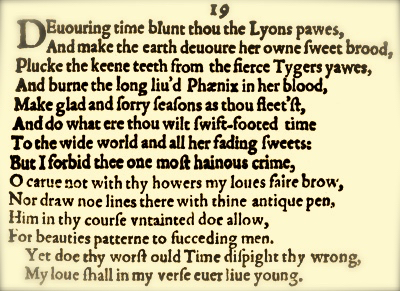
sonnet 19

As this old year meanders to a close, I thought it appropriate to share one of Shakespeare’s  ‘Time’ sonnets.  In this one, The Bard treats Time like a character, whom the Poet addresses directly with a series of vivid metaphors.  These images describe how Time ultimately destroys everything, no matter how powerful or sublime.

Sonnet 19:

Devouring Time, blunt thou the lion’s paws,

And make the earth devour her own sweet brood;

Pluck the keen teeth from the fierce tiger’s jaws,

And burn the long-liv’d phoenix, in her blood;

Make glad and sorry seasons as thou fleet’st,

And do whate’er thou wilt, swift-footed Time,

To the wide world and all her fading sweets;

But I forbid thee one most heinous crime:

O! carve not with thy hours my love’s fair brow,

Nor draw no lines there with thine antique pen;

Him in thy course untainted do allow

For beauty’s pattern to succeeding men.

Yet, do thy worst old Time: despite thy wrong,

My love shall in my verse ever live young.

For me, this sonnet marks a turn in the Young Man sequence of verses.  The Poet has now given up on his earlier arguments: that the Young Man should procreate to preserve his own beauty.  Now the Poet employs something more powerful than nature’s gift to humans—the ability to reproduce.  Starting with the Sonnets in the late teens, the Poet summons power the Art, specifically Poetry.  Shakespeare’s poem itself shall preserve the Young Man’s beauty for eternity, thereby defeating Time’s ‘worst’.

Could Shakespeare have know how right he was?  Could he have dreamt that over 400 years later, his beloved would still live on in the lines of these immortal words?  Possibly not.  Scholarly evidence suggests fairly convincingly that the Sonnets were published without Shakespeare’s permission.  He likely intended for all of 154 of these verses—to the Young Man and the Dark Lady alike—to never see the public eye.  They were risqué, dangerous in the Elizabethan world of religious morality and homophobia.   Thankfully, today, at the close of 2014, they are regarded as the epitome of the poetic form in the English Language.  They have defeated Time’s ‘most heinous crime.’

The image is from Thomas Thorpe’s unauthorized publication of ‘SHAKES-SPEARES SONNETS’ from 1609.

Sunday Sonnet – Winter Solstice 2014

Sonnet 2

With today’s Solstice, I think of this sonnet, where the ravages of age will be counted in the number of winters the battered face of the Poet’s lovely Young Man might endure. 

Sonnet II

When forty winters shall besiege thy brow,

And dig deep trenches in thy beauty’s field,

Thy youth’s proud livery so gazed on now,

Will be a totter’d weed of small worth held:

Then being asked, where all thy beauty lies,

Where all the treasure of thy lusty days;

To say, within thine own deep sunken eyes,

Were an all-eating shame, and thriftless praise.

How much more praise deserv’d thy beauty’s use,

If thou couldst answer ‘This fair child of mine

Shall sum my count, and make my old excuse,’

Proving his beauty by succession thine!

   This were to be new made when thou art old,

   And see thy blood warm when thou feel’st it cold.

This second poem of Shakespeare’s long sequence of sonnets establish many of themes that would be revisited–and touch upon many truths that we still have trouble facing today: beauty never lasts; your cloak of youth will fade; there is a reason why we have children.  

What’s truly astonishing about all this, is that this sonnet–and most of the early Young Man sonnets–Shakespeare very likely wrote under commission. In other words, he might have been paid to write them on just this topic.  

Lord Burghley was Queen Elizabeth’s Lord Treasurer, and Burghley had a young ward he was in charge of–none other than the Earl of Southampton, very probably Shakespeare’s ‘Young Man’.   Southampton did not want to marry (The reasons for this are numerous and speculative, but one is that Southampton had no interest in women). What’s odd is that the first 17 sonnets all urge the Young Man to procreate. Never before had the Romantic form of the Sonnet been used for such an odd endeavor: that is a male Poet urging another male–a beautiful and lovely male–to procreate. But Shakespeare makes it work. I mean–how else to convince a vain, spoiled and possibly gay Earl to marry up and reproduce? Flatter him. 

Alas, after Sonnet 17, things turn for the Poet (that is, Will Shakespeare), and he finds himself falling in love with this vain, beautiful creature.   But for today, let’s revel in Number 2, and its lovely, varied imagery. And remember: braving these cold winters will only dig deep the trenches in our fields of beauty. 

The image is from the northern woods of Wisconsin, of a dear old place I’ll very likely never be able to visit again.

Sunday Sonnet – 26 Oct 2015

Medieval-Bath

Sonnet 153

Cupid laid by his brand, and fell asleep:
A maid of Dian’s this advantage found,
And his love-kindling fire did quickly steep
In a cold valley-fountain of that ground;
Which borrow’d from this holy fire of Love
A dateless lively heat, still to endure,
And grew a seething bath, which yet men prove
Against strange maladies a sovereign cure.
But at my mistress’ eye Love’s brand new-fired,
The boy for trial needs would touch my breast;
I, sick withal, the help of bath desired,
And thither hied, a sad distemper’d guest,
But found no cure: the bath for my help lies
Where Cupid got new fire–my mistress’ eyes.

Venereal Disease?

In the traditional parsing out of Shakespeare’s sonnets, the Bard’s last two sonnets, 153 and 154, are not lumped in with the Dark Lady sequence, which includes sonnets 127 – 152. However, if one reads between the lines, it quickly become obvious there are double entendres here. Why doubt it? Shakespeare was the master of weaving multiple meanings into lines.

The ‘lively heat’ of a ‘seething bath’ ‘against strange maladies’ that lead to ‘a sovereign cure’ seem to unmistakably refer to one of the two most common Elizabethan cures for syphilis: severely hot baths. (And the references to venereal disease continue in Sonnet 154, which I’ll save for another day).

A ho-hum love sonnet with fairly tepid classical references? Or a whole lot more? We’re talking about Shakespeare here! If this sonnet is multilayered, the irony becoming inescapable.   At first blush Sonnet 153 poses as a traditional paean to love, with its references to classical Greek mythology. But Shakespeare, in so many of his great works, was rarely only traditional; his calling card was to take the a traditional source, then meld it, mold it, twist it, to his own purposes. I believe this sonnet bemoans the contraction of an STD, with its unpleasant cure, all of which is not quite enough to prevent the Poet to keep yearning for a return to the delicious but diseased arms of his lover:  

But found no cure: the bath for my help lies
Where Cupid got new fire–my mistress’ eyes.