Friday’s Maniacal Poe Quote – 17 April 2015

Oval Portrait

Poe once wrote, ‘The death of a beautiful woman is, unquestionably, the most poetical topic in the world.’ His ghostly yarn, “The Oval Portrait”, embodies this notion.   

She was a maiden of rarest beauty, and not more lovely than full of glee. And evil was the hour when she saw, and loved, and wedded the painter. He, passionate, studious, austere, and having already a bride in his Art; she a maiden of rarest beauty, and not more lovely than full of glee; all light and smiles, and frolicsome as the young fawn; loving and cherishing all things; hating only the Art which was her rival; dreading only the pallet and brushes and other untoward instruments which deprived her of the countenance of her lover. It was thus a terrible thing for this lady to hear the painter speak of his desire to portray even his young bride.

–from ‘The Oval Portrait’ (1842)

The story is very short, but nonetheless encompasses several important Poe tropes in only about two pages: a gothic setting; a beautiful woman; Art and the Artist; Death; and how the innocent usually die first. 

‘The Oval Portrait’s’ concept that a portrait can collect or reflect the physical or moral aspects of a living human certainly caught Oscar Wilde’s attention. It’s said that Wilde thought so highly of Poe’s tale, that it inspired his idea for The Picture of Dorian Gray.

The image is a daguerreotype of Poe taken in 1848, during the last year of his life–after the long and lingering death of his beautiful wife, Virginia.

Friday’s Maniacal Poe Quote – 10 April 2015

valdemar

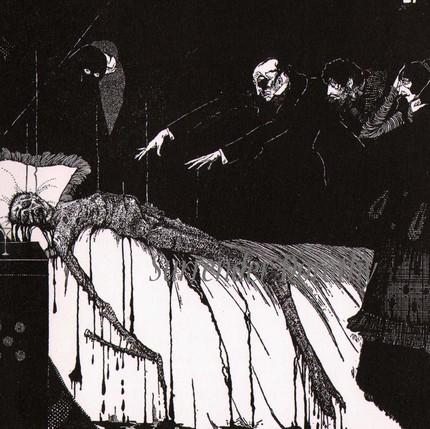
The indefinable boundary between life and death fascinated Poe. In one of his more bizarre and grotesque yarns, Poe explores the power of hypnotism, and whether such a thing as an induced trance might have the power to stave off death. A morally questionable mesmerizer attempts it on a tuberculosis victim, only to yank the voice of Death itself from the lips of the fresh cadaver: 

I now feel that I have reached a point of this narrative at which every reader will be startled into positive disbelief. It is my business, however, simply to proceed. 

There was no longer the faintest sign of vitality in M. Valdemar; and concluding him to be dead, we were consigning him to the charge of the nurses, when a strong vibratory motion was observable in the tongue. This continued for perhaps a minute. At the expiration of this period, there issued from the distended and motionless jaws a voice—such as it would be madness in me to attempt describing. There are, indeed, two or three epithets which might be considered as applicable to it in part; I might say, for example, that the sound was harsh, and broken and hollow; but the hideous whole is indescribable, for the simple reason that no similar sounds have ever jarred upon the ear of humanity. 

–from ‘The Facts in the Case of M. Valdemar’ (1845) 

The narrator’s attempt to put the dying Mr. Valdemar in a state of suspended animation ends in a spectacularly gruesome denouement. I won’t spoil it for you–the story’s short, you should go read it. But remember this when you do: We know it’s fiction, but when Poe published this in 1845, it wasn’t labeled as fiction; many readers believed it to be a scientific report. Poe fills the story with a plethora of succinct details; the lurid accumulation of leaking bodily fluids, the ghastly anatomical descriptions and abrupt pronouncements of unpleasant sights and smells. These convinced many people that this little horror show actually happened. 

What many people perhaps didn’t think about is the Poe’s own wife, Virginia, died of tuberculosis. Perhaps there’s a moral lesson buried here, as it were, beneath all the grotesqueries. 

The image is Harry Clarke’s illustration of the story for a 1919 edition of Poe’s works.

Friday’s Maniacal Poe Quote – 03 April 2015

Pit

For Good Friday, an anniversary of a particularly gruesome execution, here’s a quote about another particularly inventive form of execution, this one from Poe’s imagination: 

It might have been half an hour, perhaps even an hour, (for I could take but imperfect note of time) before I again cast my eyes upward. What I then saw confounded and amazed me. The sweep of the pendulum had increased in extent by nearly a yard. As a natural consequence, its velocity was also much greater. But what mainly disturbed me was the idea that had perceptibly descended. I now observed—with what horror it is needless to say—that its nether extremity was formed of a crescent of glittering steel, about a foot in length from horn to horn; the horns upward, and the under edge evidently as keen as that of a razor. Like a razor also, it seemed massy and heavy, tapering from the edge into a solid and broad structure above. It was appended to a weighty rod of brass, and the whole hissed as it swung through the air.

What boots it to tell of the long, long hours of horror more than mortal, during which I counted the rushing vibrations of the steel! Inch by inch—line by line—with a descent only appreciable at intervals that seemed ages—down and
still down it came! Days passed—it might have been that many days passed—ere it swept so closely over me as to fan me with its acrid breath. The odor of the sharp steel forced itself into my nostrils. I prayed—I wearied heaven with my prayer for its more speedy descent. I grew frantically mad, and struggled to force myself upward against the sweep of the fearful scimitar. And then I fell suddenly calm, and lay smiling at the glittering death, as a child at some rare bauble.

–excerpted from “The Pit and Pendulum” (1842) 

These two paragraphs (not exactly contiguous in the story) form one of the most infamous images from Poe’s oeuvre, the kind of diabolical form of execution worthy of the ancient Romans, where executions were engineered to extract the maximum amount of pain and horror from the condemned before his death. 

Of course, in Poe’s story, the target of this design is the reader’s horror. Could Poe have known in the 1840’s that his story would still be read today, would spawn two films (though he couldn’t know what ‘films’ were) and enter our English vernacular? I doubt it: Poe was just desperately trying to make a living.       

The image comes from Stuart Gordon’s pretty awful 1991 version of Poe’s story. Please watch the Roger Corman version instead.

Friday’s Maniacal Poe Quote – 27 March 2015

dental-keys

Today’s quote comes from a little known Poe yarn, “Berenice,” but in Poe circles it’s infamous for its excessive violence, brutality and horror: 

His looks were wild with terror, and he spoke to me in a voice tremulous, husky, and very low. What said he?—some broken sentences I heard. He told of a wild cry disturbing the silence of the night—of the gathering together of the household—of a search in the direction of the sound; and then his tones grew thrillingly distinct as he whispered me of a violated grave—of a disfigured body enshrouded, yet still breathing—still palpitating—still alive! 

He pointed to garments;—they were muddy and clotted with gore. I spoke not, and he took me gently by the hand: it was indented with the impress of human nails. He directed my attention to some object against the wall. I looked at it for some minutes: it was a spade. With a shriek I bounded to the table, and grasped the box that lay upon it. But I could not force it open; and in my tremor, it slipped from my hands, and fell heavily, and burst into pieces; and from it, with a rattling sound, there rolled out some instruments of dental surgery, intermingled with thirty-two small, white and ivory-looking substances that were scattered to and fro about the floor. 

–‘Berenice’ (1835) 

Yes, the narrator, Egaeus, is completely out of his mind, who suffers from catatonic episodes and epileptic seizures. He falls in love with his cousin, Berenice, who subsequently seems to die from some strange malady. As the story end, Egeaus’ servant informs Egaeus that in one of his catatonic episodes, he exhumed her grave and–using a set of barbaric 19th century dental instruments–tore out her teeth, teeth which he had become obsessed with. Of course–as is common in Poe stories–Berenice was unwittingly buried alive and is now screaming from her grave in terror and toothless agony. 

In this little gem of a story we can enjoy some reoccurring themes of Poe’s fiction and poetry: madness, incest, the death of a beautiful woman (or, in this case, a seeming death), episodes of shocking violence and premature burial. 

Readers complained to the editor of Southern Literary Messenger about the story’s violence, but Poe was unrepentant. 

The image is a set of late 18th to early 19th century dental instruments, likely the kind used to dig out Berenice’s teeth. No, the story makes no mention of anesthesia.

Poe Potpourri for Friday the 13th!

13th

Today for all you triskaidekaphobiacs I thought I’d share some of my favorite quotes from Edgar A. Poe. Enjoy!

My original soul seemed, at once, to take its flight from my body and a more than fiendish malevolence, gin-nurtured, thrilled every fibre of my frame.

–‘The Black Cat’ (1843) 

TRUE!—nervous—very, very dreadfully nervous I had been and am; but why will you say that I am mad? The disease had sharpened my senses—not destroyed—not dulled them. Above all was the sense of hearing acute. I heard all things in the heaven and in the earth. I heard many things in hell. How, then, am I mad? Hearken!

–‘The Tell-Tale Heart’ (1843) 

Of Madame L’Espanaye no traces were here seen; but an unusual quantity of soot being observed in the fire-place, a search was made in the chimney, and (horrible to relate!) the corpse of the daughter, head downward, was dragged therefrom; it having been thus forced up the narrow aperture for a considerable distance. The body was quite warm.

–‘The Murders in the Rue Morgue’ (1841) 

I WAS sick—sick unto death with that long agony; and when they at length unbound me, and I was permitted to sit, I felt that my senses were leaving me. The sentence—the dread sentence of death—was the last of distinct accentuation which reached my ears.

–‘The Pit and the Pendulum’ (1842)

A feeling, for which I have no name, has taken possession of my soul —a sensation which will admit of no analysis, to which the lessons of bygone times are inadequate, and for which I fear futurity itself will offer me no key.

–‘Ms. Found in a Bottle’ (1833) 

Not hear it?—yes, I hear it, and have heard it. Long—long—long—many minutes, many hours, many days, have I heard it—yet I dared not—oh, pity me, miserable wretch that I am!—I dared not—I dared not speak! We have put her living in the tomb! Said I not that my senses were acute? I now tell you that I heard her first feeble movements in the hollow coffin…

–‘The Fall of the House of Usher’ (1839) 

The death of a beautiful woman, is unquestionably the most poetical topic in the world.

–‘The Philosophy of Composition’ (1846) 

I became insane, with long intervals of horrible sanity.

–from a letter written by Poe

Friday’s Poe Quote – Ciphers! – 06 March 2015

poe-the-gold-bug-1843-granger

In addition to Poe’s detective stories with Inspector Dupin, Poe wrote one other story that fits into his meme of ‘ratiocination’–that is, Poe’s science of deduction that launched the entire modern genre of detective fiction. Poe wrote ‘The Gold-Bug’ in 1843 for a contest. His tale about buried treasure, secret writing and ciphers:   

“Here Legrand, having re-heated the parchment, submitted it to my inspection. The following characters were rudely traced, in a red tint, between the death’s-head and the goat:    

“53æææ305))6*;4826)4æ)4æ);806*;48æ8æ60))85;1æ);:æ   

*8æ83(88)5*æ;46(;88*96*?;8)*æ(;485);5*æ2:*æ(;4956*   

2(5*–4)8æ8*;4069285);)6æ8)4ææ;1(æ9;48081;8:8æ1;4   

8æ85;4)485æ528806*81(æ9;48;(88;4(æ?34;48)4æ;161;:   

188;æ?;” 

“But,” said I, returning him the slip, “I am as much in the dark as ever. Were all the jewels of Golconda awaiting me upon my solution of this enigma, I am quite sure that I should be unable to earn them.” 

–from ‘The Gold-Bug’ 

This ended up being Poe’s most successful and popular story in his lifetime. However, it hasn’t aged as well as some of his other classics like ‘The Tell-Tale Art’ or ‘The Black Cat.’ Namely, the character of Jupiter is such a grotesque caricature of an African American, that most modern readers have trouble getting through the many racist passages of Jupiter’s stilted speech and abject stupidity. 

Nonetheless, ‘The Gold-Bug’ remains a prime of example of period fiction, and if you can get past the stereotyped Jupiter, it’s a great buried treasure yarn and a good introduction to the notion of the ‘substitution cipher’, which is the simplest kind of secret writing. 

The image comes from a wood engraving by Fritz Eichenberg for a 1944 version of the short story, showing the treasure hunters discovering their hidden loot.

Friday’s Maniacal Poe Quote – Cannibalism!

Pym book

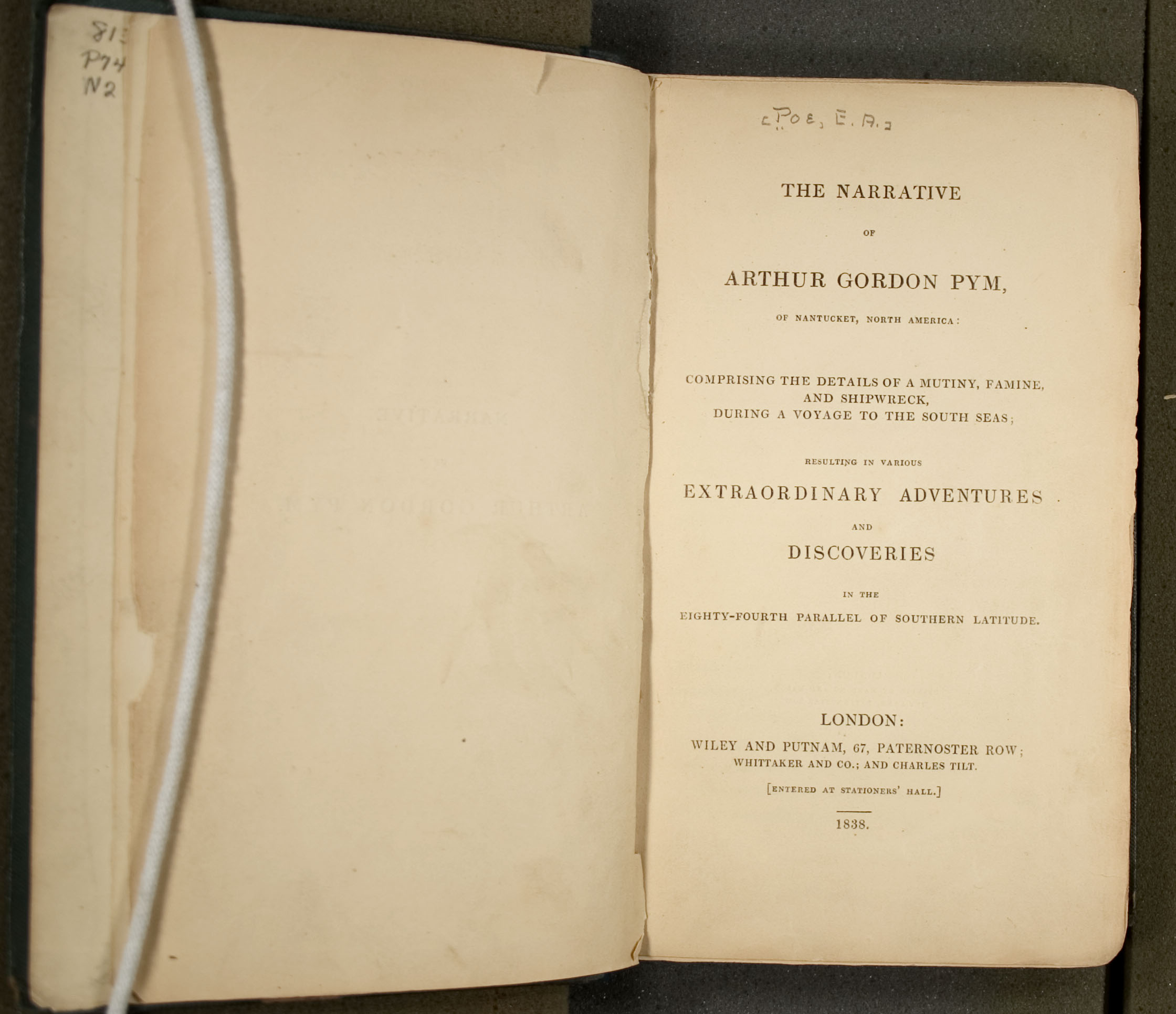
Today’s quote comes from Poe’s only novel, Gordon Pym. I’ve talked about this book before, but have reserved its most gruesome excerpt for the dark of late winter: shipwreck survivors reduced to cannibalism.   In this scene, they’ve just drawn straws to see which of the last four starving survivors will fall beneath the knife: 

‘I recovered from my swoon in time to behold the consummation of the tragedy in the death of him who had been chiefly instrumental in bringing it about. He made no resistance whatever, and was stabbed in the back by Peters, when he fell instantly dead. I must not dwell upon the fearful repast which immediately ensued. Such things may be imagined, but words have no power to impress the mind with the exquisite horror of their reality. Let it suffice to say that, having in some measure appeased the raging thirst which consumed us by the blood of the victim, and having by common consent taken off the hands, feet, and head, throwing them together with the entrails, into the sea, we devoured the rest of the body, piecemeal, during the four ever memorable days of the seventeenth, eighteenth, nineteenth, and twentieth of the month.’ 

Narrative of A. Gordon Pym of Nantucket, Chapter 12 

Imagine, if you can, how shocking this must’ve been to readers in 1838 when Pym was published. It’s work like this that helped cement Poe’s reputation as the grand master of the macabre. It’s a flawed novel, gratuitously violent, meandering and lurid, but it blazed a trail, heralding the dark romanticism of Herman Melville’s Moby-Dick, published only a few years later in 1851. I’m not writing a Herman Melville blog, but yet–of course–Moby Dick is a masterpiece, Gordon Pym ‘just’ a classic. However, Poe struck first and struck hard.   Gordon Pym is a quick and easy read: pick it and enjoy an 18th century classic.   Don’t read it during dinner. 

The image is from the title page of the original published edition of the novel. Parts of the novel were previously serialized, but it didn’t see full publication in book form until 1838.

Friday’s Poe Quote – 20 February 2015

the Turk

One of Poe’s more odd but interesting stories isn’t fiction at all, but an essay. ‘Maelzel’s Chess Player’ is an article Poe wrote in 1836, attempting to debunk the amazing but fraudulent chess-playing automaton called ‘The Turk’ that was touring Europe and America during the late 18th and early 19th centuries. Poe opens with: 

PERHAPS no exhibition of the kind has ever elicited so general attention as the Chess-Player of Maelzel. Wherever seen it has been an object of intense curiosity, to all persons who think. Yet the question of its modus operandi is still undetermined. Nothing has been written on this topic which can be considered as decisive—and accordingly we find every where men of mechanical genius, of great general acuteness, and discriminative understanding, who make no scruple in pronouncing the Automaton a pure machine, unconnected with human agency in its movements, and consequently, beyond all comparison, the most astonishing of the inventions of mankind.

Unfortunately, I think this essay is a failure; it goes on too long, becomes too detailed and in the end doesn’t correctly explain how the fraud really worked. However, this essay did some other amazing things:

  • It helped Poe develop his science of ‘ratiocination’–that is, a kind of deductive reasoning what would premiere in 1841 with ‘The Murders in the Rue Morgue’, and continue in ‘The Purloined Letter’ and ‘The Mystery of the Rue Morgue.’ And ratiocination continues to this very day. The whole modern real world science as well as the fictional genre of the crime detective owe their births to Poe’s ideas.  
  • Poe was right, ‘The Turk’ was a fraud, hiding a small ‘director’–that is, a human chess player–deep within its recesses, even if Poe didn’t get all the details right.
  • This essay bolstered Poe’s reputation as a genius at ciphers, further enhancing the aura of The Raven–the ingeniously brilliant but deeply troubled Romantic. 

The image comes from a contemporary engraving of the magical and mystical chess automaton, ‘The Turk’.

Friday the 13th Special Maniacal Poe Quote

the-black-cat-1934

I have a tonic for those of you who suffer from triskaidekaphobia–that is, fear of the number 13. What you should fear more is gin-addiction, mental illness and black cats, not some silly number. Edgar A. Poe’s brilliant horror story, “The Black Cat”, illustrates this with guile, craft, voice and lurid prose:   

‘One night, returning home, much intoxicated, from one of my haunts about town, I fancied that the cat avoided my presence. I seized him; when, in his fright at my violence, he inflicted a slight wound upon my hand with his teeth. The fury of a demon instantly possessed me. I knew myself no longer. My original soul seemed, at once, to take its flight from my body and a more than fiendish malevolence, gin-nurtured, thrilled every fibre of my frame. I took from my waistcoat-pocket a pen-knife, opened it, grasped the poor beast by the throat, and deliberately cut one of its eyes from the socket! I blush, I burn, I shudder, while I pen the damnable atrocity.’ 

I can’t even imagine how shocking this must have been to readers in 1843. But what makes this truly great, is that it’s not gratuitous, not the pornography of violence: everything in this brilliant story is carefully crafted: the tight prose; the unreliable narrator; the building tension; the emphatic denunciation of alcoholism disintegrating into a paradoxical embrace of its madness; and the rhetorical brilliance of its shock ending. This is my all time favorite Poe story, and horror and thriller writers have been copying it for more than a century.

The image is a great movie poster from the 1934 movie of The Black Cat, which has virtually nothing to do with the original story.

Friday’s Maniacal Poe Quote – 06 February 2015

Poe last dag

Today I’m taking the unusual step of quoting an entire story; the tale Edgar A. Poe is more famous for: ‘The Tell-Tale Heart’ (1843). At only 2210 words, it’s not much beyond the modern fad of flash fiction. This yarn–which I’m sure most of you’ve been forced to read in high school–is a triumph of tension, point of view and voice. A prime example of an unreliable narrator, who through his prose reveals his unreliability (I’m using the male pronoun here–but you might notice that no gender is ever assigned; the mad narrator could just as easily be a woman). It’s an imminently modern story, in that it features so many things so prized in cutting-edge modern fiction: it begins in the heat of the action, and it’s a story devoid of any padding. There’s no excess verbiage.   

Poe, for all his faults, was a visionary, and this story predates the direction fiction would take decades later–more than one hundred sixty years later. And it’s still a delicious delight today. 

The image of Poe is from what is believed to be the last daguerreotype of his life, possibly within a month of his death in 1849.

TRUE! –nervous –very, very dreadfully nervous I had been and am; but why will you say that I am mad? The disease had sharpened my senses –not destroyed –not dulled them. Above all was the sense of hearing acute. I heard all things in the heaven and in the earth. I heard many things in hell. How, then, am I mad? Hearken! and observe how healthily –how calmly I can tell you the whole story.

It is impossible to say how first the idea entered my brain; but once conceived, it haunted me day and night. Object there was none. Passion there was none. I loved the old man. He had never wronged me. He had never given me insult. For his gold I had no desire. I think it was his eye! yes, it was this! He had the eye of a vulture –a pale blue eye, with a film over it. Whenever it fell upon me, my blood ran cold; and so by degrees –very gradually –I made up my mind to take the life of the old man, and thus rid myself of the eye forever.

Now this is the point. You fancy me mad. Madmen know nothing. But you should have seen me. You should have seen how wisely I proceeded –with what caution –with what foresight –with what dissimulation I went to work! I was never kinder to the old man than during the whole week before I killed him. And every night, about midnight, I turned the latch of his door and opened it –oh so gently! And then, when I had made an opening sufficient for my head, I put in a dark lantern, all closed, closed, that no light shone out, and then I thrust in my head. Oh, you would have laughed to see how cunningly I thrust it in! I moved it slowly –very, very slowly, so that I might not disturb the old man’s sleep. It took me an hour to place my whole head within the opening so far that I could see him as he lay upon his bed. Ha! would a madman have been so wise as this, And then, when my head was well in the room, I undid the lantern cautiously-oh, so cautiously –cautiously (for the hinges creaked) –I undid it just so much that a single thin ray fell upon the vulture eye. And this I did for seven long nights –every night just at midnight –but I found the eye always closed; and so it was impossible to do the work; for it was not the old man who vexed me, but his Evil Eye. And every morning, when the day broke, I went boldly into the chamber, and spoke courageously to him, calling him by name in a hearty tone, and inquiring how he has passed the night. So you see he would have been a very profound old man, indeed, to suspect that every night, just at twelve, I looked in upon him while he slept.

Upon the eighth night I was more than usually cautious in opening the door. A watch’s minute hand moves more quickly than did mine. Never before that night had I felt the extent of my own powers –of my sagacity. I could scarcely contain my feelings of triumph. To think that there I was, opening the door, little by little, and he not even to dream of my secret deeds or thoughts. I fairly chuckled at the idea; and perhaps he heard me; for he moved on the bed suddenly, as if startled. Now you may think that I drew back –but no. His room was as black as pitch with the thick darkness, (for the shutters were close fastened, through fear of robbers,) and so I knew that he could not see the opening of the door, and I kept pushing it on steadily, steadily.

I had my head in, and was about to open the lantern, when my thumb slipped upon the tin fastening, and the old man sprang up in bed, crying out –“Who’s there?”

I kept quite still and said nothing. For a whole hour I did not move a muscle, and in the meantime I did not hear him lie down. He was still sitting up in the bed listening; –just as I have done, night after night, hearkening to the death watches in the wall.

Presently I heard a slight groan, and I knew it was the groan of mortal terror. It was not a groan of pain or of grief –oh, no! –it was the low stifled sound that arises from the bottom of the soul when overcharged with awe. I knew the sound well. Many a night, just at midnight, when all the world slept, it has welled up from my own bosom, deepening, with its dreadful echo, the terrors that distracted me. I say I knew it well. I knew what the old man felt, and pitied him, although I chuckled at heart. I knew that he had been lying awake ever since the first slight noise, when he had turned in the bed. His fears had been ever since growing upon him. He had been trying to fancy them causeless, but could not. He had been saying to himself –“It is nothing but the wind in the chimney –it is only a mouse crossing the floor,” or “It is merely a cricket which has made a single chirp.” Yes, he had been trying to comfort himself with these suppositions: but he had found all in vain. All in vain; because Death, in approaching him had stalked with his black shadow before him, and enveloped the victim. And it was the mournful influence of the unperceived shadow that caused him to feel –although he neither saw nor heard –to feel the presence of my head within the room.

When I had waited a long time, very patiently, without hearing him lie down, I resolved to open a little –a very, very little crevice in the lantern. So I opened it –you cannot imagine how stealthily, stealthily –until, at length a simple dim ray, like the thread of the spider, shot from out the crevice and fell full upon the vulture eye.

It was open –wide, wide open –and I grew furious as I gazed upon it. I saw it with perfect distinctness –all a dull blue, with a hideous veil over it that chilled the very marrow in my bones; but I could see nothing else of the old man’s face or person: for I had directed the ray as if by instinct, precisely upon the damned spot.

And have I not told you that what you mistake for madness is but over-acuteness of the sense? –now, I say, there came to my ears a low, dull, quick sound, such as a watch makes when enveloped in cotton. I knew that sound well, too. It was the beating of the old man’s heart. It increased my fury, as the beating of a drum stimulates the soldier into courage.

But even yet I refrained and kept still. I scarcely breathed. I held the lantern motionless. I tried how steadily I could maintain the ray upon the eve. Meantime the hellish tattoo of the heart increased. It grew quicker and quicker, and louder and louder every instant. The old man’s terror must have been extreme! It grew louder, I say, louder every moment! –do you mark me well I have told you that I am nervous: so I am. And now at the dead hour of the night, amid the dreadful silence of that old house, so strange a noise as this excited me to uncontrollable terror. Yet, for some minutes longer I refrained and stood still. But the beating grew louder, louder! I thought the heart must burst. And now a new anxiety seized me –the sound would be heard by a neighbour! The old man’s hour had come! With a loud yell, I threw open the lantern and leaped into the room. He shrieked once –once only. In an instant I dragged him to the floor, and pulled the heavy bed over him. I then smiled gaily, to find the deed so far done. But, for many minutes, the heart beat on with a muffled sound. This, however, did not vex me; it would not be heard through the wall. At length it ceased. The old man was dead. I removed the bed and examined the corpse. Yes, he was stone, stone dead. I placed my hand upon the heart and held it there many minutes. There was no pulsation. He was stone dead. His eve would trouble me no more.

If still you think me mad, you will think so no longer when I describe the wise precautions I took for the concealment of the body. The night waned, and I worked hastily, but in silence. First of all I dismembered the corpse. I cut off the head and the arms and the legs.

I then took up three planks from the flooring of the chamber, and deposited all between the scantlings. I then replaced the boards so cleverly, so cunningly, that no human eye –not even his –could have detected any thing wrong. There was nothing to wash out –no stain of any kind –no blood-spot whatever. I had been too wary for that. A tub had caught all –ha! ha!

When I had made an end of these labors, it was four o’clock –still dark as midnight. As the bell sounded the hour, there came a knocking at the street door. I went down to open it with a light heart, –for what had I now to fear? There entered three men, who introduced themselves, with perfect suavity, as officers of the police. A shriek had been heard by a neighbour during the night; suspicion of foul play had been aroused; information had been lodged at the police office, and they (the officers) had been deputed to search the premises.

I smiled, –for what had I to fear? I bade the gentlemen welcome. The shriek, I said, was my own in a dream. The old man, I mentioned, was absent in the country. I took my visitors all over the house. I bade them search –search well. I led them, at length, to his chamber. I showed them his treasures, secure, undisturbed. In the enthusiasm of my confidence, I brought chairs into the room, and desired them here to rest from their fatigues, while I myself, in the wild audacity of my perfect triumph, placed my own seat upon the very spot beneath which reposed the corpse of the victim.

The officers were satisfied. My manner had convinced them. I was singularly at ease. They sat, and while I answered cheerily, they chatted of familiar things. But, ere long, I felt myself getting pale and wished them gone. My head ached, and I fancied a ringing in my ears: but still they sat and still chatted. The ringing became more distinct: –It continued and became more distinct: I talked more freely to get rid of the feeling: but it continued and gained definiteness –until, at length, I found that the noise was not within my ears.

No doubt I now grew very pale; –but I talked more fluently, and with a heightened voice. Yet the sound increased –and what could I do? It was a low, dull, quick sound –much such a sound as a watch makes when enveloped in cotton. I gasped for breath –and yet the officers heard it not. I talked more quickly –more vehemently; but the noise steadily increased. I arose and argued about trifles, in a high key and with violent gesticulations; but the noise steadily increased. Why would they not be gone? I paced the floor to and fro with heavy strides, as if excited to fury by the observations of the men –but the noise steadily increased. Oh God! what could I do? I foamed –I raved –I swore! I swung the chair upon which I had been sitting, and grated it upon the boards, but the noise arose over all and continually increased. It grew louder –louder –louder! And still the men chatted pleasantly, and smiled. Was it possible they heard not? Almighty God! –no, no! They heard! –they suspected! –they knew! –they were making a mockery of my horror!-this I thought, and this I think. But anything was better than this agony! Anything was more tolerable than this derision! I could bear those hypocritical smiles no longer! I felt that I must scream or die! and now –again! –hark! louder! louder! louder! louder!

“Villains!” I shrieked, “dissemble no more! I admit the deed! –tear up the planks! here, here! –It is the beating of his hideous heart!”