Sunday Sonnet – 25 January 2015

Shakespeare's grave

Shakespeare was obsessed with Time. He saw what the ravages of time did to those he knew and loved. His own son Hamnet died at the age of eleven. In Elizabethan times, death was all around: plague, pestilence, violence, war and the Elizabethan judicial system.   Perhaps in no other sonnet does the destructive power of Time enjoy such concrete imagery as in Sonnet 60:

Like as the waves make towards the pebbled shore,
So do our minutes hasten to their end;
Each changing place with that which goes before,
In sequent toil all forwards do contend.
Nativity, once in the main of light,
Crawls to maturity, wherewith being crown’d,
Crooked elipses ‘gainst his glory fight,
And Time that gave doth now his gift confound.
Time doth transfix the flourish set on youth
And delves the parallels in beauty’s brow,
Feeds on the rarities of nature’s truth,
And nothing stands but for his scythe to mow:
And yet to times in hope my verse shall stand,
Praising thy worth, despite his cruel hand.

There’s so much going on here. The imagery of time: waves on pebbled shore as minutes. The powerful language of struggle: toil, fight, confound, delves, scythe. The journey of human life set down: nativity to maturity. Time as gift-giver and the gift-taker. And finally, the triumph of Art, which is the only thing we have that can defeat time: ‘in hope my verse shall stand.’

Here’s the thing about this Sonnet: To read, study and understand this single ‘Young Man’ sonnet is to understand much of Shakespeare: so many of the chief themes worked out in his plays and poetry are all here: The universal struggle against time’s destruction, and the only way to defeat it–to create Art. In Shakespeare’s case, to write. 

The image is of Will Shakespeare’s grave in Holy Trinity Church in Stratford-upon-Avon. I took this photo when I visited several years ago. Notice how Shakespeare is identified as “Poet.” The was his greatness, and how, in the end, he defeated time.

Friday’s Maniacal Poe Quote – 23 January 2015

Maelstrom-Clarke

So many of Poe’s tales have been made into movies, and most of those movies have been dreadfully bad. There’s one Poe tale, however, that as far as I can tell, has never been adapted to film, but should be. “A Descent into the Maelström.” (There are a couple of films with this name, but they’ve nothing to do with the story.) With today’s CGI, this could be an exciting adventure, combing equal measures of science fiction, horror, sea-adventure and loads of period costumes: 

“Never shall I forget the sensations of awe, horror, and admiration with which I gazed about me. The boat appeared to be hanging, as if by magic, midway down, upon the interior surface of a funnel vast in circumference, prodigious in depth, and whose perfectly smooth sides might have been mistaken for ebony, but for the bewildering rapidity with which they spun around, and for the gleaming and ghastly radiance they shot forth, as the rays of the full moon, from that circular rift amid the clouds which I have already described, streamed in a flood of golden glory along the black walls, and far away down into the inmost recesses of the abyss.”

-from “A Descent into the Maelström” (1841) 

This wonderful little yarn from Poe is a mystery and a bit of science fiction. Weird physics, the bending of time, as well as a shipwreck yarn all wrapped into one. It’s an easy read, and full of the kind of purple prose only Poe could write. 

Finally, this story is another example of Poe’s ‘ratiocination’, his science of reason developed in “The Murders in the Rue Morgue” and “The Purloined Letter.” The science of reason and calm analysis, the kind of deductive thinking that invented the modern detective.

The image of the vortex (the ‘Maelström’) is from Harry Clarke’s illustration for the story from a 1919 edition. Notice the lack of CGI.

Hump Day Shakespearean Quote – 21 January 2015

Hamlet

Shakespeare’s Hamlet is the crown jewel of Western Art: the superlatives thrown at it are innumerable and pretty over-the-top: ‘the greatest tragedy written in 2000 years’; ‘the first manic-depressive hero of Western Literature’; 170 new words introduced to the English language; and that freaking great ‘to be or not to be’ speech that Mel Brooks put to music.   Well, here’s a bit of Hamlet for you (there’ll be more, much more, on my blog as time goes by). The opening of Hamlet’s first soliloquy, Act I, Scene ii: 

Oh, that this too, too sullied flesh would melt,

Thaw, and resolve itself into a dew,

Or that the Everlasting had not fixed

His canon ‘gainst self-slaughter! O God, God!

How weary, stale, flat, and unprofitable

Seem to me all the uses of this world!

Fie on ’t, ah fie! ‘Tis an unweeded garden

That grows to seed. Things rank and gross in nature

Possess it merely. That it should come to this.

But two months dead—nay, not so much, not two.

So lovely, dark and eloquent.  

Going forward, for each Hamlet quote I share, I’ll share a few choice tidbits about this play or its history. 

Today? Hamlet is too long to perform! If you take all the versions from all the Quartos and the First Folio and mash them up all together, the play runs over four hours long, and the character Hamlet no longer makes any damned sense. In my opinion, many critics and literary historians throughout the centuries have done a disservice to this play. What does makes sense is that we’re dealing with revisions upon revisions. Yes, even Shakespeare revised his work. It just didn’t spring out of his head like, say, Mozart’s.

You see, Hamlet was first performed in the Globe Theatre in about 1600, an outdoor theatre, and because of available light, the Lord Chamberlain’s Men couldn’t perform plays over 3000 lines. Hamlet–if you add in all the different versions and texts into one giant baggy monster–is over 4000 lines long. It had to be cut. Which is why the editors of the First Folio–Shakespeare’s own fellow actors–included a shortened version of the play. In all likelihood, there were probably several acting versions of the play, all under 3000 lines.

Still, we can see by all the different versions, and the various changes and the contrary soliloquys, that the writing and creating of Hamlet gave Shakespeare a lot of trouble. What has happened over the centuries is that critics and scholars have been so beside themselves with academic ecstasy, that they just couldn’t bare to have only one of these shortened ‘performance versions’. And thus we modern theatre-goers are inflicted with monstrosities like Kenneth Branagh’s ‘complete’ movie version of Hamlet.

So–it’s okay to go and enjoy an ‘abbreviated’ or shortened Hamlet. That’s how it was presented back in Shakespeare’s time. We don’t know exactly which version or versions were performed (there were probably several). But Hamlet was always been bigger than anything: too big for performance, too big for critics and–judging by all the revision documents–too big for its author. Will Shakespeare was discovering something new as he wrote Hamlet. It changed literature; and if we look at the rest of Shakespeare’s plays, it changed him.  

The image is taken from an ‘abbreviated’ film version of Hamlet, Mel Gibson’s very excellent turn as the depressed Dane (here pictured with the superb Glenn Close as Gertrude). Perhaps Mel’s performance was so good because the actor himself pretty much went nuts later on in life.   Anyhow, don’t let Mel’s antics keep you from renting or streaming this fantastic version. It’s really lovely, dark and eloquent.   

Sunday Sonnet – 18 January 2015

Chang

‘You’ or ‘Thou’? Elizabethan language, for all its poetic beauty and metaphoric phrasing, can be a bit of a drag for us modern readers. One strangeness you may have noticed is the seeming interchangeability of ‘You’ and ‘Thou’. Sonnet 13 is an excellent example of one difference between them: You was often reserved for intimacy. 

13

O, that you were yourself! but, love, you are
No longer yours than you yourself here live:
Against this coming end you should prepare,
And your sweet semblance to some other give.
So should that beauty which you hold in lease
Find no determination: then you were
Yourself again after yourself’s decease,
When your sweet issue your sweet form should bear.
Who lets so fair a house fall to decay,
Which husbandry in honour might uphold
Against the stormy gusts of winter’s day
And barren rage of death’s eternal cold?
O, none but unthrifts! Dear my love, you know
You had a father: let your son say so. 

Here, Shakespeare uses ‘You’ almost as much as he uses the name ‘Will’ much, much later in the Dark Lady sonnets: repeated use, multiple meanings and as integral part of the rhythm of the verse.

The Elizabethan subtleties of ‘You’ and ‘Thou’ are difficult to grasp (I have trouble with it all the time). English was transitioning into true Modern English, and Thou would soon be making its way out. There were instances when ‘Thou’ was appropriate (certainly it was more formal–but there were instances in very intimate settings where Thou might be used–it could encompass an accusatory or sarcastic complexion). But ‘You’ was definitely more intimate, and certainly appropriate here: The Poet urges his Young Man to procreate so that his beauty might be preserved. The Poet reminds the Young Man of how much he enjoyed his father’s guidance–would not the Young Man enjoy giving that to his son?

Unfortunately, the Earl of Southampton (or–insert your historical Young Man of choice) was too vain and selfish a creature to really be convinced by this pretty lame argument.   However, despite its inability to close the sale, Sonnet 13’s imagery of ‘so fair a house fall to decay’ or ‘stormy gusts of winter’s day’ certainly convinces readers four centuries later of one thing: Shakespeare wrote beautiful verse.   And he knew the difference between ‘You’ and ‘Thou’–even if some of that nuance is now lost to us.

The image is of Admiral Chang, the only person from the future who still uses the word ‘Thou.’ He was a Shakespeare-quoting Klingon from Star Trek: The Undiscovered Country. As a side note, the Klingons claimed that Shakespeare was…a Klingon.

Friday’s Maniacal Poe Quote – 16 January 2015

MurdersInTheRueMorgue13

A gruesome and sensational description of a murder–or the invention of an entire genre of literature?

“Of Madame L’Espanaye no traces were here seen; but an unusual quantity of soot being observed in the fire-place, a search was made in the chimney, and (horrible to relate!) the corpse of the daughter, head downward, was dragged therefrom; it having been thus forced up the narrow aperture for a considerable distance. The body was quite warm. Upon examining it, many excoriations were perceived, no doubt occasioned by the violence with which it had been thrust up and disengaged. Upon the face were many severe scratches, and, upon the throat, dark bruises, and deep indentations of finger nails, as if the deceased had been throttled to death.” 

–from ‘The Murders in the Rue Morgue’ (1841)

With the publication of this short story in Graham’s Magazine, Poe unleashed upon the world a whole new novelty–a whole new realm of art and fiction: the literary detective, as well as ideas and practices extending far beyond fiction:

  • The science of ratiocination, and the birth of the modern detective–in fact and in fiction
  • The ‘closed room’ mystery; the bumbling apprentice; incompetent police.
  • The trope of the eccentric but brilliant detective. In this case, C. Auguste Dipun, who inspired the creation of Sherlock Holmes and Hercule Poirot.
  • Another example of Poe’s aesthetic notion that “the most poetical thing in the world is the death of a beautiful woman.” Alfred Hitchcock, a century later, would take this notion to outrageous extremes. 

Despite this lurid description of the poor woman stuffed up a chimney, this story (and the two other C. Auguste Dupin mysteries) concern themselves mainly with the intellectual exercise of unraveling a mystery.   An entire portion of the publishing industry has thrived on this simple notion for decades.   

In 1841, Poe was paid the not inconsiderable sum of $56 for this gruesome but intellectually stimulating yarn.  

The image is from the 1932 film Murders in the Rue Morgue, which had virtually nothing to do, plot-wise, with Poe’s story. But it did have Bela Lugosi, an ape, and the beautiful actress Sidney Fox.

Hump Day Shakespearean Quote – 14 January 2015

touchstone

For the date of my birth anniversary I choose to celebrate that most magnificent of Shakespearean creations, the Fool. Fools, or Clowns, in Shakespeare were usually the smartest characters on stage. One of my favorite Fool speeches comes from As You Like It, where the Fool Touchstone enumerates the parts of an argument, and how to win any argument.   

JAQUES

Can you nominate in order now the degrees of the lie?

TOUCHSTONE

O sir, we quarrel in print, by the book; as you have
books for good manners: I will name you the degrees.
The first, the Retort Courteous; the second, the
Quip Modest; the third, the Reply Churlish; the
fourth, the Reproof Valiant; the fifth, the
Countercheque Quarrelsome; the sixth, the Lie with
Circumstance; the seventh, the Lie Direct. All
these you may avoid but the Lie Direct; and you may
avoid that too, with an If. I knew when seven
justices could not take up a quarrel, but when the
parties were met themselves, one of them thought but
of an If, as, ‘If you said so, then I said so;’ and
they shook hands and swore brothers. Your If is the
only peacemaker; much virtue in If. 

As You Like It, Act V, Scene iv 

As if all arguments in the world could be parsed out into a simple formula, he lectures the character Jaques (much stupider than Touchstone) on the finer points of debate: For instance, the ‘Retort Courteous’; the ‘Quip Modest’; the ‘Reply Churlish’; the ‘Reproof Valiant’ and so on. And as if this weren’t enough, Touchstones seals the list with the Power Word–the one word that can win any argument: ‘If’.  (If you continue with this scene, Touchstone goes on to give examples of how well ‘If’ works.)

As You Like It is filled with grand wit, and was one of Shakespeare’s most risky plays: for its wittiest character is a woman–Rosalind. Elizabethans, as a rule, considered woman property and grossly inferior to men. But Rosalind was by no means a fool, and I’ll reserve her for another day. 

Some other infamous and favorite Shakespearean Fools include Trinculo in The Tempest, Bottom in A Midsummer Night’s Dream, The Fool in King Lear and, of course, Falstaff from Henry IV, Parts 1 and 2 and The Merry Wives of Windsor.  

The image comes from the Royal Shakespeare Company’s production of As You Like It from 1996 with David Tennant as the Fool Touchstone.

Sunday Sonnet – 11 January 2015

gatehouse-2

Have you ever missed your lover? Ever been in the throes of a wild love affair, where every waking minute away from your lover is torture, and every dream at night puts you back into his or her arms?    

43

When most I wink, then do mine eyes best see,
For all the day they view things unrespected;
But when I sleep, in dreams they look on thee,
And darkly bright are bright in dark directed.
Then thou, whose shadow shadows doth make bright,
How would thy shadow’s form form happy show
To the clear day with thy much clearer light,
When to unseeing eyes thy shade shines so!
How would, I say, mine eyes be blessed made
By looking on thee in the living day,
When in dead night thy fair imperfect shade
Through heavy sleep on sightless eyes doth stay!
All days are nights to see till I see thee,
And nights bright days when dreams do show thee me.

Shakespeare loved reversals, opposites, turns and double-meanings. They’re common in his plays, but he also used them in his sonnets. Paradoxical feelings are part of what makes us human, and part of what makes these centuries-old sonnets still applicable to our lives today.  

Double-meanings – Many words here serve double use as noun and verb: ‘shadow’ and ‘form’:

Then thou, whose shadow shadows doth make bright,

How would thy shadow’s form form happy show. 

Opposites – night and bright; ‘eyes best see’ and sightless; ‘living day’ and ‘dead night’; and that lovely phrase, ‘thy shade shines so’.

The sonnet’s final turn contains two reversals – the final couplet, where night is day, and day is night: 

All days are nights to see till I see thee,
And nights bright days when dreams do show thee me.

My favorite line is just simply lovely and gorgeous: 

And darkly bright are bright in dark directed.

Some interesting facts about this sonnet: Yes, it’s part of the Young Man sequence of sonnets: the Poet’s beloved is a man. And Benjamin Britten set this sonnet to music in his Nocturne, from 1958.   That Nocturne contains poetry from Keats, Shelley, Coleridge and Wordsworth.

The image is a royal Elizabethan bedroom. This particular one is from Leicester’s Gatehouse at Kenilworth Castle. Robert Dudley’s (The Earl of Leicester) was Queen Elizabeth’s suitor, and wooed her–unsuccessfully–for years.   He set up this bedroom for her. Just as the Poet above pined away for his lover, Dudley apparently pined away for Liz.  

Friday’s Maniacal Poe Quote – 09 January 2015

Amontillado

Want to delve into the mind of a murderer? 

Poe was a master of voice and dramatic irony.   In many of his tales he recreated the voice of a murderous madman.  And in each of these cases, that first-person narration makes it abundantly clear to the reader that the narrator is utterly out of his mind, which is a delicious kind of dramatic irony (that is, the reader’s knowledge of the individual surpasses that of the character). 

THE thousand injuries of Fortunato I had borne as I best could; but when he ventured upon insult, I vowed revenge. You, who so well know the nature of my soul, will not suppose, however, that I gave utterance to a threat. At length I would be avenged; this was a point definitively settled—but the very definitiveness with which it was resolved, precluded the idea of risk. I must not only punish, but punish with impunity. A wrong is unredressed when retribution overtakes its redresser. It is equally unredressed when the avenger fails to make himself felt as such to him who has done the wrong.

It must be understood, that neither by word nor deed had I given Fortunato cause to doubt my good will. I continued, as was my wont, to smile in his face, and he did not perceive that my smile now was at the thought of his immolation. 

–from ‘The Cask of Amontillado’ (1846) 

These are the opening lines of the story, and so Poe does yet another amazing thing with his tale: he grips the reader from the very first paragraph.    

Interestingly enough, we never really learn what Fortunato’s crime was, or what he did to insult Mentrosor, the murderer.  But judging by Fortunato’s comments about Amontillado and sherry, his crime may have been a simple vulgar ignorance of good wine.  In the end, what kind of rational justification can there be for revenge? There is none. And so, believe it or not, by not revealing Montresor’s ‘reason’ for revenge, ‘The Cask of Amontillado’ contains a moral lesson–especially applicable in today’s tragic world.

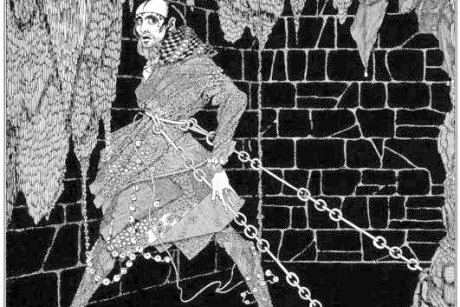
The image is taken from  Harry Clarke’s (1889-1931) illustration of poor Fortunato, chained up and ready to be sealed up alive.   

Hump Day Shakespearean Quotes – 07 January 2015

Cassius & Brutus 2

Rationalizing cold-blooded murder is something for sick minds and for the greatest of writers.   Shakespeare was able to imagine how a flawed personality might rationalize the assassination of a friend for something the intended victim had not yet done, but might do. Amoral? Sick? Reprehensible? Yes, all of these. And also the topic for the first great soliloquy Shakespeare ever wrote:

Brutus
It must be by his death, and, for my part,
I know no personal cause to spurn at him,
But for the general. He would be crown’d:
How that might change his nature, there’s the question.
It is the bright day that brings forth the adder
And that craves wary walking. Crown him that,
And then, I grant, we put a sting in him
That at his will he may do danger with.
The abuse of greatness is when it disjoins
Remorse from power, and, to speak truth of Caesar,
I have not known when his affections sway’d
More than his reason. But ’tis a common proof
That lowliness is young ambition’s ladder,
Whereto the climber-upward turns his face;
But when he once attains the upmost round,
He then unto the ladder turns his back,
Looks in the clouds, scorning the base degrees
By which he did ascend. So Caesar may;
Then, lest he may, prevent. And, since the quarrel
Will bear no color for the thing he is,
Fashion it thus: that what he is, augmented,
Would run to these and these extremities;
And therefore think him as a serpent’s egg
Which hatch’d would as his kind grow mischievous,
And kill him in the shell.

Julius Caesar, Act 2, Scene 1

Before we get to the why this soliloquy is the first of its kind, note the imagery: There are two metaphors here. Caesar as a serpent, and Caesar as a ladder-climber. The ladder-climber has become part of our common vernacular today–“climb the corporate ladder.” The other metaphor, though–Caesar as the adder–is the creepier of the two, and Shakespeare has Brutus return to that image in the final, decisive line: “And kill him in the shell.”

That metaphor allows Brutus to develop the rationalization to murder Caesar not for anything he has done, but for what he might do. That is, kill the snake in its shell. As cold-blooded as you can get. Yet–it’s okay, he’s rationalized it.

Finally, as mentioned above, this was Shakespeare’s first great soliloquy. The idea of being able to convey on-stage a character’s innermost thoughts was something never before done in theatre until Shakespeare tried it out in Julius Caesar–all the way back in 1599. This speech is the first one. 

It worked so well for Shakespeare–it so illuminated the inner workings of his characters–that he then refined the practice. To this very day, we remember even greater soliloquys that followed in his later plays: ‘To be or not to be’ from Hamlet, or ‘Tomorrow, and tomorrow, and tomorrow’ from Macbeth, just to name two. This technique changed the nature of art forever. Need examples? It’s used today in popular culture: think of ‘The Office’ or ‘Modern Family’, where characters are given the opportunity to speak directly to the audience.

The image comes from the 1953 film version of Julius Caesar, with James Mason as Brutus (right) and John Gielgud as Cassius (left). Note their post-assassination bloodstained tunics, in glorious black and white.

Sunday Sonnet – 28 December 2014

sonnet 19

As this old year meanders to a close, I thought it appropriate to share one of Shakespeare’s  ‘Time’ sonnets.  In this one, The Bard treats Time like a character, whom the Poet addresses directly with a series of vivid metaphors.  These images describe how Time ultimately destroys everything, no matter how powerful or sublime.

Sonnet 19:

Devouring Time, blunt thou the lion’s paws,

And make the earth devour her own sweet brood;

Pluck the keen teeth from the fierce tiger’s jaws,

And burn the long-liv’d phoenix, in her blood;

Make glad and sorry seasons as thou fleet’st,

And do whate’er thou wilt, swift-footed Time,

To the wide world and all her fading sweets;

But I forbid thee one most heinous crime:

O! carve not with thy hours my love’s fair brow,

Nor draw no lines there with thine antique pen;

Him in thy course untainted do allow

For beauty’s pattern to succeeding men.

Yet, do thy worst old Time: despite thy wrong,

My love shall in my verse ever live young.

For me, this sonnet marks a turn in the Young Man sequence of verses.  The Poet has now given up on his earlier arguments: that the Young Man should procreate to preserve his own beauty.  Now the Poet employs something more powerful than nature’s gift to humans—the ability to reproduce.  Starting with the Sonnets in the late teens, the Poet summons power the Art, specifically Poetry.  Shakespeare’s poem itself shall preserve the Young Man’s beauty for eternity, thereby defeating Time’s ‘worst’.

Could Shakespeare have know how right he was?  Could he have dreamt that over 400 years later, his beloved would still live on in the lines of these immortal words?  Possibly not.  Scholarly evidence suggests fairly convincingly that the Sonnets were published without Shakespeare’s permission.  He likely intended for all of 154 of these verses—to the Young Man and the Dark Lady alike—to never see the public eye.  They were risqué, dangerous in the Elizabethan world of religious morality and homophobia.   Thankfully, today, at the close of 2014, they are regarded as the epitome of the poetic form in the English Language.  They have defeated Time’s ‘most heinous crime.’

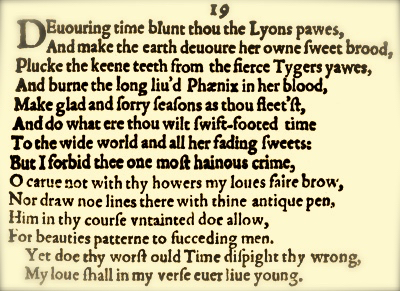
The image is from Thomas Thorpe’s unauthorized publication of ‘SHAKES-SPEARES SONNETS’ from 1609.