Sunday Sonnet – 31 May 2015

lovely Will

The Spring morning breaks bright and beautiful here in Southern Wisconsin, and so it seems a perfect time to enjoy Shakespeare’s Sonnet 33, which features a complex metaphor about the shining sun–but that sun’s not always what it seems: 

33

Full many a glorious morning have I seen
Flatter the mountain-tops with sovereign eye,
Kissing with golden face the meadows green,
Gilding pale streams with heavenly alchemy;
Anon permit the basest clouds to ride
With ugly rack on his celestial face,
And from the forlorn world his visage hide,
Stealing unseen to west with this disgrace:
Even so my sun one early morn did shine
With all triumphant splendor on my brow;
But out, alack! he was but one hour mine;
The region cloud hath mask’d him from me now.
Yet him for this my love no whit disdaineth;
Suns of the world may stain when heaven’s sun staineth.

Despite the poem’s bright opening, this verse is mournful. Apparently the Young Man had rejected the Poet. This sonnet, and the ones following, seem to relate to a specific episode of genuine grief, casting an autobiographical aspect to the Sonnets. These episodes don’t hold the structural majesty of a Hamlet or an Othello, but seem to muddy through a betrayal, hurt feelings, and ambivalent (but beautifully poetic) metaphoric imagery. 

Anyhow, what a splendid, lovely image: the rising sun beautifies the mountains and meadows, brightens the streams, only to be blotted out by a cloud, so that the sun must sneak away into sunset.   Likewise, the Young Man, a shining beauty, has let something blot his beauty–betraying himself and the Poet.   

The image is of William Shakespeare, the recently rediscovered ‘Cobbe Family’ portrait. Scholars suppose this anonymous portrait of the Bard was commissioned later in his life–after Will had achieved fame–yet was painted as a representation of how Will might’ve looked in his younger years, when he was first storming the London stage.

Sunday Sonnet – 26 April 2015

courthouse

Today a sonnet to friendship seems appropriate to me because this weekend I’m briefly seeing a lot of friends I seldom get to visit.   Part of the Young Man sequence of sonnets, this beautiful poem speaks to the melancholy of departed friends, and the memories you take with you:

30

When to the sessions of sweet silent thought
I summon up remembrance of things past,
I sigh the lack of many a thing I sought,
And with old woes new wail my dear time’s waste:
Then can I drown an eye, unused to flow,
For precious friends hid in death’s dateless night,
And weep afresh love’s long since cancell’d woe,
And moan the expense of many a vanish’d sight:
Then can I grieve at grievances foregone,
And heavily from woe to woe tell o’er
The sad account of fore-bemoaned moan,
Which I new pay as if not paid before.
But if the while I think on thee, dear friend,
All losses are restored and sorrows end. 

One of the remarkable things about this poem it its use of Elizabethan courtroom language: ‘Sessions’; ‘cancell’d’; ‘expense’; ‘grievances’; ‘account’; ‘pay’ and ‘paid’; ‘losses are restored’. The love for separated friends and courtroom lingo don’t seem an obvious match, but Shakespeare makes it work.

Lost chances, lost friends, the death of friends or loved ones brings the Poet to tears. However, all he has to do is think upon his dear friend–in this case the Young Man–and all his sorrows end. 

Finally, ‘remembrance of things past’ from the gorgeous pair of opening lines is a phrase made famous by the translated English title of Proust’s 20th century classic novel.   

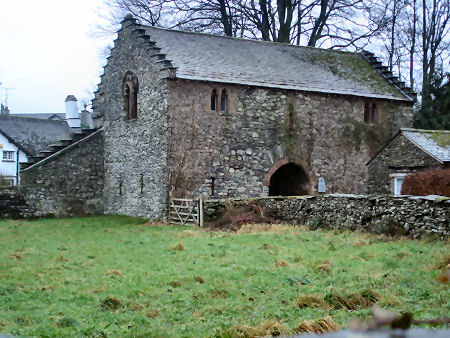
The image is of the Hawkshead Courthouse in the Lake District, an example of what many courthouses might have looked like in the time of Shakespeare.

Sunday Sonnet – 08 March 2015

SonnetsQuarto001356

This sonnet is especially evocative for me because it appears that an actual event or circumstance inspired it: the Poet gives the Young Man a blank book. For someone like me, who’s writing a novel about Shakespeare, the notion that the sonnets might reflect actual events in the Bard’s life becomes irresistible:

77

Thy glass will show thee how thy beauties wear,
Thy dial how thy precious minutes waste;
The vacant leaves thy mind’s imprint will bear,
And of this book this learning mayst thou taste.
The wrinkles which thy glass will truly show
Of mouthed graves will give thee memory;
Thou by thy dial’s shady stealth mayst know
Time’s thievish progress to eternity.
Look, what thy memory can not contain
Commit to these waste blanks, and thou shalt find
Those children nursed, deliver’d from thy brain,
To take a new acquaintance of thy mind.
These offices, so oft as thou wilt look,
Shall profit thee and much enrich thy book.

Shakespearean scholarship is undecided about the biographical veracity of the Sonnets. But this one and one other (a Dark Lady sonnet where she’s playing music on a virginal) both seem to include specific details from actual events. Do the other major events of the sonnets–the Poet’s love for a Young Man and a Dark Lady; circumstances of physical parting; specific instances of betrayal–reflect chapters in Will’s life? 

I like to believe so. Though this debate has gone on for years, and a complete parsing out of all the arguments for and against would fill entire book, two main points convince me:

First, the Sonnets were published in 1609 without Shakespeare’s permission. Yet much of Shakespeare’s contemporary fame came from his profession as a Poet and not a playwright, including his publication of Venus and Adonis, The Rape of Lucrece and ‘The Phoenix and the Turtle.’ So why not publish the Sonnets he had been writing for years? Simple: their highly personal nature–in cases, so personal as to be dangerous (homosexual acts in Elizabethan England were punishable by imprisonment). 

Second, because autobiographical inspiration is the way of Artistry. This is more of a right brain kind of argument, but history is full of hundreds of instances where great writers drew from their own experiences to create their stories. No, of course Shakespeare never ruled an ancient Roman Empire like in Julius Caesar; no, of course he didn’t avenge his father’s death like Hamlet did. But Will lived and recognized and empathized with all the great emotions, trials and hopes of the human condition (and expressed them brilliantly). And in the case of his very private sonnets, those troubles and aspirations bubble to surface in curiously detailed and repetitive ways. 

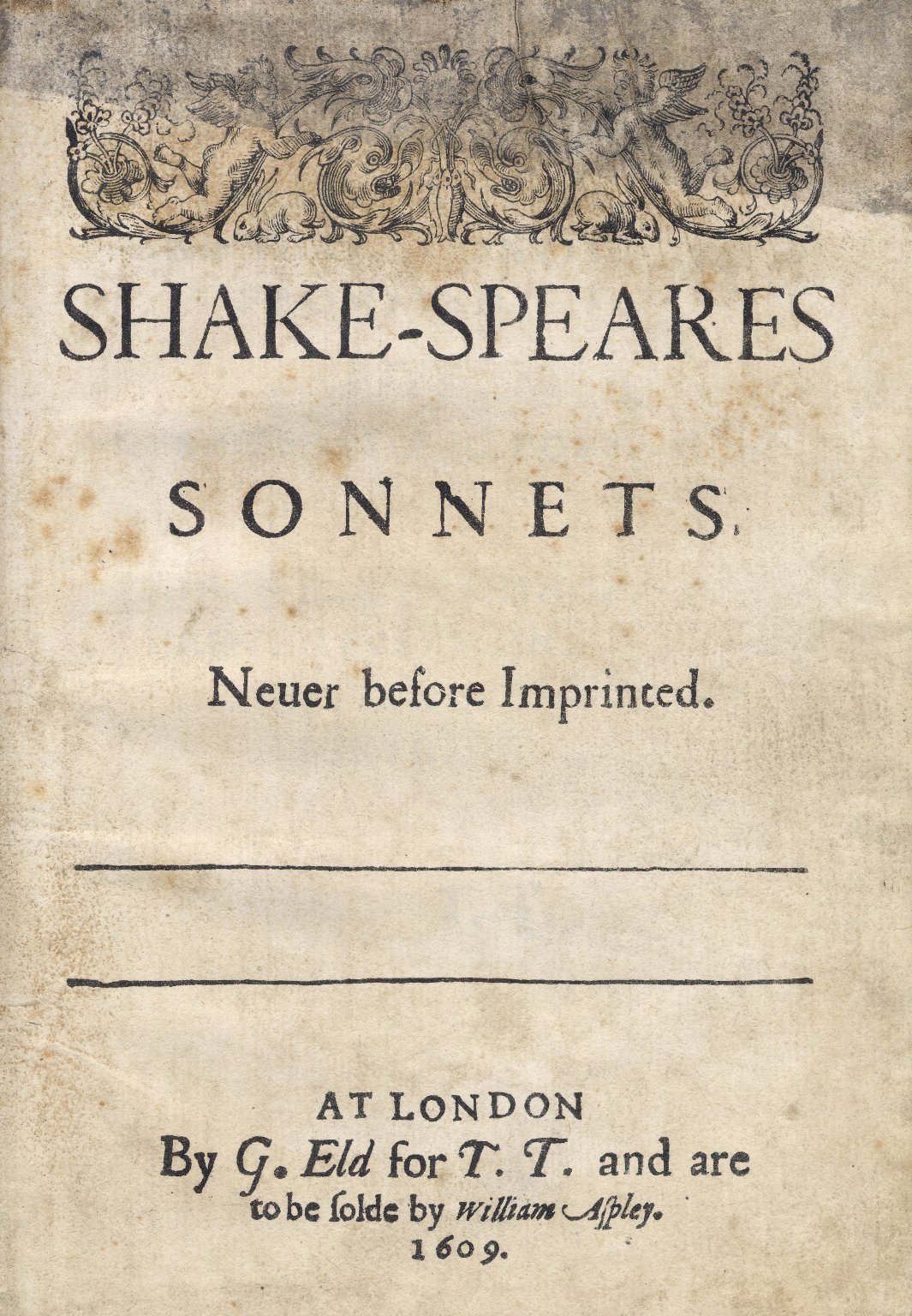
The image comes from an actual First Edition of Shakespeare’s Sonnets, 1609.

Sunday Sonnet – 22 February 2015

Stratford

Much of the United States is under a deep freeze, under deep snow, or both. So Sonnet 97 came to mind, with its marvelous and repeated winter imagery. 

97

How like a winter hath my absence been
From thee, the pleasure of the fleeting year!
What freezings have I felt, what dark days seen!
What old December’s bareness every where!
And yet this time removed was summer’s time,
The teeming autumn, big with rich increase,
Bearing the wanton burden of the prime,
Like widow’d wombs after their lords’ decease:
Yet this abundant issue seem’d to me
But hope of orphans and unfather’d fruit;
For summer and his pleasures wait on thee,
And, thou away, the very birds are mute;
Or, if they sing, ’tis with so dull a cheer
That leaves look pale, dreading the winter’s near.

The Young Man has abandoned the Poet, being gone, it seems, for a the better part of a year.   And his absence, though it comes during the Summer and Autumn, makes those seasons seem as barren as Winter. That absence has frozen the Poet’s emotions and made the harvest time barren: ‘Like widow’d wombs after their lords’ decease,’ one of my favorite lines. 

The Sonnet’s final couplet is a beautiful turn: Even if the birds should sing, they sing with a dull cheer: ‘Or, if they sing, ‘tis with so dull a cheer.’

I like the Sonnet because it is quintessential in its construction: a great metaphor that carries through from start to finish; the almost perfect construction of its sonnet form (rhyme, meter, quatrains, turns); its easy grace and the natural melody of its rhythm. Read it aloud! However, if you read it to your beloved, preface things first, lest he or she misinterpret it: this is Sonnet of longing, after all.

The image is of an old vintage postcard of the River Avon in Stratford in the heart of winter.  

Sunday Sonnet – Valentine’s Day 2015 Special Edition

summers day

This week’s Sunday Sonnet comes a day early in recognition of Valentine’s Day. It already existed with some of its romantic connotations in Shakespeare’s time: Geoffrey Chaucer seems to have helped take the Feast of St. Valentine and color it with some aspects of courtly love. It wasn’t until the 18th century, however, that it really became the day for lovers. And it wasn’t until the 20th century that Hallmark ruined the holiday. But romantic love certainly existed in Shakespeare’s time. Today I’d like to share perhaps one of Shakespeare’s most famous sonnets.

18

Shall I compare thee to a summer’s day?
Thou art more lovely and more temperate:
Rough winds do shake the darling buds of May,
And summer’s lease hath all too short a date;
Sometime too hot the eye of heaven shines,
And often is his gold complexion dimm’d;
And every fair from fair sometime declines,
By chance or nature’s changing course untrimm’d;
But thy eternal summer shall not fade,
Nor lose possession of that fair thou ow’st;
Nor shall Death brag thou wander’st in his shade,
When in eternal lines to time thou grow’st:
So long as men can breathe or eyes can see,
So long lives this, and this gives life to thee.
 

This sonnet is still bandied about today, read at weddings, and was even misappropriated in the popular movie Shakespeare in Love.   Well, if Shakespeare had been love when he wrote this sonnet, he was in love with the Young Man, and not Gwyneth Paltrow. This lovely verse is written by a man to a man. 

But why worry to whom ,or why, this exquisite sonnet was written? Sonnet 18’s gorgeous imagery, multi-leveled language and lush verse speaks universally to undying love, and the power of Art to preserve that love, both the transitory nature of romantic love and the undying ‘eternal summer’ of true love. 

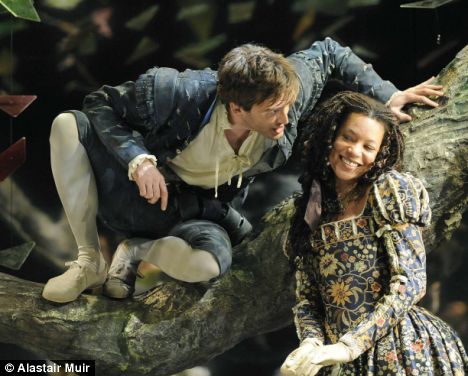
The image is from Shakespeare in Love, of Gwyneth Paltrow as the imaginary Viola and Joseph Fiennes as Shakespeare, living out modern scholarship’s heterosexual fantasy that Shakespeare never wrote any sonnets to a man. In truth, Will was an equal opportunity romantic, doling out magnificent verse to Young Men and Dark Ladies alike.

Sunday Sonnet – 08 February 2015

Tennant

The delicious and dark eroticism of the Dark Lady sonnets reaches its peak, I think, in Number 132.   Oh, how the Poet loves and lusts for the Dark Lady, though she doesn’t love him.   That unrequited love is epitomized in Shakespeare’s pun of the words ‘morning’ and ‘mourning.’ And what of the Elizabethan perception of female beauty? Plain and simple, it was misogynistic and racist. Will Shakespeare turns that on its head: for the Poet, black is sublimely beautiful, and this beautiful woman is more powerful than the Poet himself. 

132

Thine eyes I love, and they, as pitying me,
Knowing thy heart torments me with disdain,
Have put on black and loving mourners be,
Looking with pretty ruth upon my pain.
And truly not the morning sun of heaven
Better becomes the grey cheeks of the east,
Nor that full star that ushers in the even
Doth half that glory to the sober west,
As those two mourning eyes become thy face:
O, let it then as well beseem thy heart
To mourn for me, since mourning doth thee grace,
And suit thy pity like in every part.
Then will I swear beauty herself is black
And all they foul that thy complexion lack. 

So odd, so strange that these sonnets were written in the Elizabethan era–the late 1500’s and the very earliest years of the new century. As I’ve said before, Will Shakespeare never published these sonnets–they were printed without his permission. Little wonder. What was going that he should write such dangerous stuff–verses that were surely shocking in their time? 

It all makes me wonder–and believe–that there was more than just imagination behind all the sonnets to the ‘Young Man’ (homoerotic and very much against he the law), and more than imagination behind all the sonnets to this magnificently dark and angry and beautiful ‘Dark Lady.’ 

The image is of David Tennant and Nina Sosanya in a Royal Shakespeare Company production of As You Like It. They look lovely together, don’t they? If the Dark Lady sonnets were indeed autobiographical, might there once have been a scene like this played out in Shakespeare’s own life? We’ll never know for certain.

Sunday Sonnet – 11 January 2015

gatehouse-2

Have you ever missed your lover? Ever been in the throes of a wild love affair, where every waking minute away from your lover is torture, and every dream at night puts you back into his or her arms?    

43

When most I wink, then do mine eyes best see,
For all the day they view things unrespected;
But when I sleep, in dreams they look on thee,
And darkly bright are bright in dark directed.
Then thou, whose shadow shadows doth make bright,
How would thy shadow’s form form happy show
To the clear day with thy much clearer light,
When to unseeing eyes thy shade shines so!
How would, I say, mine eyes be blessed made
By looking on thee in the living day,
When in dead night thy fair imperfect shade
Through heavy sleep on sightless eyes doth stay!
All days are nights to see till I see thee,
And nights bright days when dreams do show thee me.

Shakespeare loved reversals, opposites, turns and double-meanings. They’re common in his plays, but he also used them in his sonnets. Paradoxical feelings are part of what makes us human, and part of what makes these centuries-old sonnets still applicable to our lives today.  

Double-meanings – Many words here serve double use as noun and verb: ‘shadow’ and ‘form’:

Then thou, whose shadow shadows doth make bright,

How would thy shadow’s form form happy show. 

Opposites – night and bright; ‘eyes best see’ and sightless; ‘living day’ and ‘dead night’; and that lovely phrase, ‘thy shade shines so’.

The sonnet’s final turn contains two reversals – the final couplet, where night is day, and day is night: 

All days are nights to see till I see thee,
And nights bright days when dreams do show thee me.

My favorite line is just simply lovely and gorgeous: 

And darkly bright are bright in dark directed.

Some interesting facts about this sonnet: Yes, it’s part of the Young Man sequence of sonnets: the Poet’s beloved is a man. And Benjamin Britten set this sonnet to music in his Nocturne, from 1958.   That Nocturne contains poetry from Keats, Shelley, Coleridge and Wordsworth.

The image is a royal Elizabethan bedroom. This particular one is from Leicester’s Gatehouse at Kenilworth Castle. Robert Dudley’s (The Earl of Leicester) was Queen Elizabeth’s suitor, and wooed her–unsuccessfully–for years.   He set up this bedroom for her. Just as the Poet above pined away for his lover, Dudley apparently pined away for Liz.  

Sunday Sonnet – 28 December 2014

sonnet 19

As this old year meanders to a close, I thought it appropriate to share one of Shakespeare’s  ‘Time’ sonnets.  In this one, The Bard treats Time like a character, whom the Poet addresses directly with a series of vivid metaphors.  These images describe how Time ultimately destroys everything, no matter how powerful or sublime.

Sonnet 19:

Devouring Time, blunt thou the lion’s paws,

And make the earth devour her own sweet brood;

Pluck the keen teeth from the fierce tiger’s jaws,

And burn the long-liv’d phoenix, in her blood;

Make glad and sorry seasons as thou fleet’st,

And do whate’er thou wilt, swift-footed Time,

To the wide world and all her fading sweets;

But I forbid thee one most heinous crime:

O! carve not with thy hours my love’s fair brow,

Nor draw no lines there with thine antique pen;

Him in thy course untainted do allow

For beauty’s pattern to succeeding men.

Yet, do thy worst old Time: despite thy wrong,

My love shall in my verse ever live young.

For me, this sonnet marks a turn in the Young Man sequence of verses.  The Poet has now given up on his earlier arguments: that the Young Man should procreate to preserve his own beauty.  Now the Poet employs something more powerful than nature’s gift to humans—the ability to reproduce.  Starting with the Sonnets in the late teens, the Poet summons power the Art, specifically Poetry.  Shakespeare’s poem itself shall preserve the Young Man’s beauty for eternity, thereby defeating Time’s ‘worst’.

Could Shakespeare have know how right he was?  Could he have dreamt that over 400 years later, his beloved would still live on in the lines of these immortal words?  Possibly not.  Scholarly evidence suggests fairly convincingly that the Sonnets were published without Shakespeare’s permission.  He likely intended for all of 154 of these verses—to the Young Man and the Dark Lady alike—to never see the public eye.  They were risqué, dangerous in the Elizabethan world of religious morality and homophobia.   Thankfully, today, at the close of 2014, they are regarded as the epitome of the poetic form in the English Language.  They have defeated Time’s ‘most heinous crime.’

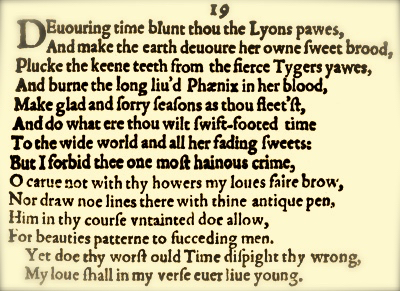
The image is from Thomas Thorpe’s unauthorized publication of ‘SHAKES-SPEARES SONNETS’ from 1609.

Sunday Sonnet – Winter Solstice 2014

Sonnet 2

With today’s Solstice, I think of this sonnet, where the ravages of age will be counted in the number of winters the battered face of the Poet’s lovely Young Man might endure. 

Sonnet II

When forty winters shall besiege thy brow,

And dig deep trenches in thy beauty’s field,

Thy youth’s proud livery so gazed on now,

Will be a totter’d weed of small worth held:

Then being asked, where all thy beauty lies,

Where all the treasure of thy lusty days;

To say, within thine own deep sunken eyes,

Were an all-eating shame, and thriftless praise.

How much more praise deserv’d thy beauty’s use,

If thou couldst answer ‘This fair child of mine

Shall sum my count, and make my old excuse,’

Proving his beauty by succession thine!

   This were to be new made when thou art old,

   And see thy blood warm when thou feel’st it cold.

This second poem of Shakespeare’s long sequence of sonnets establish many of themes that would be revisited–and touch upon many truths that we still have trouble facing today: beauty never lasts; your cloak of youth will fade; there is a reason why we have children.  

What’s truly astonishing about all this, is that this sonnet–and most of the early Young Man sonnets–Shakespeare very likely wrote under commission. In other words, he might have been paid to write them on just this topic.  

Lord Burghley was Queen Elizabeth’s Lord Treasurer, and Burghley had a young ward he was in charge of–none other than the Earl of Southampton, very probably Shakespeare’s ‘Young Man’.   Southampton did not want to marry (The reasons for this are numerous and speculative, but one is that Southampton had no interest in women). What’s odd is that the first 17 sonnets all urge the Young Man to procreate. Never before had the Romantic form of the Sonnet been used for such an odd endeavor: that is a male Poet urging another male–a beautiful and lovely male–to procreate. But Shakespeare makes it work. I mean–how else to convince a vain, spoiled and possibly gay Earl to marry up and reproduce? Flatter him. 

Alas, after Sonnet 17, things turn for the Poet (that is, Will Shakespeare), and he finds himself falling in love with this vain, beautiful creature.   But for today, let’s revel in Number 2, and its lovely, varied imagery. And remember: braving these cold winters will only dig deep the trenches in our fields of beauty. 

The image is from the northern woods of Wisconsin, of a dear old place I’ll very likely never be able to visit again.