Shakespeare on War – Memorial Day 2016

Memorial day battle

Shakespeare, as far as we know, never served in any military capacity, was never forcibly pressed into service (which was how Elizabethan England filled its military ranks), yet he seems to know something of it. Many of his plays contain characters, high and low, connected to military action, from men in the field to the Kings who order those men to their deaths. During Shakespeare’s lifetime, Queen Elizabeth conducted war with Spain and the poor Irish people, and these wars lasted years. The subject of war must’ve been common talk, and many people must’ve lost loved ones in the wars.

I consider Shakespeare’s works the heart and soul of Western morality, and The Bard’s approach to war is no different. Ambitious warmongers fill his plays, some coming to bad ends (the Richards, the Macbeths), some glorified (Henry V), and some just outright mocked (Falstaff). A majority are treated with profound authorial ambivalence, left to the reader (or spectator) to decide for themselves.

This latter category I consider the most instructive. There are many examples to choose from in Shakespeare. In recognition of Memorial Day here in America, where we honor our fallen soldiers, I’d like to highlight a passage from Julius Caesar, where Caesar and his wife Calpurnia wax poetic about war, and the difference between cowardice and valor.

CALPURNIA.

Caesar, I never stood on ceremonies,

Yet now they fright me. There is one within,

Besides the things that we have heard and seen,

Recounts most horrid sights seen by the watch.

A lioness hath whelped in the streets;

And graves have yawn’d, and yielded up their dead;

Fierce fiery warriors fight upon the clouds,

In ranks and squadrons and right form of war,

Which drizzled blood upon the Capitol;

The noise of battle hurtled in the air,

Horses did neigh, and dying men did groan;

And ghosts did shriek and squeal about the streets.

O Caesar,these things are beyond all use,

And I do fear them!

CAESAR.

What can be avoided

Whose end is purposed by the mighty gods?

Yet Caesar shall go forth; for these predictions

Are to the world in general as to Caesar.

CALPURNIA.

When beggars die, there are no comets seen;

The heavens themselves blaze forth the death of princes.

CAESAR.

Cowards die many times before their deaths;

The valiant never taste of death but once.

Of all the wonders that I yet have heard,

It seems to me most strange that men should fear;

Seeing that death, a necessary end,

Will come when it will come.—

Julius Caesar, Act II Scene ii

Caesar uses death both as a metaphor and literally. ‘Cowards die many times before their deaths; The valiant never taste of death but once.’ A noble sentiment. I suspect that many of those we consider valiant–many of those who died–were terrified: but the valiant conquer their fears, the cowards don’t. And there is Shakespeare’s use of death as a metaphor: each time the coward suffers under the failure of his own fear, a small piece of him dies.

Crucial to this scene is Calpurnia’s more feminine perspective about the violence of war: her soaring and terrifying description of battle. If Shakespeare wasn’t in battle, he certainly must’ve read of it, or heard of it from those who had suffered it first hand. Or, miraculously, applied his own brilliant and empathetic imagination:  

‘Fierce fiery warriors fight upon the clouds,

In ranks and squadrons and right form of war,

Which drizzled blood upon the Capitol;

The noise of battle hurtled in the air,

Horses did neigh, and dying men did groan;

And ghosts did shriek and squeal about the streets.’

In sad remembrance to all of those who have fallen in defense of our country. I can never know what it must be like, and certainly don’t have the imagination of Shakespeare to recreate it. To those who suffered it, and died for our country, honor, awe and profound sadness.

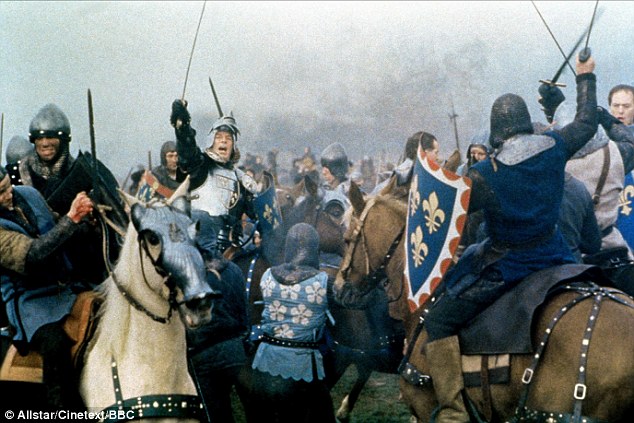
The image is from Kenneth Branagh’s film version of Henry V, here showing men dying for their country at the Battle of Agincourt. Today we honor our own fallen. In 600 years we haven’t learned much, have we?

 

Did Shakespeare Have a Mom? – 08 May 2016

BIRTH

Of course he did. Her name was Mary Arden, the daughter of a wealthy farmer. We know hardly anything about Mary Arden, except that Shakespeare decided to honor his maternal family’s name by setting his play, As You Like It, in the ‘Forests of Arden’.

Interestingly enough, As You Like It contains one of the strongest and most progressive female characters in all of Shakespeare’s plays, Rosalind. Not only is she still extraordinary today, in Shakespeare’s time she would’ve been almost unrecognizable in a world where women were considered property, and rarely played any role in society outside of mothers, servants or prostitutes (the singular exception of Queen being duly noted). I’m not suggesting Shakespeare based Rosalind on his mother, there’s absolutely no evidence of that. But I think it’s neat that Rosalind tromped about in the Forests of Arden.

Mary Arden most definitely fulfilled the role of mother. She bore her husband John Shakespeare eight children, and most certainly suffered her share of tragedy: Will Shakespeare had seven siblings, yet three of them died either in infancy or childhood. Many of the extended Arden family were Catholic, though we really don’t know about Mary herself or her husband. And Will Shakespeare? He kept his religious beliefs–if he even had any–wisely secret.

What impact did this virtually unknown woman have on the Bard of Avon? It’s hard to ever know, but we do know this: the role of mothers don’t appear often in Shakespeare’s plays. Too much shouldn’t be read into this, for in Shakespeare’s times, women weren’t allowed to perform on stage. Shakespeare designed his plays for an existing company of actors, and he had to make certain he had boy actors for every very female role.

Gertrude, the mother in Hamlet, isn’t the world’s greatest mom. Lady Macbeth, the supreme villainess, muses that she probably wouldn’t have made a great mother. So many of the other scintillating females in Shakespeare’s plays are not mothers or, if they are, never really address the issue. But getting boys to play moms? That would be tough.

There is, however, one famous monologue delivered by a mother in grief. Shakespeare must’ve had an extraordinary lad in his troupe to perform this. I hate to end this blog–on Mother’s Day–on a negative note. But in writing this speech, Shakespeare shows he strived to reveal a mother’s love, and the kind of raging grief the deaths of sons could elicit. It’s a powerful speech, words that could only ever come from the heart of a Mother.

From Richard III, here is Queen Margaret’s magnificent speech:

QUEEN MARGARET:

If ancient sorrow be most reverent,

Give mine the benefit of seniory

And let my griefs frown on the upper hand.

If sorrow can admit society,

Tell over your woes again by viewing mine.

I had an Edward, till a Richard killed him;

I had a Harry, till a Richard killed him:

Thou hadst an Edward, till a Richard killed him;

Thou hadst a Richard, till a Richard killed him.

Thou hadst a Clarence too, and Richard killed him.

From forth the kennel of thy womb hath crept

A hellhound that doth hunt us all to death:

That dog, that had his teeth before his eyes,

To worry lambs and lap their gentle blood,

That foul defacer of God’s handiwork,

That excellent grand tyrant of the earth

That reigns in gallèd eyes of weeping souls,

Thy womb let loose to chase us to our graves.

O upright, just, and true-disposing God,

How do I thank thee that this carnal cur

Preys on the issue of his mother’s body

And makes her pew-fellow with others’ moan!

Bear with me! I am hungry for revenge,

And now I cloy me with beholding it.

Thy Edward he is dead, that killed my Edward;

Thy other Edward dead, to quit my Edward;

Young York he is but boot, because both they

Matched not the high perfection of my loss.

Thy Clarence he is dead that stabbed my Edward,

And the beholders of this frantic play,

Th’ adulterate Hastings, Rivers, Vaughan, Grey,

Untimely smoth’red in their dusky graves.

Richard yet lives, hell’s black intelligencer;

Only reserved their factor to buy souls

And send them thither. But at hand, at hand,

Ensues his piteous and unpitied end.

Earth gapes, hell burns, fiends roar, saints pray,

To have him suddenly conveyed from hence.

Cancel his bond of life, dear God, I pray,

That I may live and say, ‘The dog is dead.’

I called thee once vain flourish of my fortune;

I called thee then poor shadow, painted queen,

The presentation of but what I was,

The flattering index of a direful pageant,

One heaved a-high to be hurled down below,

A mother only mocked with two fair babes,

A dream of what thou wast, a garish flag,

To be the aim of every dangerous shot;

A sign of dignity, a breath, a bubble,

A queen in jest, only to fill the scene.

Where is thy husband now? Where be thy brothers?

Where be thy two sons? Wherein dost thou joy?

Who sues and kneels and says, ‘God save the queen’?

Where be the bending peers that flatterèd thee?

Where be the thronging troops that followèd thee?

Decline all this, and see what now thou art:

For happy wife, a most distressèd widow;

For joyful mother, one that wails the name;

For one being sued to, one that humbly sues;

For queen, a very caitiff crowned with care;

For she that scorned at me, now scorned of me;

For she being feared of all, now fearing one;

For she commanding all, obeyed of none.

Thus hath the course of justice whirled about

And left thee but a very prey to time,

Having no more but thought of what thou wast,

To torture thee the more, being what thou art.

Thou didst usurp my place, and dost thou not

Usurp the just proportion of my sorrow?

Now thy proud neck bears half my burdened yoke,

From which even here I slip my weary head

And leave the burden of it all on thee.

Farewell, York’s wife, and queen of sad mischance!

These English woes shall make me smile in France.

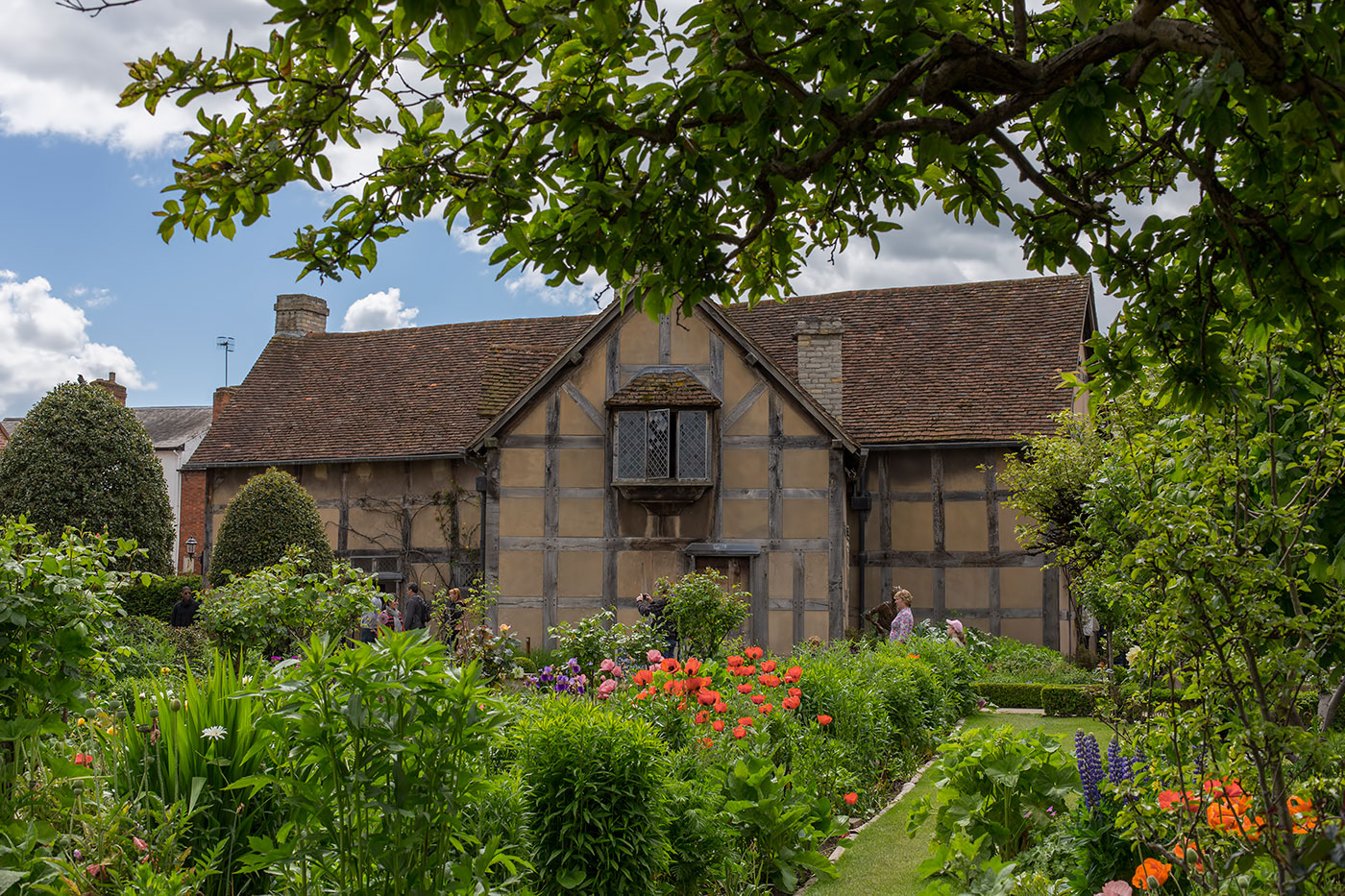
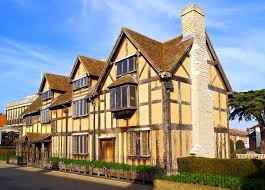
The image is of the house on Henley Street in Stratford-Upon-Avon, where Mary Arden gave birth to her playwright son.

400th Anniversary of Shakespeare’s Death

william-shakespeare

Shakespeare has become my religion.

Back in 1976, between my junior and senior years of high school, my family was uprooted to a new town because my father needed work. I was enrolled into a new high school at midsummer by a well-meaning principal who knew nothing about me and not much about his school’s curriculum. A mediocre student was thrown into Mrs. Kelley’s Honors English. Mrs. Kelly introduced me to two new couples: Romeo and Juliet, and the Macbeths. The epitome of Romantic Love dashed with a dagger and dram of poison. And the portrait of a happy marriage, mired in blood, that still inspires our entertainment industry today–thank you Robin Wright and Kevin Spacey.

In college, after I flunked out of Engineering, I gravitated back to where the long dead finger of Shakespeare had pointed me a couple years earlier: Theatre and Literature. In college I grew to love Shakespeare, ‘The Bard’, under the tutelage of some great minds: Doctors Paul and Sommer. Despite their best efforts, I graduated with a bachelor’s, but not much else. I would become no professor of literature, and no Kenneth Branagh.

As Shakespeare himself wrote, ‘with eyes severe and beard of formal cut’, I labored in all kinds of business, trying to find my way. Decades later, I’ve come back to the beginning. Beyond trying to write a novel about Shakespeare, I’ve grown to realize that Shakespeare has become my religion.  

He shapes and guides everything I write, promote and believe: Art, Love, Work, Daily Life, Politics, Society, Imagination and Hope. His works delve into what it means to be human, provide a guide of conduct, a code of ethics, all lessons to be learned, but presented lavishly in the most eloquent and beautiful language ever put to English.

  • What does human love mean and what is its importance? A seeming infinite list of plays, poems and characters explore this, but my favorite is Sonnet 116 (quoted at the end of this blog)
  • Romantic Love. True Love is not Romantic mush, but a meeting of minds, rooted in reality, nurtured with mutual respect, smart, tender but unmoving. See Beatrice and Benedict, from Much Ado About Nothing.
  • Open Love. Love between two people is not subject to anyone else’s bigoted restrictions. See The Sonnets. The (male) Poet and the Young Man; The Poet and the Dark Lady.
  • Women are the equal of Men. Shakespeare wrote in a society where women were considered property; yet by the end of his career what did he create? A long list of diverse and powerful women: Juliet, Beatrice, Lady Macbeth, Rosalind, Cordelia, Ophelia, Portia, Viola, Cleopatra just to name a few.
  • People are equal regardless of race. Elizabethans were violently and openly racist, and yet Shakespeare daringly created the tragic Othello.
  • Power corrupts. The examples seem infinite. Almost every History play teaches this.
  • The Divine Right of Kings. It’s a sham. This was especially tricky, since Shakespeare lived in a monarchy, and that Monarch, Elizabeth, liked Shakespeare’s plays. But his genius was that he could illustrate what may seem obvious to us in the most sly ways. And not all his History plays took the monarch down; in some the monarch succeeded, but that leader always exhibited what all good political leaders should embody: intelligence, grace, mercy, empathy, strength, wit and self sacrifice. This is the measure we should use today too.
  • War is vile. See any of his History plays, and most his Tragedies.
  • There’s not a lot religion in Shakespeare’s plays or poetry. By and large he avoided references to it or talking much about it. Perhaps a good practice to follow today in daily life and in our politics?
  • Life is Unfair. Love while you can, life is capricious. Shakespeare lived in plague times, and lost his own son, Hamnet, at age 11. Many of Shakespeare’s Histories and most of his Tragedies end with a stage strewn in blood. It’s a lesson.
  • Laughter is essential to life. His great Comedies and clowns seem almost infinite in their wit and joy.
  • Often the Fool is the Wisest. Certainly this is true in life, as was so often true in his plays. The best Fool? See King Lear.
  • Revenge is not the way to go. It’s better to forgive. See Hamlet.
  • Mental illness and suicide are things. See Ophelia and Hamlet. This was a particularly wild notion in Elizabethan times. But Shakespeare could see it, and was able to show it on stage.
  • Forgive, cast away your power and strive for grace. Prospero, from one of Shakespeare’s last plays.
  • Shakespeare’s plays and poetry are a treasure trove of words and phrases first used in English, many of which are still in use today, including but not limited to:
    • Brave New World
    • Break the ice
    • Cold comfort
    • Dead as a doornail
    • Eaten out of house and home
    • Faint-hearted
    • For goodness’ sake
    • Full circle
    • Good riddance
    • Heart of gold
    • Kill with kindness
    • Laughing stock
    • Love is blind
    • Milk of human kindness
    • My heart on my sleeve
    • One fell swoop
    • Wild goose chase

And don’t forget, Shakespeare invented the Knock-knock joke!

Though we celebrate the anniversary of his death today, 23 April is also traditionally considered Shakespeare’s birthday, the day calculated back from his day of christening.

Happy Birthday, William Shakespeare, and thank you for the immense contribution to life, language and love.

Sonnet 116

Let me not to the marriage of true minds  

Admit impediments. Love is not love  

Which alters when it alteration finds,  

Or bends with the remover to remove:  

O, no! it is an ever-fixed mark,

That looks on tempests and is never shaken;  

It is the star to every wandering bark,  

Whose worth’s unknown, although his height be taken.  

Love ’s not Time’s fool, though rosy lips and cheeks  

Within his bending sickle’s compass come;

Love alters not with his brief hours and weeks,  

But bears it out even to the edge of doom.  

If this be error, and upon me prov’d,  

I never writ, nor no man ever lov’d.


Sunday Shakespeare – 10 April 2016

Stratford-upon-Avon-12

I spent the day today with my aged mother. Her growing infirmity, and the difficulty with which she confronts her daily tasks, had me ruminating on age, and the whole cycle of life. All this was happened under a shadow, for earlier this week a beautiful young soul I know of was cut down in her prime. Which is worse? They both have their evils.

This strange cycle of birth, growth, prime and the winding down toward death versus capricious strokes of accident or disease are all tragedies humans have had to struggle with since we first made fire. Shakespeare recognized it, of course, and in his day just as today, those that lived into old age (which was much earlier than it is today), had to struggle with that downward spiral. But of course, Shakespeare also know what it was like for the young to die; his own son Hamnet died at age eleven.

Interesting, and perhaps wise, that Shakespeare should choose one of his comedies, As You Like It, rather than a history or tragedy, to lay out the great cycle of human life in an eloquent monologue. It’s delivered by the melancholy cynic, Jaques:

All the world’s a stage,

And all the men and women merely players:

They have their exits and their entrances;

And one man in his time plays many parts,

His acts being seven ages. At first the infant,

Mewling and puking in the nurse’s arms.

And then the whining school-boy, with his satchel

And shining morning face, creeping like snail

Unwillingly to school. And then the lover,

Sighing like furnace, with a woeful ballad

Made to his mistress’ eyebrow. Then a soldier,

Full of strange oaths and bearded like the pard,

Jealous in honour, sudden and quick in quarrel,

Seeking the bubble reputation

Even in the cannon’s mouth. And then the justice,

In fair round belly with good capon lined,

With eyes severe and beard of formal cut,

Full of wise saws and modern instances;

And so he plays his part. The sixth age shifts

Into the lean and slipper’d pantaloon,

With spectacles on nose and pouch on side,

His youthful hose, well saved, a world too wide

For his shrunk shank; and his big manly voice,

Turning again toward childish treble, pipes

And whistles in his sound. Last scene of all,

That ends this strange eventful history,

Is second childishness and mere oblivion,

Sans teeth, sans eyes, sans taste, sans everything.

As You Like It, Act II Scene vii

George Bernard Shaw hated the Jacques character for his cynicism, and Oscar Wilde mocked this speech–‘All the world’s a stage, and the play is badly cast’–and there’s reason to believe the Elizabethans might’ve thought this monologue banal; the seven ages of man are borrowed from Aristotle.

I’m no Shaw or Wilde, and so I find the speech comforting. It tells me that what my mother’s suffering she isn’t suffering alone. As to the other tragedy this week–nothing can mitigate it. But so much of Shakespeare is so full of unjust death and bad luck, the beautiful and innocent–as well as the bad–being cut down in full-bloom. Live life while you may.

Yes, I love this monologue, for with each stage of life, it employs some vital characteristic, going beyond just a list: with image, sound and action it takes the audience through the journey of age: infants puke; school children whine but shine; young lovers sigh like furnaces; soldiers utter oaths, filled with jealously, sudden and quick; middle agers saw wisely; older middle agers shrink, their booming voice of youth raising into trebles; and last, oblivion.

Other writers mock it, or hate Jacques’ cynicism, or wonder why this speech doesn’t show up in Macbeth along with Macbeth’s own stage metaphor, but I love it where it is: a gentle reminder, gently placed, that the Elizabethans struggled with the same things we do. Shakespeare, time and again, endures.

The image is of Nash House in Stratford-upon-Avon. Right next to this Tudor building stands the foundation of New Place, now gone: the building where Shakespeare died.

Sunday Shakespeare – Easter 2016

Richard_II_King_of_England

Easter in Shakespeare? It barely exists. Rare are the Shakespearean references to Christianity: yes, members of the clergy are characters, and characters often invoke God, and use events from the Bible as poetic imagery, and as metaphor. Beyond that the Bard largely avoids the issue of Christian Theology.

Was this a reflection of Shakespeare’s own belief? It’d be a mistake to believe that; we really can’t know for certain. But what we do know is that Queen Elizabeth’s flavor of Protestantism was strictly enforced by her government, and it was not a good idea to be Catholic, Jew or Muslim. The other thing we know is that Shakespeare was a savvy businessman and for his own benefit avoided political controversy. Religious theology in Elizabethan England was extremely political.

So if some fool, like Yours Truly, is going to post some Easter blog about the beautiful things Shakespeare wrote about the Easter holiday, he’s going to come up quite short.  There’s a one-line reference to the holiday in Romeo and Juliet, and then perhaps some oblique references in other places. That’s about it.

There is, however, one delicious tidbit related to Easter: it’s a reference to the nasty business that went on after the Last Supper and on Good Friday.

In Shakespeare’s history play Richard II, written about 1595, King Richard, near play’s end is facing the end of his Machiavellian reign and dares to compare himself with none other than Jesus Christ:

Yet I well remember

The favours of these men. Were they not mine?

Did they not sometime cry “All hail’ to me?”

So Judas did to Christ. But he in twelve

Found truth in all but one; I in twelve thousand, none.

Richard II, Act IV

That’s not enough. The disposed Richard takes his bold comparison one step further, from Judas’ betrayal to Pilate’s prosecution:

Though some of you, with Pilate, wash your hands,

Showing an outward pity, yet you Pilates

Have here delivered me to my sour cross,

And water cannot wash away your sin.

Richard II, Act IV

It was dangerous to put anything religious in print, but in the play Shakespeare could get away with these powerful images invoking Judas, Pilate, Christ and the crucifixion because they were words spoken by a character Shakespeare had managed to make villainous by play’s end. History paints a more ambivalent picture of King Richard II, but for generations, Shakespeare’s play skewed opinion. The powerful evocation of Judas’ betrayal and the Savior’s crucifixion would probably have shocked audiences in the day, all carefully exploited for the purposes of creating exciting drama.

And so while Shakespeare’s works are full of tales and imagery about things destroyed and then coming back to life (i.e., the Easter story), his only direct references to the Passion and Resurrection are the Last Supper betrayal and the Good Friday crucifixion–used to great effect in an impassioned speech by a King who knows he’s doomed.

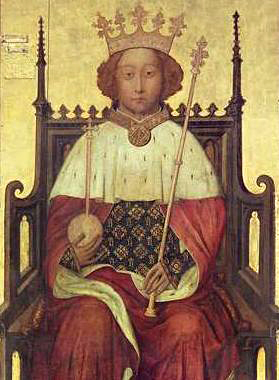
The image is the definitive painting of Richard II, anonymous, now housed in Westminster Abbey.

Sunday Sonnet – 13 March 2015

timon

Flattery will get you nowhere: that’s the gist of Sonnet 82.

82

I grant thou wert not married to my Muse
And therefore mayst without attaint o’erlook
The dedicated words which writers use
Of their fair subject, blessing every book
Thou art as fair in knowledge as in hue,
Finding thy worth a limit past my praise,
And therefore art enforced to seek anew
Some fresher stamp of the time-bettering days
And do so, love; yet when they have devised
What strained touches rhetoric can lend,
Thou truly fair wert truly sympathized
In true plain words by thy true-telling friend;
And their gross painting might be better used
Where cheeks need blood; in thee it is abused.

In the ‘rival poet sequence’, numbers 78 – 82, Shakespeare’s sonnet-writer (or perhaps Shakespeare himself) finds that a rival Poet is wooing the Young Man away from him. It opens with the realization that the Young Man might never have been married to Shakespeare’s verse: ‘thou wert not married to my Muse’. Like any artsy-fartsy old timer today complaining about how anything new is not as good as the old, Shakespeare spends the middle of the Sonnet describing how the rival poet’s verses are currently in vogue, quite flowery and flattering:

‘Some fresher stamp of the time-bettering days’ and ‘yet when they have devised / What strained touches rhetoric can lend.’

As you might expect, Shakespeare claims his verses are better. They may not be as showy, he admits, but they hold more truth: ‘In true plain words by thy true-telling friend’

In 16th century England as well as today, we’re often subjected to the newest, best thing. Is it always the best?

We’ll never know if there was, in fact, a rival poet, or who that poet was (the scholars and historians all have their theories). Suffice to say, the rival’s verse hasn’t survived, nor his identity. But over four centuries later, we still have Shakespeare and his sonnets.

But there’s a more important lesson here. I believe Shakespeare’s works, all the plays and poetry together, beyond storytelling or simple entertainment, are the greatest guide we have to what it means to be and act as humans. One of the lessons here is more than old versus new. It’s flattery. We’ll always have flatterers–so don’t succumb to them. Years after these Sonnets were written, an older, wiser and perhaps more succinct Mr. Shakespeare addresses flattery in one pithy quote in his late play, Timon of Athens, where the misanthropic character Apemantus says “he that loves to be flattered is worthy o’ the flatterer.”  

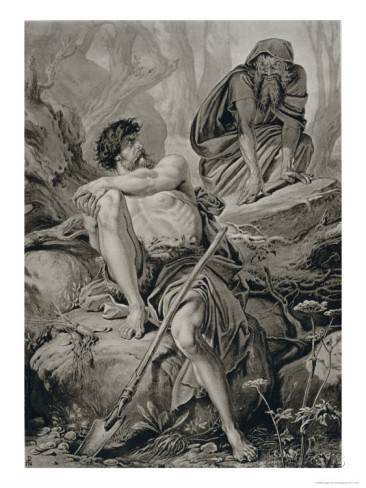
The image is from an anonymous 19th century artist, showing the gadfly Apemantus confronting Timon of Athens with some desperately needed truisms.


Sunday Sonnet – 06 March 2016

sonnet 151

A case can be made that Queen Elizabeth I ushered England into the Renaissance. That said, despite the Elizabethan explosion of Art, Science and Thought, it was an incredibly repressive society. And it was sexually repressive–to the point where it was dangerous to be too risqué. Shakespeare, though, knew just how far he could push it.

151

Love is too young to know what conscience is;
Yet who knows not conscience is born of love?
Then, gentle cheater, urge not my amiss,
Lest guilty of my faults thy sweet self prove:
For, thou betraying me, I do betray
My nobler part to my gross body’s treason;
My soul doth tell my body that he may
Triumph in love; flesh stays no father reason;
But, rising at thy name, doth point out thee
As his triumphant prize. Proud of this pride,
He is contented thy poor drudge to be,
To stand in thy affairs, fall by thy side.
No want of conscience hold it that I call
Her ‘love’ for whose dear love I rise and fall.

This verse is all about how the Poet’s spiritual inclinations succumb to his bodily lust for the Dark Lady. Where it gets risqué–especially for Elizabethan society–is in its second half, where the Poet is reduced to nothing but a phallus, rising and lowering to the Dark Lady’s bidding. You see, it wasn’t permissible in the Elizabethan world of poetry to express sexual desire. But here Shakespeare takes it on. Re-read the start of the second half, it’s really quite explicit:

But, rising at thy name, doth point out thee
As his triumphant prize. Proud of this pride,
He is contented thy poor drudge to be,
To stand in thy affairs…

With Sonnet 151, is Shakespeare perhaps also addressing the conventions of the day? In the opening lines Shakespeare seems to be referring to Cupid, who’s too naïve to really understand the way of the world. I think this Sonnet might be taking aim at the Petrarchan ideal of Romantic Love as idolized in most love poetry of the day: grow up, kids, the way of the world is a lot different than what you’re writing about. This is what it’s like: Soul and lust and pleasure and guilt, all mixed up together.

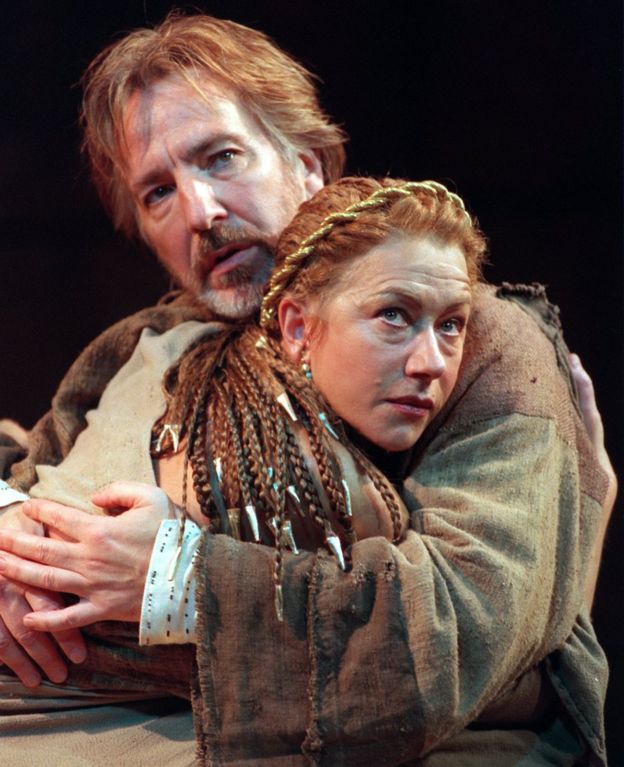
Shakespeare’s plays were full of lovers, usually unhappy and always complicated. Today’s images is of the great Allan Rickman and Helen Mirren as Antony and Cleopatra from a live performance: certainly sexual, most definitely troubled.


Sunday Sonnet – 28 February 2016

Sonnet 146

If ever there were a Shakespearean sonnet appropriate for a Sunday, it’s probably this one.

146

Poor soul, the centre of my sinful earth,
[…] these rebel powers that thee array;
Why dost thou pine within and suffer dearth,
Painting thy outward walls so costly gay?
Why so large cost, having so short a lease,
Dost thou upon thy fading mansion spend?
Shall worms, inheritors of this excess,
Eat up thy charge? is this thy body’s end?
Then soul, live thou upon thy servant’s loss,
And let that pine to aggravate thy store;
Buy terms divine in selling hours of dross;
Within be fed, without be rich no more:
So shalt thou feed on Death, that feeds on men,
And Death once dead, there’s no more dying then.

Shakespeare to a large degree avoided Christian references in his plays and poetry, which was probably wise in Elizabethan England: The war between the Protestant and Catholic faiths had seesawed back and for since Henry VIII, and plenty of people had ended up dead, usually in very unpleasant ways. And so this Dark Lady Sonnet (there’s no explicit mention of her here, but the sins here are carnal ones) is a bit unusual in that the Poet is starting to worry about the eternal disposition of his soul.

This argument between one’s eternal soul and the aging of the temporal body, in this poem imaged as a fading mansion, concludes that it’s time to stop trying to prop up that failing body:

Painting thy outward walls so costly gay?
Why so large cost, having so short a lease,
Dost thou upon thy fading mansion spend?

The whole thrust of this poem is pretty straightforward: Neglect your worldly body so that you might enrich your soul. Which leads you to one of Shakespeare’s most lovely couplets:

So shalt thou feed on Death, that feeds on men,
And Death once dead, there’s no more dying then.

But what makes this sonnet famous (at least in literary circles) isn’t Shakespeare’s rare dalliance into matters piously religious, but those missing words in the second line: In the original Folio, that blank space is filled with ‘My sinful earth.’ Yes–that’s right, the phrase ‘My sinful earth’ is repeated, at the end of line 1 and at the start of line 2.

This is, if you know anything about meter and about Shakespeare’s unerring genius for economy and beauty of language, IS IMPOSSIBLE. The Bard wouldn’t have a) messed up his meter in line 2 with those three words and b) wouldn’t have repeated himself so stupidly. The pervading argument goes that some idiot printer made an error.

So what are those lost words? That’s where all the fun begins. Critics, scholars, poets and gadflies have been arguing for centuries what the Bard must’ve intended. Short of a séance or traveling back in time, we’ll never know. But here are some suggestions, none of which really work beautifully if you take into account meter, cadence, imagery and theme:

Trapp’d these rebel powers that thee array;

or….

Ring’d

Fenced

Foil’d

Pressed

Hemm’d

Fool’d

Which do you like? All this sound and fury, caused by an idiot, which in the end probably signifies nothing.

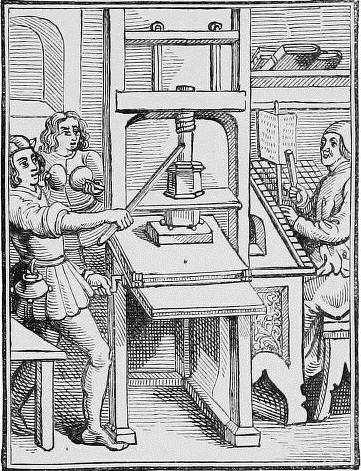
The image of an old woodcut is of an Elizabethan era printing press. They had movable type, but it was still laborious and prone to error.

Sunday Sonnet – 21 February 2016

Sonnet 140

Sometimes it’s delicious to watch a love affair blow apart with jealously, infidelity and threats, especially if you’re not one of the lovers.   I give you Shakespeare’s Dark Lady Sonnet Number 140:

140

Be wise as thou art cruel; do not press
My tongue-tied patience with too much disdain;
Lest sorrow lend me words and words express
The manner of my pity-wanting pain.
If I might teach thee wit, better it were,
Though not to love, yet, love, to tell me so;
As testy sick men, when their deaths be near,
No news but health from their physicians know;
For if I should despair, I should grow mad,
And in my madness might speak ill of thee:
Now this ill-wresting world is grown so bad,
Mad slanderers by mad ears believed be,
That I may not be so, nor thou belied,
Bear thine eyes straight, though thy proud heart go wide.

So what’s going on here? The Poet accuses the Dark Lady of cruelty, but warns hers that she’d better wise up and at least pretend to love him, or he’s going to tell everyone what a philanderer she is.

I’ll speak ill of you: ‘Lest sorrow lend me words and words express’ and ‘And in my madness might speak ill of thee’

Dote on me, even though I know you’re cheating with others : ‘Bear thine eyes straight, though thy proud heart go wide’

And what would a Shakespeare sonnet be without a metaphor? Here the Poet talks about how a dying man begs his doctor to lie to him about how bad it is:  

‘As testy sick men, when their deaths be near,
No news but health from their physicians know;’

Yes, this relationship is in deplorable shape. Despite that–despite the fact that the Dark Lady really doesn’t love him, and is cheating on him–the Poet threatens to spread the truth around if she doesn’t at least pretend.  

Don’t miss some of the beautiful language: ‘My tongue-tied patience with too much disdain;’ or ‘The manner of my pity-wanting pain’. Then there’s the little pun on ‘testy sick men’, hinting at the real reason why the Poet is so desperate to stay with his Dark Lady: lust. Though this sonnet–like so many of Shakespeare’s–throws the idea of Romantic Love on its head, it does embody one facet of that idea: that being in the throes of love is like a sickness. Here the sickness is nothing so lofty and unrequited love for a pristine and angelic mistress–it’s just lust, jealousy and payback.

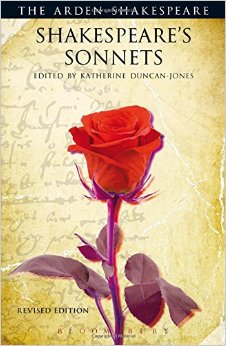
The image is from a cover of an old Arden edition of Shakespeare’s sonnets, which I’ve always found ironic. We associate the gift of a red rose with traditional Romantic love. The sonnets, however–both the Young Man and the Dark Lady ones–turned that notion on its head. At least roses have thorns.


Sunday Sonnet – Valentine’s Day 2016

valentine

Happy Valentine’s Day from William Shakespeare! This love sonnet is one of his greatest, not only eloquent and beautiful, but it speaks so wisely to the quality and temperament of true love.

116

Let me not to the marriage of true minds
Admit impediments. Love is not love
Which alters when it alteration finds,
Or bends with the remover to remove:
O no! it is an ever-fixed mark
That looks on tempests and is never shaken;
It is the star to every wandering bark,
Whose worth’s unknown, although his height be taken.
Love’s not Time’s fool, though rosy lips and cheeks
Within his bending sickle’s compass come:
Love alters not with his brief hours and weeks,
But bears it out even to the edge of doom.
If this be error and upon me proved,
I never writ, nor no man ever loved.

What is love? A marriage of true minds. It never alters. The vagaries of life–tempests–will not shake it. It guides us, like a star guiding a vessel (a ‘bark’ is a boat). It’s timeless, not subject to hours and weeks. True love stays with us until the ends of our lives–the edge of doom. And the Poet attests that all this is true, or ‘I never writ’ and no man ever loved.

The image is of one of Shakespeare’s most successful romantic pairings–and certainly a pairing of true minds: Beatrice and Benedict from Much Ado About Nothing. Amy Acker and Alexis Denisof from Joss Whedon’s 2012 film version.