Sunday Sonnet – 05 July 2015

Sonnet 144

Let’s have some fun today. Some four hundred years Shakespeare evidently did, composing this delicious sonnet about the betrayals of a bisexual love triangle. Here the Young Man of the earlier sonnets intersects with the Dark Lady of the later sonnets. The Poet fears that the Dark Lady might have seduced the Poet’s sweet young boy away from him:

144

Two loves I have of comfort and despair,
Which like two spirits do suggest me still;
The better angel is a man right fair, 
The worser spirit a woman colour’d ill. 
To win me soon to hell, my female evil 
Tempteth my better angel from my side, 
And would corrupt my saint to be a devil, 
Wooing his purity with her foul pride. 
And whether that my angel be turn’d fiend 
Suspect I may, but not directly tell; 
But being both from me, both to each friend,
I guess one angel in another’s hell: 
Yet this shall I ne’er know, but live in doubt,
Till my bad angel fire my good one out.

The Poet’s obviously furious that his better angel–the sweet Young Man–is in all likelihood inside (in a sexual way) the Poet’s other angel–the devilish Dark Lady: ‘I guess one angel in another’s hell:’.   But it almost feels that Shakespeare shows his hand a bit here, for despite the Poet’s pique, the nest of puns and turns in this poem are delightful.

Beyond the fun of it all, this sonnet sings on multiple levels: two angels, one of comfort, one of despair, signifying the common internal struggle all humans share.   The very Elizabethan notion that the two forces which influence us, angel and devil, are delineated by gender: men being good and fair, women being evil and dark:

The better angel is a man right fair, 
The worser spirit a woman colour’d ill. 

Yet, amazingly so for the times, the Poet in this sonnet all but admits to bisexuality.

And while all this is going on, the sonnet itself is a superb example of the Elizabethan sonnet form, that in itself an achievement.   All of this makes Sonnet144 an enduring masterpiece: poetic, provocative, delicious, beautiful, insightful.  

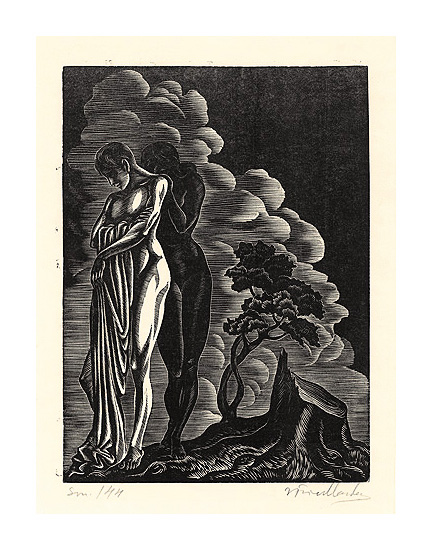
The gorgeous image comes from a wood engraving by Isac Friedlander, circa 1931, created specifically for Sonnet 144.
Sunday Sonnet – 28 June 2015

Sonnet 129

Once again Shakespeare turns the Romantic ideal of a love sonnet on its head, bitterly attacking romantic love in Sonnet 129: a visceral attack against sensual love–an attack, really, against his sensual beloved, The Dark Lady.

129

The expense of spirit in a waste of shame
Is lust in action; and till action, lust
Is perjured, murderous, bloody, full of blame,
Savage, extreme, rude, cruel, not to trust,
Enjoy’d no sooner but despised straight,
Past reason hunted, and no sooner had
Past reason hated, as a swallow’d bait
On purpose laid to make the taker mad;
Mad in pursuit and in possession so;
Had, having, and in quest to have, extreme;
A bliss in proof, and proved, a very woe;
Before, a joy proposed; behind, a dream.
All this the world well knows; yet none knows well
To shun the heaven that leads men to this hell.

No, the Dark Lady isn’t mentioned by name or gender in this verse. But 129’s placement in the Dark Lady sequence, between a lovely sonnet where the Poet watches her play on a virginal (#128) and the delightful parody homage to her physically repellent nature (#130), this verse leaves no doubt as to whom it’s about.  

Or, better put, it leaves no doubt as to what it’s about: the luxury of sinful lovemaking. How extreme and crazed human behavior is before sex; how uncontrolled, yet delightful, it is during sex; how regretful it is after.

And please, read this sonnet aloud: its use of repetition, its deliciously ferocious language, the way it skips back and forth in time, all evoke the uncontrolled actions of lovers in the act.   Yet, strangely so, the sonnet remains so impersonal. In the end, the Poet regards what he and she did as only that: an impersonal act.

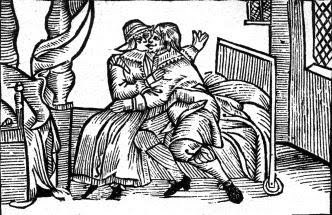
The image is an anonymous woodcut of an Elizabethan couple getting it on in a very unapproved manner: purchased sex in a brothel.

Sunday Sonnet – Summer Solstice – 21 June 2015

Poster produced for the London, Midland & Scottish Railway (LMS) to promote rail travel to Stratford-upon-Avon, Warwickshire, and the LMS Welcombe Hotel, described as 'England's newest country house hotel'. As the birthplace of the playwright William Shakespeare (1564-1616), Stratford-upon-Avon was promoted extensively to the American market. c 1923. Artwork by Warwick Goble, who studied at Westminster School of Art and started out as a lithographer. He exhibited at the Royal Academy and other leading galleries. He illustrated many books and designed posters for the LMS and Great Western Railway (GWR).
Poster produced for the London, Midland & Scottish Railway (LMS) to promote rail travel to Stratford-upon-Avon, Warwickshire, and the LMS Welcombe Hotel, described as ‘England’s newest country house hotel’. As the birthplace of the playwright William Shakespeare (1564-1616), Stratford-upon-Avon was promoted extensively to the American market. c 1923. Artwork by Warwick Goble, who studied at Westminster School of Art and started out as a lithographer. He exhibited at the Royal Academy and other leading galleries. He illustrated many books and designed posters for the LMS and Great Western Railway (GWR).

In celebration of the Summer Solstice this morning, let’s enjoy The Bard’s sonnet famous for its seasons metaphor. Three winters have overcome three summers; and three springs have led to three autumns. It even references June:

104

To me, fair friend, you never can be old,
For as you were when first your eye I eyed,
Such seems your beauty still. Three winters cold
Have from the forests shook three summers’ pride,
Three beauteous springs to yellow autumn turn’d
In process of the seasons have I seen,
Three April perfumes in three hot Junes burn’d,
Since first I saw you fresh, which yet are green.
Ah! yet doth beauty, like a dial-hand,
Steal from his figure and no pace perceived;
So your sweet hue, which methinks still doth stand,
Hath motion and mine eye may be deceived:
For fear of which, hear this, thou age unbred;
Ere you were born was beauty’s summer dead.

Beyond the beauty and cleverness of the metaphorical seasonal changes–and the natural aging that comes with them–Shakespeare tantalizes us with what seems to be a time span of how long he’s known the Young Man. About three years (or, if you’re a numerologist or conspiracy theorist, 9 years or 12 years). And so for those of us who like to hope or believe that the Young Man was an actual person Will Shakespeare knew in real life, this sonnets seems to suggest that when this was written, Will had known his Young Man for three years.

But the important thing about this sonnet is its message, one Shakespeare obsessed over in many of the sonnets and in his plays: time, and how it so slowly steals away youth and beauty:

‘So your sweet hue, which methinks still doth stand,
Hath motion and mine eye may be deceived’

Yet, despite the aging of time, Love can blind us to those changes.

The image comes from a tourism poster for Stratford-upon-Avon (Shakespeare’s birthplace and home town), produced by the Midland and Scottish Railway, circa 1923.

Sunday Sonnet – 24 May 2015

Elizabeth_I_(Armada_Portrait)

Shakespeare’s 154 Sonnets are famous and enduring for many reasons: their beauty; their poetic genius of lyricism and form; their originality and refusal to bend to conventions, whether Elizabethan or modern; the fact that some of them express love for a man, and other express love for an arguably unlovable woman. But what also makes these great are their varied metaphors. One of the most unlikely set are Sonnets 123 and 124, which use the world of politics and state to make their case. 124 is full of politics. 

124

If my dear love were but the child of state,
It might for Fortune’s bastard be unfather’d’
As subject to Time’s love or to Time’s hate,
Weeds among weeds, or flowers with flowers gather’d.
No, it was builded far from accident;
It suffers not in smiling pomp, nor falls
Under the blow of thralled discontent,
Whereto the inviting time our fashion calls:
It fears not policy, that heretic,
Which works on leases of short-number’d hours,
But all alone stands hugely politic,
That it nor grows with heat nor drowns with showers.
To this I witness call the fools of time,
Which die for goodness, who have lived for crime. 

Few of us today are experts in Elizabethan history and politics. Reading this poem simply for its argument–that love is greater than all human-created conventions or ideals–is evident enough. But scholars and historians have, for centuries, tried to parse out all of the specific political references. In the hands of a lesser poet, such references might cripple the work, forever rendering it anachronistic. But with Shakespeare, these references also work in a general sense. Some examples: 

‘were but the child of state’: if you were something created only for profit or power (meaning, but you, dear love, are not)

‘for Fortune’s bastard be unfather’d’: the political world of Europe was littered with bastards of royal birth (meaning, but your love is true born)

‘it suffers not in smiling pomp’; the falseness of Courtly and political life (meaning, but your love shows true)

‘But all alone stands hugely politic’: politics dictate what’s important at the moment (meaning, but your love stands beyond the rage or worry of the moment) 

This sonnet is full of many more examples. 

So even today, any person woefully ignorant of Elizabethan goings-on can listen to or read Shakespeare’s great sonnets and come away with a sense of wonder, enlightenment and the sonnet’s central message: that love conquers time and anything man can build.

The image is of the prevailing head of state for most of Shakespeare’s life, Queen Elizabeth. The artist is uncertain, but what is certain is that this painting was commissioned by the state as political propaganda after Elizabeth’s defeat of the Armanda.  

Sunday Sonnet – 17 May 2015

anne-hathaway2

Today’s installment in the Dark Lady sequence of sonnets is rather an ugly one, and I mean that in more ways than one.

137

Thou blind fool, Love, what dost thou to mine eyes,
That they behold, and see not what they see?
They know what beauty is, see where it lies,
Yet what the best is take the worst to be.
If eyes corrupt by over-partial looks
Be anchor’d in the bay where all men ride,
Why of eyes’ falsehood hast thou forged hooks,
Whereto the judgment of my heart is tied?
Why should my heart think that a several plot
Which my heart knows the wide world’s common place?
Or mine eyes seeing this, say this is not,
To put fair truth upon so foul a face?
In things right true my heart and eyes have erred,
And to this false plague are they now transferr’d.

As Shakespeare did with so many of his sonnets–both to the Young Man and the Dark Lady–he turns the Petrarchan Ideal of Romantic Love on its head: he doesn’t flatter his love, rather he tells her (or him in the case of the Young Man), and the entire world, the truth.

The truth in Sonnet 137 is that the Poet regards the Dark Lady as an unfaithful tramp; yet still he loves her.   Unfortunately, this misogynistic meme had continued to this very day, over four centuries later, in so much of our Blues and Rock ‘n’ Roll. I can forgive Shakespeare for this, since he a) was largely a product of his time and b) he was the first writer in Western Literature to create thoroughly realistic and empathic female characters–especially in his later plays. And so he grew into a kind of gender enlightenment.

But back to Sonnet 137. The Poet uses some entertaining imagery to describe how Love has blinded him to his lady’s faults:

  • ‘Be anchored in the bay were all men ride’: a scathing condemnation of the Dark Lady’s promiscuity.
  • ‘Which my heart knows the wide world’s common place’: that which my heart loves is available to the whole world for the taking.
  • The vicious couplet: ‘In things true my heart and eyes have erred, / And to this false plague are they now transferred’: My eyes and heart have been fooled; for they love a lying and diseased woman.

So the next time your lover betrays you (be they male, female, the same gender as you or different), instead of sending them a Sam Smith song, send them this sonnet.

The image is reputed to be of Shakespeare’s wife, Anne Hathaway (though we can never really know), whom Shakespeare probably betrayed often. But back in those days, outside the realm of Petrarchan poetry, marriages were more of a practical contract than any kind of romantic or sexual hook-up.

Sunday Sonnet – 26 April 2015

courthouse

Today a sonnet to friendship seems appropriate to me because this weekend I’m briefly seeing a lot of friends I seldom get to visit.   Part of the Young Man sequence of sonnets, this beautiful poem speaks to the melancholy of departed friends, and the memories you take with you:

30

When to the sessions of sweet silent thought
I summon up remembrance of things past,
I sigh the lack of many a thing I sought,
And with old woes new wail my dear time’s waste:
Then can I drown an eye, unused to flow,
For precious friends hid in death’s dateless night,
And weep afresh love’s long since cancell’d woe,
And moan the expense of many a vanish’d sight:
Then can I grieve at grievances foregone,
And heavily from woe to woe tell o’er
The sad account of fore-bemoaned moan,
Which I new pay as if not paid before.
But if the while I think on thee, dear friend,
All losses are restored and sorrows end. 

One of the remarkable things about this poem it its use of Elizabethan courtroom language: ‘Sessions’; ‘cancell’d’; ‘expense’; ‘grievances’; ‘account’; ‘pay’ and ‘paid’; ‘losses are restored’. The love for separated friends and courtroom lingo don’t seem an obvious match, but Shakespeare makes it work.

Lost chances, lost friends, the death of friends or loved ones brings the Poet to tears. However, all he has to do is think upon his dear friend–in this case the Young Man–and all his sorrows end. 

Finally, ‘remembrance of things past’ from the gorgeous pair of opening lines is a phrase made famous by the translated English title of Proust’s 20th century classic novel.   

The image is of the Hawkshead Courthouse in the Lake District, an example of what many courthouses might have looked like in the time of Shakespeare.

Sunday Sonnet – 12 April 2015

gunshots

Medical care in Elizabethan times was a regular horror show. Your treatment–if you were unlucky enough to survive long enough to receive care–might come from a physician, a surgeon or an apothecary, depending on the ailment. I call number 147 Shakespeare’s ‘Medical Sonnet.’ The Poet longs to break away from the Dark Lady, but his lust resists all powers of reason. Lust is his fever, and reason is the physician; one has left in lieu of the other. 

147

My love is as a fever, longing still
For that which longer nurseth the disease,
Feeding on that which doth preserve the ill,
The uncertain sickly appetite to please.
My reason, the physician to my love,
Angry that his prescriptions are not kept,
Hath left me, and I desperate now approve
Desire is death, which physic did except.
Past cure I am, now reason is past care,
And frantic-mad with evermore unrest;
My thoughts and my discourse as madmen’s are,
At random from the truth vainly express’d;
For I have sworn thee fair and thought thee bright,
Who art as black as hell, as dark as night. 

The Poet has ignored reason, and so good sense–his physician–has left him: ‘Angry that his prescriptions are not kept, Hath left me.’ The Poet longs for death, but this disease won’t quite kill him: “Desire is death, which physic did except. Finally, the Poet is past the point of caring: “Past cure I am, now reason is past care.’ 

As if this wonderfully intricate metaphor weren’t enough, Sonnet 147 ends with one of the most delicious couplets ever: 

For I have sworn thee fair and thought thee bright,
Who art as black as hell, as dark as night. 

Finally, the opening: ‘My love is like a fever.’ Rock ‘n’ rollers to this very day have used this metaphor–so worn out we can no longer stand it. Shakespeare invented it.   

The image comes from the cover of a French book on the treatment of battle wounds, printed in Shakespeare’s time.

Sunday Sonnet – 5 April 2015

Startford

When does Easter fall every year? The simplest explanation is that it’s always on the Sunday after the first Full Moon after the Spring Equinox, though this hasn’t always been the case. The point is that the Early Church Fathers wanted to approximate the timing of Easter to match the of year they imagined the first one occurred on. Anyhow, tying the lives of people to the cycles of Nature–that’s what today’s sonnet is all about: 

5

Those hours, that with gentle work did frame

The lovely gaze where every eye doth dwell,

Will play the tyrants to the very same

And that unfair which fairly doth excel;

For never-resting time leads summer on

To hideous winter, and confounds him there;

Sap checked with frost, and lusty leaves quite gone,

Beauty o’er-snowed and bareness every where:

Then were not summer’s distillation left,

A liquid prisoner pent in walls of glass,

Beauty’s effect with beauty were bereft,

Nor it, nor no remembrance what it was:

   But flowers distilled, though they with winter meet,

   Leese but their show; their substance still lives sweet. 

I believe this sonnet is best enjoyed for its wonderful extended metaphor, and not for its lame argument. Its argument is that Poet’s beautiful Young Man should procreate in order to preserve the ‘summer’s distillation’ of his physical beauty so that in the face of hideous winter, something is left. But what’s really lovely is how Shakespeare ties in the progression of human life through the seasons and how they all relate to one another. Especially flowers, that wilt once winter comes, but remain memorable because of the perfume there were used to create: 

   But flowers distilled, though they with winter meet,

   Leese but their show; their substance still lives sweet. 

What I most like in this sonnet are the lines: ‘For never-resting time leads summer on / To hideous winter, and confounds him there.’ A wise warning to us all to cherish and embrace the ones you love, especially on a day like today. 

The image is from my visit a few years ago to Stratford-upon-Avon on a very spring-like rainy day. This is leading up to entrance of Holy Trinity Church, where William Shakespeare is buried.

Sunday Sonnet – 29 March 2015

Aemilia-Lanyer

With freezing rain pelting the countryside, today seems a good time for masochistic verse. Shakespeare’s Dark Lady Sonnet 141 enumerates all the faults of his lady love–her looks, her personality and even his own sin of nonetheless loving her: 

141

In faith, I do not love thee with mine eyes,
For they in thee a thousand errors note;
But ’tis my heart that loves what they despise,
Who in despite of view is pleased to dote;
Nor are mine ears with thy tongue’s tune delighted,
Nor tender feeling, to base touches prone,
Nor taste, nor smell, desire to be invited
To any sensual feast with thee alone:
But my five wits nor my five senses can
Dissuade one foolish heart from serving thee,
Who leaves unsway’d the likeness of a man,
Thy proud hearts slave and vassal wretch to be:
Only my plague thus far I count my gain,
That she that makes me sin awards me pain. 

Sonnets of Shakespeare’s time where largely written following the ‘Petrarchan Ideal’ of love–that is, that the object of your lovely sonnet should be a be chaste, beautiful aristocratic woman whom the Poet can never hope to posses. Shakespeare says the hell with that. 

Quite the opposite, the Dark Lady is not pleasant in appearance–‘I do not love thee with mine eyes, For they in thee a thousand errors note’; her voice is hardly pleasing–‘Nor are mine ears with thy tongue’s tune delighted’; and physical contact, even sexual, is not hot–‘Nor tender feeling, to base touches prone.’ 

However, despite all this or even the Poet’s own good sense, The Dark Lady still owns the Poet’s heart: ‘But my five wits nor my five senses can Dissuade one foolish heart from serving thee.’

Don’t choose this poem to read at Nuptials or to give to your beloved. 

The image is of Aemilia Lanier, an Elizabethan poet who supposedly had an affair with William Shakespeare. Some people believe she might’ve been the Dark Lady of the Sonnets. There’s scant evidence of this, and there’s even doubt this painting is her. Lanier was a woman who dared to publish a book of verse in Shakespeare’s time, so there aren’t many records left. She was a woman, after all, and except for obsessive and progressive minds like Mr. Shakespeare, Elizabethans didn’t much trouble themselves writing about real women, unless they could fit them into something like the ridiculous notion of the Petrarchan Ideal. Or if she was Queen.

Sunday Sonnet – 22 March 2015

RomeoJuliet

According to the movement of planets–that is, the Vernal Equinox–it’s supposed to be Spring. But in my particular part of the country, snow is coming this evening. So for today I’ve chosen a sonnet that bemoans the many common-day misfortunes that can befall any of us–and what the cure for that misfortune is.

29

When, in disgrace with fortune and men’s eyes,
I all alone beweep my outcast state
And trouble deaf heaven with my bootless cries
And look upon myself and curse my fate,
Wishing me like to one more rich in hope,
Featured like him, like him with friends possess’d,
Desiring this man’s art and that man’s scope,
With what I most enjoy contented least;
Yet in these thoughts myself almost despising,
Haply I think on thee, and then my state,
Like to the lark at break of day arising
From sullen earth, sings hymns at heaven’s gate;
For thy sweet love remember’d such wealth brings
That then I scorn to change my state with kings.

The Poet curses his bad fate, looking at others more fortunate than him, people with friends, art, possessions: “with friends possess’d, Desiring this man’s art and that man’s scope.” He even believes any prayers to God are falling on deaf ears: “And trouble deaf heaven with my bootless cries.” It almost seems the Poet is treading very close to apostasy here. But even in the Elizabethan era of a state-sanctioned religion and compulsory church attendance, I’m sure many, many people felt their constant prayers did no good.   Another example of Shakespeare’s ability to speak to the Everyman in each of us, and doing it without quite crossing the line.

In the end, Sonnet 29 holds a lesson for us, applicable even four centuries later: the love of your life can make you feel so wealthy, you wouldn’t trade him or her for being a king. This nice couplet turns it all around:

For thy sweet love remember’d such wealth brings
That then I scorn to change my state with kings.

So today, if things don’t go right–or if snow is coming to bury your sprouting irises and tulips, turn to that special person who loves you more than anything: that is the greatest treasure on Earth.

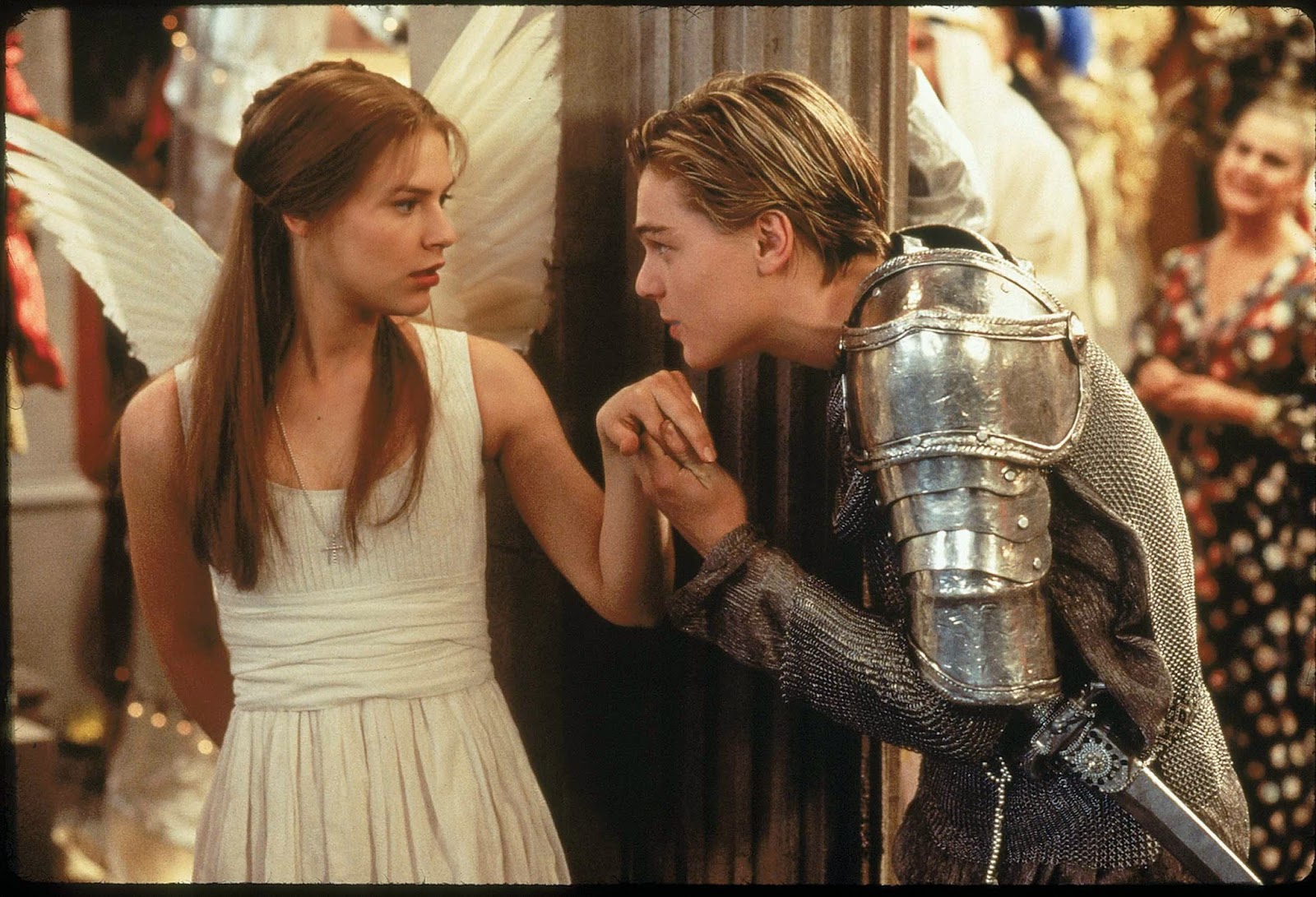
The image comes from the 1996 movie Romeo + Juliet, with Claire Danes and Leo DiCaprio, a good example of true love in the midst of growing troubles.