Sunday Sonnet – 06 Sep 2015

George_Chapman

Shakespeare’s 154 Sonnets create a narrative with a number of characters: the Poet himself, the Young Man and the Dark Lady. Well, there’s another character, in a sequence of eight sonnets–the ‘Rival Poet’–another writer vying for the favor of the Young Man. This contest for the attentions of the Young Man (possibly the Earl of Southampton), begins with Sonnet 79:

79

Whilst I alone did call upon thy aid,
My verse alone had all thy gentle grace,
But now my gracious numbers are decay’d
And my sick Muse doth give another place.
I grant, sweet love, thy lovely argument
Deserves the travail of a worthier pen,
Yet what of thee thy poet doth invent
He robs thee of and pays it thee again.
He lends thee virtue and he stole that word
From thy behavior; beauty doth he give
And found it in thy cheek; he can afford
No praise to thee but what in thee doth live.
Then thank him not for that which he doth say,
Since what he owes thee thou thyself dost pay.

For this first ‘Rival Poet’ sonnet, the only thing Shakespeare’s really arguing are words, that is verse, and through the tangled layers of this sonnet Shakespeare claims that for a long time only his verse received the benefit of the Young Man’s ‘gentle grace.’ Yet Shakespeare admits that maybe his verse is not as good as it used to be: ‘my gracious numbers are decay’d / And my sick Muse…’ And so Shakespeare admits the Young Man deserves a better poet. That said, Shakespeare then goes on to claim that this new rival only steals from the Young Man; his verses might lend the Young Man virtue, but the rival only learned virtue from the Young Man himself: ‘No praise to thee but what in thee doth live.’ The same with beauty. In other words, don’t thank this rival poet for his flattery, because he’s stolen it all from you.

I’ve said this in my blog before, and I’ll say it again: these characters, the layered progressions of the relationships, the risqué nature of the love affairs (risqué for Elizabethan times), that is, the homosexual love affair, the love triangles, the interracial couplings: all these fly in the face what Elizabethans considered Romantic Love should be in poetry. So this somewhat subversive set of verse all speaks to the possibility of autobiography. And finally, though Shakespeare himself published other major works of verse to great acclaim, he never published his Sonnets. Why not?

Who was the Rival Poet? Possibly the poet George Chapman, or possibly even Christopher Marlowe.   Possibly others. We’ll never know, assuming these sonnets were even inspired by a real human beings.

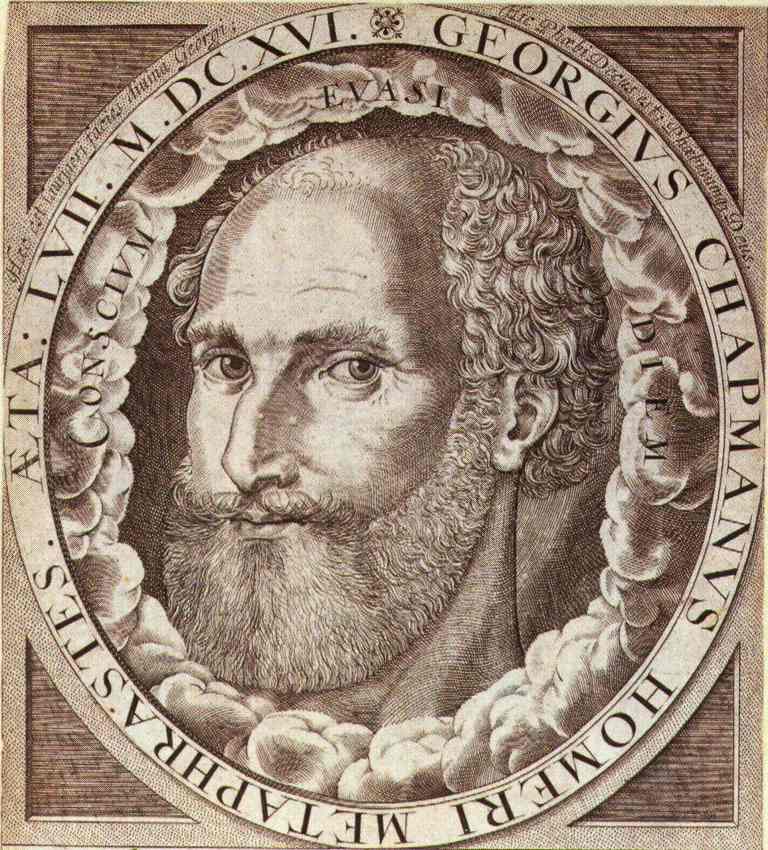
The image is of George Chapman, an Elizabethan dramatist, writer and poet. He, like Shakespeare, knew the Earl of Southampton. Chapman translated a lot of Ovid’s works; Ovid’s Metamorphoses was one of Shakespeare’s favorite sources for his plays. Chapman, unlike Shakespeare, never could find patrons or great success, and died in poverty.

Friday Poe Quote – 04 Sep 2015

city in the sea - 1

‘The City in the Sea’ is another gloomy gothic verse from Poe, this one possibly inspired by another Romantic poet, Samuel Taylor Coleridge, and his masterpiece, ‘Kubla Khan’.

Lo! Death has reared himself a throne

In a strange city lying alone

Far down within the dim West,

Where the good and the bad and the worst and the best

Have gone to their eternal rest.

There shrines and palaces and towers

(Time-eaten towers that tremble not!)

Resemble nothing that is ours.

Around, by lifting winds forgot,

Resignedly beneath the sky

The melancholy waters lie.

No rays from the holy heaven come down

On the long night-time of that town;

But light from out the lurid sea

Streams up the turrets silently —

Gleams up the pinnacles far and free —

Up domes — up spires — up kingly halls —

Up fanes — up Babylon-like walls —

Up shadowy long-forgotten bowers

Of sculptured ivy and stone flowers —

Up many and many a marvelous shrine

Whose wreathéd friezes intertwine

The viol, the violet, and the vine.

So blend the turrets and shadows there

That all seem pendulous in the air,

While from a proud tower in the town

Death looks gigantically down.

There open fanes and gaping graves

Yawn level with the luminous waves;

But not the riches there that lie

In each idol’s diamond eye —

Not the gaily-jeweled dead

Tempt the waters from their bed;

For no ripples curl, alas!

Along that wilderness of glass —

No swellings tell that winds may be

Upon some far-off happier sea —

No heavings hint that winds have been

On seas less hideously serene.

But lo, a stir is in the air!

The wave — there is a movement there!

As if the towers had thrust aside,

In slightly sinking, the dull tide —

As if their tops had feebly given

A void within the filmy Heaven.

The waves have now a redder glow —

The hours are breathing faint and low —

And when, amid no earthly moans,

Down, down that town shall settle hence,

Hell, rising from a thousand thrones,

Shall do it reverence.

This atmospheric verse was published in 1845, though it did exist in earlier versions. There are no actual characters in this poem, except for Death itself, but this poem still follows some of the major tropes of Poe’s brand of Gothic fiction: the decay of the aristocracy, death and madness. It’s an easy read, and when read aloud it’s pleasing to the ear, which is interesting, since the poem contains no descriptions of any kind of sound: the city is silent, like the dead. I think the elevated language is intentional, giving the poem a feeling of antiquity.

The image is a photograph I took of the sun setting into the western Pacific. Poe possibly set his mysterious city to the west, because the setting sun was often associated with the end of life–something Poe obsessed over.

Hump Day Shakespearean Quote – 02 Sep 2015

othello

This coming weekend I’ll be fortunate enough to visit one of the Midwest’s premiere Shakespeare venues, American Players Theatre, in the deep woods of Southern Wisconsin. They’ll be performing the classic tragedy, Othello.

OTHELLO:

Soft you; a word or two before you go.

I have done the state some service, and they know’t.

No more of that. I pray you, in your letters,

When you shall these unlucky deeds relate,

Speak of me as I am; nothing extenuate,

Nor set down aught in malice: then must you speak

Of one that loved not wisely but too well;

Of one not easily jealous, but being wrought

Perplex’d in the extreme; of one whose hand,

Like the base Indian, threw a pearl away

Richer than all his tribe; of one whose subdued eyes,

Albeit unused to the melting mood,

Drop tears as fast as the Arabian trees

Their medicinal gum. Set you down this;

And say besides, that in Aleppo once,

Where a malignant and a turban’d Turk

Beat a Venetian and traduced the state,

I took by the throat the circumcised dog,

And smote him, thus.

[Stabs himself]

Othello, Act V, Scene ii

Here Othello writes his own epitaph. At this point in the play, all has been revealed: Iago’s murderous plot of revenge, tricking Othello into murdering his innocent wife, Desdemona. In his last speech, Othello eloquently confesses that he loved well, but was unwise; was not prone to jealousy, but when driven to it, pursued it to its last degree; and that he held the most precious thing in the world only to foolishly cast it away.

His final couplet, after stabbing himself, is to kiss the dead Desdemona with these words:

I kissed thee ere I killed thee. No way but this,

Killing myself, do die upon a kiss.

Othello was written in about 1604, just a few years after the triumphant tragedy of Hamlet, and began Shakespeare’s run of shockingly brilliant tragedies, including King Lear, Macbeth and Antony and Cleopatra. Iago the villain of Othello, is considered to be the epitome of evil in western literature, and even in its day, Othello was powerfully provocative. Elizabethans were frightfully racist, and yet Shakespeare dared to make a ‘blackamoor’ the tragic protagonist of his play.

The image comes from the currently running production of Othello at American Players Theatre, with Chike Johnson as Othello and James Ridge as Iago.

Sunday Sonnet – 16 August 2015

Scotney Castle

One of Shakespeare’s most powerful sonnets boldly asserts that its lines shall conquer death and time, outlasting not only the Young Man and the Poet himself, but even marble monuments, wars, or the besmearing of time.

55

Not marble, nor the gilded monuments
Of princes, shall outlive this powerful rhyme;
But you shall shine more bright in these contents
Than unswept stone besmear’d with sluttish time.
When wasteful war shall statues overturn,
And broils root out the work of masonry,
Nor Mars his sword nor war’s quick fire shall burn
The living record of your memory.
‘Gainst death and all-oblivious enmity
Shall you pace forth; your praise shall still find room
Even in the eyes of all posterity
That wear this world out to the ending doom.
So, till the judgment that yourself arise,
You live in this, and dwell in lover’s eyes.

Ostensibly this poem was written to the Young Man, but it’s really about the enduring power of the written word, the most indelible form of Art–resistant to the ravages of war and the slow degradation of ‘sluttish’ time (the Elizabethan use of the word sluttish meaning messy or untidy).

So many great details and contrasts in this sonnet: how wars broil out the work of masonry, and how that power is godlike in its ferocity and speed (Mars’ sword); how gilded monuments and princes can’t outlive rhymes. It’s all kind of crazy, but, as it turns out, utterly true.: Did this verse conquer death and time? For four hundred years it has.  

Of course, there are untold amounts of literature, written history and poetry that have been lost to the ages.   Despite that, the Poet makes this bold prediction about his own verse. Could Shakespeare somehow had an inkling at how great his rhymes were? Did he imagine that succeeding generations would labor to reproduce these lines many countless of times, thereby insuring them against loss?   I think he believed the possibility existed. And thus he worked very hard to make his sonnets gorgeous, multifaceted and full of great truths.

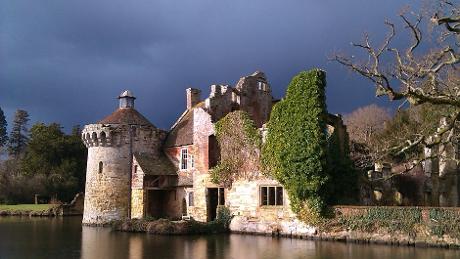
The image is of Scotney Castle, much of it Elizabethan, part of it in ruins.   It’s now run by the National Trust.     

Midweek Shakespearean Quote – 12 August 2015

Kenneth Albers and Susan Shunk, The Tempest, 2011.

It’s been a beautiful summer here in Southern Wisconsin. Such delightful, gentle days bring to mind a snippet of verse from The Tempest, where the forces of Nature, including Prospero’s magical island, almost act as one of the characters. Caliban and Ariel, both preternatural creatures, are manifestations of that island, and in the opening of the final act, Ariel sings a song:

Where the bee sucks, there suck I:

In a cowslip’s bell I lie;

There I couch when owls do cry.

On the bat’s back I do fly

After summer merrily.  

Merrily, merrily shall I live now

Under the blossom that hangs on the bough.

–The Tempest, Act V, Scene i

And why shouldn’t Ariel sing? For it’s in this scene that Prospero promises Ariel her freedom after decades of servitude the Prospero the Sorcerer.  

The image comes from Southern Wisconsin’s very own American Players Theatre, with Susan Shunk as Ariel and Kenneth Albers as Propsero from the troupe’s 2011 production of The Tempest.

Sunday Sonnet – 09 August 2015

tudor rose

One of the many mysteries of Shakespeare’s personal life is how did he acquire all the vast areas of expertise needed to write about so many characters and so many avocations? For example, his knowledge of horticulture, herbalism and botany are evident in many of his plays (think of A Midsummer Night’s Dream). We really don’t know for sure where Shakespeare learned all this–though there a bunch of ‘missing years’ from his youth.

In Sonnet 54, Shakespeare utilizes this knowledge of botany to create a complicated metaphor, where he likens the beauty in his Young Man to a rose’s beauty, which is both outer and inner. Elizabethans extracted perfume from roses. However, canker-blooms were also visually beautiful, but unlike roses, contained no lovely scent. And so here comes a life lesson: When looking for beauty in others, don’t just look for the outer beauty:

54

O, how much more doth beauty beauteous seem
By that sweet ornament which truth doth give!
The rose looks fair, but fairer we it deem
For that sweet odour which doth in it live.
The canker-blooms have full as deep a dye
As the perfumed tincture of the roses,
Hang on such thorns and play as wantonly
When summer’s breath their masked buds discloses:
But, for their virtue only is their show,
They live unwoo’d and unrespected fade,
Die to themselves. Sweet roses do not so;
Of their sweet deaths are sweetest odours made:
And so of you, beauteous and lovely youth,
When that shall fade, my verse distills your truth.

As complicated and delicate as this construction is, Shakespeare’s rose metaphor extends beyond a mere characterization of his Young Man’s beauty: Shakespeare means to liken his rose to the Art of poetry too. The inner-sweetness of the rose can only be enjoyed because perfumers distill it; likewise does the Poet distill his Young Man’s beauty into the lines of this sonnet. Already, it’s lasted for over four hundred years.

The image is of the Tudor Rose, one of Queen Elizabeth’s royal symbols, for she was of the House of Tudor.

Sunday Sonnet – 02 August 2015

300px-Adonis_Mazarin_Louvre_MR239

Shakespeare was no stranger to hyperbole, and in sonnet 106 he goes all the way, to the point of being ridiculous. But the language is so beautiful, and the imagery is so straight forward and accessible. that for a moment the reader might find her or himself swept up by the main argument: that the Young Man’s beauty is so great, even Art cannot capture his beauty:

106

When in the chronicle of wasted time
I see descriptions of the fairest wights,
And beauty making beautiful old rhyme
In praise of ladies dead and lovely knights,
Then, in the blazon of sweet beauty’s best,
Of hand, of foot, of lip, of eye, of brow,
I see their antique pen would have express’d
Even such a beauty as you master now.
So all their praises are but prophecies
Of this our time, all you prefiguring;
And, for they look’d but with divining eyes,
They had not skill enough your worth to sing:
For we, which now behold these present days,
Had eyes to wonder, but lack tongues to praise.

Could this Elizabethan Young Man have been so beautiful that even the ancients couldn’t capture him? Hardly likely. Yet Sonnet 106 declares ‘They had not skill enough your worth to sing.’   Crazy. And then Shakespeare–who in other sonnets has suggested this his verses will live on forever–admits that even present day poets cannot capture the Young Man’s beauty:

For we, which now behold these present days,
Had eyes to wonder, but lack tongues to praise.

There’s a coy lie in all this, for the Poet has made plainly obvious in many other sonnets that it’s only in Art, and in the lines of immortal verses that real beauty can be preserved. But you see, the 154 Sonnets taken as a whole form a narrative; and that story is the map of the human heart, which is ever fickle, ever changing.

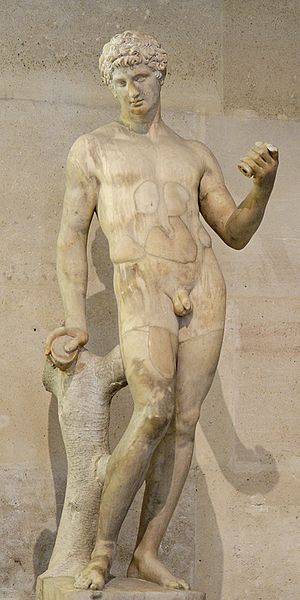
The image is of how the Greeks attempted to capture the image of male beauty: an ancient statue of Adonis, the Greek god of Love, currently in the Louvre. Who better captures youthful beauty–the ancient Greek sculptors or Mr. Shakespeare, our Elizabethan poet?

Weekly Shakespeare Quote – 30 July 2015

hamlet-ghost-

One of all my all time favorite Shakespeare speeches is pretty kick-ass, and plays wonderfully even today, 400 years later. It’s a speech actors love to sink their teeth into (it’s not a true monologue since there’s some interjections from another character, and it’s not a soliloquy, but it’s still a hell of a thing). And more than its marvelous theme, it tells a great story, acting as the springboard to Hamlet’s madness. Yes, it’s the Ghost, Hamlet’s slain father, recounting his tale of woe, speaking from the depths of purgatorial torment. It’s long, but delicious.

GHOST:

I am thy father’s spirit,

Doomed for a certain term to walk the night,

And for the day confined to fast in fires,

Till the foul crimes done in my days of nature

Are burnt and purged away. But that I am forbid

To tell the secrets of my prison house,

I could a tale unfold whose lightest word

Would harrow up thy soul, freeze thy young blood,

Make thy two eyes like stars start from their spheres,

Thy knotted and combinèd locks to part,

And each particular hair to stand an end

Like quills upon the fretful porpentine.

But this eternal blazon must not be

To ears of flesh and blood. List, list, O, list!

If thou didst ever thy dear father love–

HAMLET:

Oh God!

GHOST:

Revenge his foul and most unnatural murder–

HAMLET:

Murder!

GHOST:

Murder most foul as in the best it is;

But this most foul, strange and unnatural.

HAMLET:

Haste me to know’t, that I, with wings as swift

As meditation or the thoughts of love,

May sweep to my revenge.

GHOST:

I find thee apt;

And duller shouldst thou be than the fat weed

That roots itself in ease on Lethe wharf,

Wouldst thou not stir in this. Now, Hamlet, hear:

‘Tis given out that, sleeping in my orchard,

A serpent stung me. So the whole ear of Denmark

Is by a forgèd process of my death

Rankly abused. But know, thou noble youth,

The serpent that did sting thy father’s life

Now wears his crown.

HAMLET:

O my prophetic soul! My uncle!

GHOST:

Ay, that incestuous, that adulterous beast,

With witchcraft of his wit, with traiterous gifts–

O wicked wit and gifts, that have the power

So to seduce! — won to his shameful lust

The will of my most seeming-virtuous queen.

O Hamlet, what a falling-off was there,

From me, whose love was of that dignity

That it went hand in hand even with the vow

I made to her in marriage, and to decline

Upon a wretch whose natural gifts were poor

To those of mine!

But virtue, as it never will be moved,

Though lewdness court it in a shape of heaven,

So lust, though to a radiant angel linked,

Will sate itself in a celestial bed

And prey on garbage.

But soft, methinks I scent the morning air.

Brief let me be. Sleeping within my orchard,

My custom always of the afternoon,

Upon my secure hour thy uncle stole

With juice of cursed hebona in a vial,

And in the porches of my ears did pour

The leperous distilment, whose effect

Holds such an enmity with blood of man

That swift as quicksilver it courses through

The natural gates and alleys of the body,

And with a sudden vigor it doth posset

And curd, like eager droppings into milk,

The thin and wholesome blood. So did it mine,

And a most instant tetter barked about

Most lazar-like with vile and loathsome crust

All my smooth body.

Thus was I sleeping by a brother’s hand

Of life, of crown, of queen at once dispatched,

Cut off even in the blossoms of my sin,

Unhouseled, disappointed, unaneled,

No reck’ning made, but sent to my account

With all my imperfections on my head.

O, horrible! O, horrible! most horrible!

If thou hast nature in thee, bear it not.

Let not the royal bed of Denmark be

A couch for luxury and damnèd incest.

But howsomever thou pursues this act,

Taint not thy mind, nor let thy soul contrive

Against thy mother aught. Leave her to heaven

And to those thorns that in her bosom lodge

To prick and sting her. Fare thee well at once.

The glowworm shows the matin to be near

And gins to pale his uneffectual fire.

Adieu, adieu, adieu. Remember me.

Hamlet, Act I, Scene v

Regret, love, betrayal, murder, incest, suffering and a longing for redemption. Who could ask for more?

Here’s the other evocative thing about this speech: Our best scholarly evidence tells us that Shakespeare was primarily a playwright and not a player–that he didn’t play the leads in his plays. But there’s strong evidence that Shakespeare did play the Ghost in Hamlet’s premiere at the Globe Theatre. Imagine these inspired words issuing from the lips of the Bard himself…

The image is of Brian Blessed playing the Ghost in Kenneth Branagh’s 1996 film of Hamlet.

Sunday Sonnet – 26 July 2015

Syphilis

Shakespeare ends the most magnificent collection of sonnets ever written in the English language with a warning about venereal disease. How romantic.

154

The little Love-god lying once asleep
Laid by his side his heart-inflaming brand,
Whilst many nymphs that vow’d chaste life to keep
Came tripping by; but in her maiden hand
The fairest votary took up that fire
Which many legions of true hearts had warm’d;
And so the general of hot desire
Was sleeping by a virgin hand disarm’d.
This brand she quenched in a cool well by,
Which from Love’s fire took heat perpetual,
Growing a bath and healthful remedy
For men diseased; but I, my mistress’ thrall,
Came there for cure, and this by that I prove,
Love’s fire heats water, water cools not love.

Cupid’s love torch (phallic symbol) burns just a bit too hot. Diana’s nymphs (she was the virgin goddess of the hunt) try to cool its heat in a nearby spring (fertility symbol). It heats up the pool so much, that now those waters can cure diseased men! The is for men diseased with the maladies of love, namely syphilis. And so the Poet, having caught that venereal disease from his mistress, goes into the hot waters to be cured. What does the Poet learn? The cure hasn’t cured his ardor for the woman who put him there.

This closing sonnet is a companion piece to the previous sonnet, #153, which also talks about syphilis and the Elizabethan cure for the disease–a rather dangerous and painful process involving inhaling mercury vapors in searing baths.

There has been a lot of scholarly argument regarding these two Cupid/hot bath/VD sonnets, and their connections to the two previous narratives–the Young Man Sonnets, and the Dark Lady Sonnets. I think they’re connected to both, and serve as an ironical denouement to this love triangle. Pervious verses show that the Young Man and the Dark Lady do intersect, and they both betray the Poet. So how better to end this winding narrative–so elusive, so full of unanswered questions, so contrary to the accepted poetic notions of Romantic Love–than to have the Poet come down with VD?

Rumors abound in scholarly circles that Shakespeare himself might have had syphilis. It’s impossible to ever know. Regardless, he certainly knew of it.

The image is from an anonymous woodcut, circa 1500, of a physician treating syphilis.

Friday’s Dreamy Poe Quote – 17 July 2015

Poe painting

This dreary but beautiful little verse, ‘Alone’, could almost be Poe’s autobiography.  

From childhood’s hour I have not been

As others were—I have not seen

As others saw—I could not bring

My passions from a common spring—

From the same source I have not taken

My sorrow—I could not awaken

My heart to joy at the same tone—

And all I lov’d—I lov’d alone—

Then—in my childhood—in the dawn

Of a most stormy life—was drawn

From ev’ry depth of good and ill

The mystery which binds me still—

From the torrent, or the fountain—

From the red cliff of the mountain—

From the sun that ’round me roll’d

In its autumn tint of gold—

From the lightning in the sky

As it pass’d me flying by—

From the thunder, and the storm—

And the cloud that took the form

(When the rest of Heaven was blue)

Of a demon in my view—

Alas, ‘Alone’ can’t be autobiographical of his later years, for Poe wrote this around 1829, when he was only twenty years old, two decades before his death. So maybe it was prophesy. It seems, though, to speak to Poe’s lifelong inner torment and feeling of isolation. Demons would haunt him throughout his life: poverty, tuberculosis, alcoholism, mental illness.

This little gem lay hidden until long after Poe’s death, when E. L. Didier ‘found it’, gave it its title and published it in 1875. For a time there was doubt as to this poem’s authorship. Scholars have resolved those question. What remains, however, is the mystery behind Poe’s uncanny self-awareness as expressed in this youthful rumination.

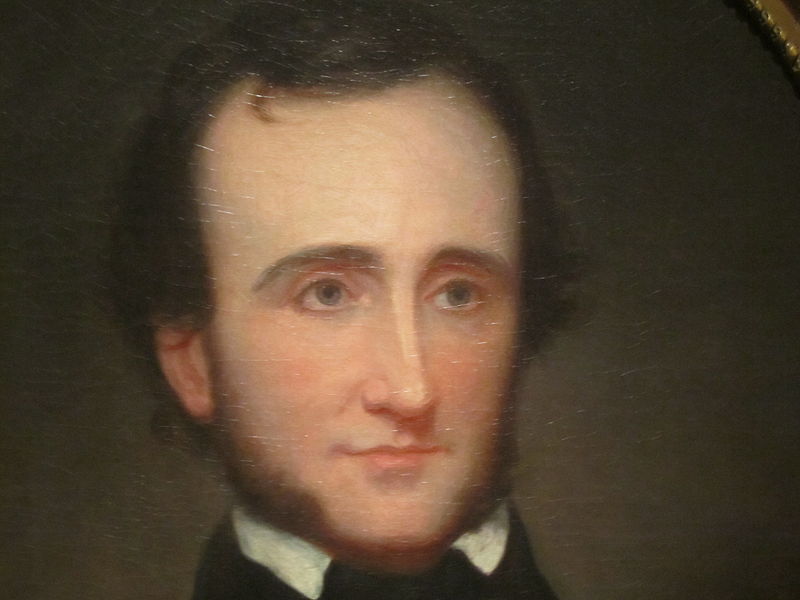
The image is a painting of Poe by Samuel Stillman Osgood, circa 1845. This idealized representation perhaps gives a hint of what Poe might’ve looked like in his youth, before he began to pose for all those wonderful daguerreotypes of the now iconic insane Romantic genius.