Hump Day Shakespearean Quote – 18 February 2015

Othelloiagomovie

Shakespeare understood jealousy, the primary driving force behind his play Othello. It’s a common belief that the motivations of Iago, one of the all-time great villains, are never revealed and that he acts without impetus. Not true. Iago’s lust to destroy Desdemona and Othello never goes on grand display, but in Act II Iago’s soliloquy sorts out his rage, revealing what sparks his hate for Othello and in that, discovers the tool of his revenge: Jealousy.

That Cassio loves her, I do well believe it;

That she loves him, ’tis apt and of great credit:

The Moor, howbeit that I endure him not,

Is of a constant, loving, noble nature,

And I dare think he’ll prove to Desdemona

A most dear husband. Now, I do love her too;

Not out of absolute lust, though peradventure

I stand accountant for as great a sin,

But partly led to diet my revenge,

For that I do suspect the lusty Moor

Hath leap’d into my seat; the thought whereof

Doth, like a poisonous mineral, gnaw my inwards;

And nothing can or shall content my soul

Till I am even’d with him, wife for wife,

Or failing so, yet that I put the Moor

At least into a jealousy so strong

That judgment cannot cure. Which thing to do,

If this poor trash of Venice, whom I trash

For his quick hunting, stand the putting on,

I’ll have our Michael Cassio on the hip,

Abuse him to the Moor in the rank garb—

For I fear Cassio with my night-cap too—

Make the Moor thank me, love me and reward me.

For making him egregiously an ass

And practising upon his peace and quiet

Even to madness. ‘Tis here, but yet confused:

Knavery’s plain face is never seen tin used. 

Othello, Act II scene i 

It appears Othello may have once slept with Iago’s wife! ‘For that I do suspect the lusty Moor Hath leap’d into my seat’. That’s Elizabethan for ‘he had sex with my wife.’ Iago cinches it with ‘Till I am even’d with him, wife for wife’. 

Iago will turn that jealousy into a tool.   In this speech the conniving bastards figures it out: ‘that I put the Moor At least into a jealousy so strong That judgment cannot cure’. 

The plan’s not completely worked out yet, but with Shakespeare’s signatory couplets–that he often used to close a scene–he promises that we’ll get to see it all: ‘but yet confused: Knavery’s plain face is never seen [till] used.’ 

To this very day, soap operas and revenge flicks still owe a kernel of their trashy existence to Shakespeare, and his uncanny insight into human nature. 

The image is of Laurence Fishburne as Othello and Kennath Branagh as Iago in the 1995 film version. Here Iago whispers poison lies into Othello’s ear.

Sunday Sonnet – Valentine’s Day 2015 Special Edition

summers day

This week’s Sunday Sonnet comes a day early in recognition of Valentine’s Day. It already existed with some of its romantic connotations in Shakespeare’s time: Geoffrey Chaucer seems to have helped take the Feast of St. Valentine and color it with some aspects of courtly love. It wasn’t until the 18th century, however, that it really became the day for lovers. And it wasn’t until the 20th century that Hallmark ruined the holiday. But romantic love certainly existed in Shakespeare’s time. Today I’d like to share perhaps one of Shakespeare’s most famous sonnets.

18

Shall I compare thee to a summer’s day?
Thou art more lovely and more temperate:
Rough winds do shake the darling buds of May,
And summer’s lease hath all too short a date;
Sometime too hot the eye of heaven shines,
And often is his gold complexion dimm’d;
And every fair from fair sometime declines,
By chance or nature’s changing course untrimm’d;
But thy eternal summer shall not fade,
Nor lose possession of that fair thou ow’st;
Nor shall Death brag thou wander’st in his shade,
When in eternal lines to time thou grow’st:
So long as men can breathe or eyes can see,
So long lives this, and this gives life to thee.
 

This sonnet is still bandied about today, read at weddings, and was even misappropriated in the popular movie Shakespeare in Love.   Well, if Shakespeare had been love when he wrote this sonnet, he was in love with the Young Man, and not Gwyneth Paltrow. This lovely verse is written by a man to a man. 

But why worry to whom ,or why, this exquisite sonnet was written? Sonnet 18’s gorgeous imagery, multi-leveled language and lush verse speaks universally to undying love, and the power of Art to preserve that love, both the transitory nature of romantic love and the undying ‘eternal summer’ of true love. 

The image is from Shakespeare in Love, of Gwyneth Paltrow as the imaginary Viola and Joseph Fiennes as Shakespeare, living out modern scholarship’s heterosexual fantasy that Shakespeare never wrote any sonnets to a man. In truth, Will was an equal opportunity romantic, doling out magnificent verse to Young Men and Dark Ladies alike.

Friday the 13th Special Maniacal Poe Quote

the-black-cat-1934

I have a tonic for those of you who suffer from triskaidekaphobia–that is, fear of the number 13. What you should fear more is gin-addiction, mental illness and black cats, not some silly number. Edgar A. Poe’s brilliant horror story, “The Black Cat”, illustrates this with guile, craft, voice and lurid prose:   

‘One night, returning home, much intoxicated, from one of my haunts about town, I fancied that the cat avoided my presence. I seized him; when, in his fright at my violence, he inflicted a slight wound upon my hand with his teeth. The fury of a demon instantly possessed me. I knew myself no longer. My original soul seemed, at once, to take its flight from my body and a more than fiendish malevolence, gin-nurtured, thrilled every fibre of my frame. I took from my waistcoat-pocket a pen-knife, opened it, grasped the poor beast by the throat, and deliberately cut one of its eyes from the socket! I blush, I burn, I shudder, while I pen the damnable atrocity.’ 

I can’t even imagine how shocking this must have been to readers in 1843. But what makes this truly great, is that it’s not gratuitous, not the pornography of violence: everything in this brilliant story is carefully crafted: the tight prose; the unreliable narrator; the building tension; the emphatic denunciation of alcoholism disintegrating into a paradoxical embrace of its madness; and the rhetorical brilliance of its shock ending. This is my all time favorite Poe story, and horror and thriller writers have been copying it for more than a century.

The image is a great movie poster from the 1934 movie of The Black Cat, which has virtually nothing to do with the original story.

Hump Day Shakespearean Quote – 11 February 2015

iago

Our modern predilection in popular fiction and film for the anti-hero has its origins back in Elizabethan times. Christopher Marlowe’s The Jew of Malta reveled in villains wreaking havoc on the stage. But it was William Shakespeare who first fleshed out the villainous heart and made it real and visceral. So real and so close to the bone that he gave his greatest villain soliloquys with which to pour out his black soul. I give you Iago:

And what’s he then that says I play the villain,
When this advice is free I give, and honest,
Probal to thinking, and indeed the course
To win the Moor again? For ’tis most easy
Th’ inclining Desdemona to subdue
In any honest suit; she’s framed as fruitful
As the free elements. And then for her
To win the Moor–were’t to renounce his baptism,
All seals and symbols of redeemed sin–
His soul is so enfettered to her love,
That she may make, unmake, do what she list,
Even as her appetite shall play the god
With his weak function. How am I then a villain
To counsel Cassio to this parallel course,
Directly to his good? Divinity of hell!
When devils will the blackest sins put on,
They do suggest at first with heavenly shows,
As I do now. For whiles this honest fool
Plies Desdemona to repair his fortune,
And she for him pleads strongly to the Moor,
I’ll pour this pestilence into his ear:
That she repeals him for her body’s lust;
And by how much she strives to do him good,
She shall undo her credit with the Moor.
So will I turn her virtue into pitch,
And out of her own goodness make the net
That shall enmesh them all. 

Othello, Act II, Scene iii 

Here Iago is boasting about how clever he is. He asks if he really can be the villain if all he’s doing is giving innocent advice to Cassio and Othello. Of course, these are lies he’s planting in their heads, lies that will lead to disastrous and murderous action. Villains love to boast–and this great boast here has been borrowed again and again in popular entertainment up to this very day. Think of it: a Bond villain always boasts of how he’s going to destroy the world, and all of us love to hear the likes of Hannibal Lector lecture us.

There are some great lines in this speech, including my favorite, ‘Divinity of hell! When devils will the blackest sins put on, they do suggest at first with heavenly shows.’

The image is of Kenneth Branagh as the vengeful Iago in the 1995 film version of Othello. The original Shakespeare play is heavily edited for the film, but the language itself remains intact, and contains great performances all around. Watch it or stream it for a delicious treat.

Sunday Sonnet – 08 February 2015

Tennant

The delicious and dark eroticism of the Dark Lady sonnets reaches its peak, I think, in Number 132.   Oh, how the Poet loves and lusts for the Dark Lady, though she doesn’t love him.   That unrequited love is epitomized in Shakespeare’s pun of the words ‘morning’ and ‘mourning.’ And what of the Elizabethan perception of female beauty? Plain and simple, it was misogynistic and racist. Will Shakespeare turns that on its head: for the Poet, black is sublimely beautiful, and this beautiful woman is more powerful than the Poet himself. 

132

Thine eyes I love, and they, as pitying me,
Knowing thy heart torments me with disdain,
Have put on black and loving mourners be,
Looking with pretty ruth upon my pain.
And truly not the morning sun of heaven
Better becomes the grey cheeks of the east,
Nor that full star that ushers in the even
Doth half that glory to the sober west,
As those two mourning eyes become thy face:
O, let it then as well beseem thy heart
To mourn for me, since mourning doth thee grace,
And suit thy pity like in every part.
Then will I swear beauty herself is black
And all they foul that thy complexion lack. 

So odd, so strange that these sonnets were written in the Elizabethan era–the late 1500’s and the very earliest years of the new century. As I’ve said before, Will Shakespeare never published these sonnets–they were printed without his permission. Little wonder. What was going that he should write such dangerous stuff–verses that were surely shocking in their time? 

It all makes me wonder–and believe–that there was more than just imagination behind all the sonnets to the ‘Young Man’ (homoerotic and very much against he the law), and more than imagination behind all the sonnets to this magnificently dark and angry and beautiful ‘Dark Lady.’ 

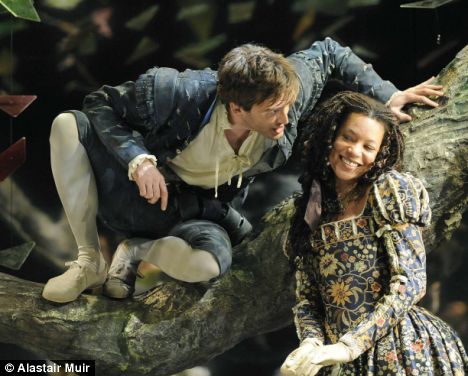
The image is of David Tennant and Nina Sosanya in a Royal Shakespeare Company production of As You Like It. They look lovely together, don’t they? If the Dark Lady sonnets were indeed autobiographical, might there once have been a scene like this played out in Shakespeare’s own life? We’ll never know for certain.

Friday’s Maniacal Poe Quote – 06 February 2015

Poe last dag

Today I’m taking the unusual step of quoting an entire story; the tale Edgar A. Poe is more famous for: ‘The Tell-Tale Heart’ (1843). At only 2210 words, it’s not much beyond the modern fad of flash fiction. This yarn–which I’m sure most of you’ve been forced to read in high school–is a triumph of tension, point of view and voice. A prime example of an unreliable narrator, who through his prose reveals his unreliability (I’m using the male pronoun here–but you might notice that no gender is ever assigned; the mad narrator could just as easily be a woman). It’s an imminently modern story, in that it features so many things so prized in cutting-edge modern fiction: it begins in the heat of the action, and it’s a story devoid of any padding. There’s no excess verbiage.   

Poe, for all his faults, was a visionary, and this story predates the direction fiction would take decades later–more than one hundred sixty years later. And it’s still a delicious delight today. 

The image of Poe is from what is believed to be the last daguerreotype of his life, possibly within a month of his death in 1849.

TRUE! –nervous –very, very dreadfully nervous I had been and am; but why will you say that I am mad? The disease had sharpened my senses –not destroyed –not dulled them. Above all was the sense of hearing acute. I heard all things in the heaven and in the earth. I heard many things in hell. How, then, am I mad? Hearken! and observe how healthily –how calmly I can tell you the whole story.

It is impossible to say how first the idea entered my brain; but once conceived, it haunted me day and night. Object there was none. Passion there was none. I loved the old man. He had never wronged me. He had never given me insult. For his gold I had no desire. I think it was his eye! yes, it was this! He had the eye of a vulture –a pale blue eye, with a film over it. Whenever it fell upon me, my blood ran cold; and so by degrees –very gradually –I made up my mind to take the life of the old man, and thus rid myself of the eye forever.

Now this is the point. You fancy me mad. Madmen know nothing. But you should have seen me. You should have seen how wisely I proceeded –with what caution –with what foresight –with what dissimulation I went to work! I was never kinder to the old man than during the whole week before I killed him. And every night, about midnight, I turned the latch of his door and opened it –oh so gently! And then, when I had made an opening sufficient for my head, I put in a dark lantern, all closed, closed, that no light shone out, and then I thrust in my head. Oh, you would have laughed to see how cunningly I thrust it in! I moved it slowly –very, very slowly, so that I might not disturb the old man’s sleep. It took me an hour to place my whole head within the opening so far that I could see him as he lay upon his bed. Ha! would a madman have been so wise as this, And then, when my head was well in the room, I undid the lantern cautiously-oh, so cautiously –cautiously (for the hinges creaked) –I undid it just so much that a single thin ray fell upon the vulture eye. And this I did for seven long nights –every night just at midnight –but I found the eye always closed; and so it was impossible to do the work; for it was not the old man who vexed me, but his Evil Eye. And every morning, when the day broke, I went boldly into the chamber, and spoke courageously to him, calling him by name in a hearty tone, and inquiring how he has passed the night. So you see he would have been a very profound old man, indeed, to suspect that every night, just at twelve, I looked in upon him while he slept.

Upon the eighth night I was more than usually cautious in opening the door. A watch’s minute hand moves more quickly than did mine. Never before that night had I felt the extent of my own powers –of my sagacity. I could scarcely contain my feelings of triumph. To think that there I was, opening the door, little by little, and he not even to dream of my secret deeds or thoughts. I fairly chuckled at the idea; and perhaps he heard me; for he moved on the bed suddenly, as if startled. Now you may think that I drew back –but no. His room was as black as pitch with the thick darkness, (for the shutters were close fastened, through fear of robbers,) and so I knew that he could not see the opening of the door, and I kept pushing it on steadily, steadily.

I had my head in, and was about to open the lantern, when my thumb slipped upon the tin fastening, and the old man sprang up in bed, crying out –“Who’s there?”

I kept quite still and said nothing. For a whole hour I did not move a muscle, and in the meantime I did not hear him lie down. He was still sitting up in the bed listening; –just as I have done, night after night, hearkening to the death watches in the wall.

Presently I heard a slight groan, and I knew it was the groan of mortal terror. It was not a groan of pain or of grief –oh, no! –it was the low stifled sound that arises from the bottom of the soul when overcharged with awe. I knew the sound well. Many a night, just at midnight, when all the world slept, it has welled up from my own bosom, deepening, with its dreadful echo, the terrors that distracted me. I say I knew it well. I knew what the old man felt, and pitied him, although I chuckled at heart. I knew that he had been lying awake ever since the first slight noise, when he had turned in the bed. His fears had been ever since growing upon him. He had been trying to fancy them causeless, but could not. He had been saying to himself –“It is nothing but the wind in the chimney –it is only a mouse crossing the floor,” or “It is merely a cricket which has made a single chirp.” Yes, he had been trying to comfort himself with these suppositions: but he had found all in vain. All in vain; because Death, in approaching him had stalked with his black shadow before him, and enveloped the victim. And it was the mournful influence of the unperceived shadow that caused him to feel –although he neither saw nor heard –to feel the presence of my head within the room.

When I had waited a long time, very patiently, without hearing him lie down, I resolved to open a little –a very, very little crevice in the lantern. So I opened it –you cannot imagine how stealthily, stealthily –until, at length a simple dim ray, like the thread of the spider, shot from out the crevice and fell full upon the vulture eye.

It was open –wide, wide open –and I grew furious as I gazed upon it. I saw it with perfect distinctness –all a dull blue, with a hideous veil over it that chilled the very marrow in my bones; but I could see nothing else of the old man’s face or person: for I had directed the ray as if by instinct, precisely upon the damned spot.

And have I not told you that what you mistake for madness is but over-acuteness of the sense? –now, I say, there came to my ears a low, dull, quick sound, such as a watch makes when enveloped in cotton. I knew that sound well, too. It was the beating of the old man’s heart. It increased my fury, as the beating of a drum stimulates the soldier into courage.

But even yet I refrained and kept still. I scarcely breathed. I held the lantern motionless. I tried how steadily I could maintain the ray upon the eve. Meantime the hellish tattoo of the heart increased. It grew quicker and quicker, and louder and louder every instant. The old man’s terror must have been extreme! It grew louder, I say, louder every moment! –do you mark me well I have told you that I am nervous: so I am. And now at the dead hour of the night, amid the dreadful silence of that old house, so strange a noise as this excited me to uncontrollable terror. Yet, for some minutes longer I refrained and stood still. But the beating grew louder, louder! I thought the heart must burst. And now a new anxiety seized me –the sound would be heard by a neighbour! The old man’s hour had come! With a loud yell, I threw open the lantern and leaped into the room. He shrieked once –once only. In an instant I dragged him to the floor, and pulled the heavy bed over him. I then smiled gaily, to find the deed so far done. But, for many minutes, the heart beat on with a muffled sound. This, however, did not vex me; it would not be heard through the wall. At length it ceased. The old man was dead. I removed the bed and examined the corpse. Yes, he was stone, stone dead. I placed my hand upon the heart and held it there many minutes. There was no pulsation. He was stone dead. His eve would trouble me no more.

If still you think me mad, you will think so no longer when I describe the wise precautions I took for the concealment of the body. The night waned, and I worked hastily, but in silence. First of all I dismembered the corpse. I cut off the head and the arms and the legs.

I then took up three planks from the flooring of the chamber, and deposited all between the scantlings. I then replaced the boards so cleverly, so cunningly, that no human eye –not even his –could have detected any thing wrong. There was nothing to wash out –no stain of any kind –no blood-spot whatever. I had been too wary for that. A tub had caught all –ha! ha!

When I had made an end of these labors, it was four o’clock –still dark as midnight. As the bell sounded the hour, there came a knocking at the street door. I went down to open it with a light heart, –for what had I now to fear? There entered three men, who introduced themselves, with perfect suavity, as officers of the police. A shriek had been heard by a neighbour during the night; suspicion of foul play had been aroused; information had been lodged at the police office, and they (the officers) had been deputed to search the premises.

I smiled, –for what had I to fear? I bade the gentlemen welcome. The shriek, I said, was my own in a dream. The old man, I mentioned, was absent in the country. I took my visitors all over the house. I bade them search –search well. I led them, at length, to his chamber. I showed them his treasures, secure, undisturbed. In the enthusiasm of my confidence, I brought chairs into the room, and desired them here to rest from their fatigues, while I myself, in the wild audacity of my perfect triumph, placed my own seat upon the very spot beneath which reposed the corpse of the victim.

The officers were satisfied. My manner had convinced them. I was singularly at ease. They sat, and while I answered cheerily, they chatted of familiar things. But, ere long, I felt myself getting pale and wished them gone. My head ached, and I fancied a ringing in my ears: but still they sat and still chatted. The ringing became more distinct: –It continued and became more distinct: I talked more freely to get rid of the feeling: but it continued and gained definiteness –until, at length, I found that the noise was not within my ears.

No doubt I now grew very pale; –but I talked more fluently, and with a heightened voice. Yet the sound increased –and what could I do? It was a low, dull, quick sound –much such a sound as a watch makes when enveloped in cotton. I gasped for breath –and yet the officers heard it not. I talked more quickly –more vehemently; but the noise steadily increased. I arose and argued about trifles, in a high key and with violent gesticulations; but the noise steadily increased. Why would they not be gone? I paced the floor to and fro with heavy strides, as if excited to fury by the observations of the men –but the noise steadily increased. Oh God! what could I do? I foamed –I raved –I swore! I swung the chair upon which I had been sitting, and grated it upon the boards, but the noise arose over all and continually increased. It grew louder –louder –louder! And still the men chatted pleasantly, and smiled. Was it possible they heard not? Almighty God! –no, no! They heard! –they suspected! –they knew! –they were making a mockery of my horror!-this I thought, and this I think. But anything was better than this agony! Anything was more tolerable than this derision! I could bear those hypocritical smiles no longer! I felt that I must scream or die! and now –again! –hark! louder! louder! louder! louder!

“Villains!” I shrieked, “dissemble no more! I admit the deed! –tear up the planks! here, here! –It is the beating of his hideous heart!”


Hump Day Shakespearean Quote – 04 February 2015

gertrude kissing

Queen Gertrude, Hamlet’s mother, had a lot to deal with, not the least of which is her seeming mad son Hamlet speaking to ghosts in her own bedchamber.  

HAMLET

How is it with you, lady? 

GERTRUDE  

Alas, how is’t with you,
That you do bend your eye on vacancy
And with the incorporal air do hold discourse?
Forth at your eyes your spirits wildly peep;
And, as the sleeping soldiers in the alarm,
Your bedded hair, like life in excrements,
Starts up, and stands on end. O gentle son,
Upon the heat and flame of thy distemper
Sprinkle cool patience. Whereon do you look? 

HAMLET

On him, on him! Look you, how pale he glares!
His form and cause conjoin’d, preaching to stones,
Would make them capable. Do not look upon me;
Lest with this piteous action you convert
My stern effects: then what I have to do
Will want true colour; tears perchance for blood.

Gertrude

To whom do you speak this?

Hamlet, Act 3, Scene iv

Ah, ‘that you do bend your eye on vacancy…’   What a lovely line. In so many ways, Gertrude’s little speech is the whole great play writ small. Who was Gertrude, though? Shakespeare never reveals much about her. What’s really important is how Hamlet sees her, and the view through that lens is dark and twisted.

Was Gertrude an adulteress? Complicit in her husband’s murder? Incestuous because she married her dead husband’s brother? All of these accusations are Hamlet’s suspicions, but a close reading of the lines of the play (in all of their various versions) doesn’t conclusively affirm any of these accusations.

I believe Gertrude was an innocent, doing what she had to do for her Kingdom (that is, marry Claudius after her husband the King had died). Her innocence parallels Ophelia’s innocence. They are the only two female speaking roles in the play: and neither are treated well by Hamlet. But can we blame Hamlet? The evil done to his father–like most evils perpetrated in this world–are seeds sown, spreading calamity (which brings to mind a great line by Hamlet in another scene, ‘Tis an unweeded garden That grows to seed.’ King Claudius’ evil act jaundiced Hamlet’s view of the world and, I believe, how he saw his mother.

The image is of the great Glenn Close from the 1990 version of Hamlet, an excellent version I think, and very much worth a view. Here she is kissing her son, Hamlet (Mel Gibson) flirting with the various incestuous memes running through this stupendous play.

Sunday Sonnet – 01 February 2015

Mary Fitton

What makes the Elizabethan Sonnet form so great? Why do modern readers have to care, and why do modern students have to suffer through them? Well, simply put, as one of my friends quipped, ‘The sonnet is the cathedral of the written word.’ Just as cathedrals–in terms of architecture–are supreme examples of that art, so too sonnets. For example, let’s look at one of my favorites. I’ve inserted spaces between each ‘quatrain’ and the final ‘couplet’: 

138

When my love swears that she is made of truth
I do believe her, though I know she lies,
That she might think me some untutor’d youth,
Unlearned in the world’s false subtleties.
Thus vainly thinking that she thinks me young,
Although she knows my days are past the best,
Simply I credit her false speaking tongue:
On both sides thus is simple truth suppress’d.
But wherefore says she not she is unjust?
And wherefore say not I that I am old?
O, love’s best habit is in seeming trust,
And age in love loves not to have years told:
Therefore I lie with her and she with me,
And in our faults by lies we flatter’d be.

This is one of Will Shakespeare’s Dark Lady sonnets, and he uses this sonnet–and its intricate construction–to illustrate the complicated and paradoxical love/hate relationship he has with the Dark Lady. Let’s look at the quatrains–each section of four lines. I’m summarizing what each quatrain pretty much says, stripping out the lovely poetics (which, I know, is a crime):

First quatrain: When my mistress claims she’s truthful, I only pretend to believe her. 

Second quatrain: She pretends I’m a young man, but we both know I’m past my prime 

Third quatrain: So why doesn’t she say I’m old, and why don’t I say she’s a liar? Because it’s easiest to love someone who seems trustworthy. 

Final couplet: So we have sex with each other, and continue lying to each other. And these two points are tied together with a pun on the word ‘lying.’ 

So the basic structure of the Elizabethan sonnet is 14 lines, three quatrains and a couplet. The first two quatrains set out the argument. And then the third quatrain typically presents ‘a turn’ or flip in the argument. And then the couplet is either a resolution or conclusion–often couched in a really clever verbal construction (in this case, the pun on ‘lying’). 

This basic structure is married into rhymed and metered lines. Iambic pentameter: ten syllables with a syllabic rhythm. And the fourteen lines are rhymed like this:

A

B

A

B


C

D

C

D


E

F

E

F


G

It’s hard as hell to write a sonnet that 1) follows these rules; 2) makes the rules work toward the final goal of the sonnet and 3) actually sounds and reads beautifully. Shakespeare did it 154 times.

And this sonnet? Don’t you recognize it? It’s what so many of us have experienced in our own lives, at one time or another, in a relationship we’d rather forget.   Most of Shakespeare’s sonnets–angry and happy alike–speak to things we still experience today, 400 years later. So, so many reasons to cherish these great poems. Not only for their incredible intricacy, but for their universal appeal–four centuries later.  

The image is a painting of Mary Fitton, one of several reputed candidates for Shakespeare’s never-identified Dark Lady. The evidence is scant at best, and we’ll never know.

Friday’s Maniacal Poe Quote – 30 January 2015

weekly mirror

Edgar A. Poe’s over the top prose wasn’t limited to fiction. The Raven wrote crazy stuff in newspaper articles too, passing it off as reporting and as criticism. Poe was a well known literary critic, feared and hated. Back in the early 19th century, authors often rebutted their critics in the magazines and newspapers, and the critics often responded. Literary gadflies airing their laundry in public. Here’s a snippet of Poe trashing the early American literary giant, Henry Wadsworth Longfellow, who dared to respond. This is Poe responding to Longfellow: 

POST-NOTES BY THE CRITIC. — If ever a man had cause to ejaculate, “Heaven preserve me from my friends!” it is Mr. Longfellow.

            My ‘literary strictures’ on the poem consisted, generally, in the assertion, that it is the best of a collection of poems, one of which, at least, ‘should have been received with acclamation.’

            I defy Prof. Longfellow and his friend conjointly, to say a rational word in defense of the ‘identical illustration’ to which, as gently as possible, I objected.

            I deny that I misconceive either rhythm or metre–call for the proofs–and assert that Prof. Longfellow knows very little about either….

–Edgar A. Poe, excepted from the New York Weekly Mirror, January 25, 1845 

Poe’s savage pen ripped Longfellow repeatedly through the years, but his attacks also skewered James Fenimore Cooper and Washington Irving, yet praised Samuel Taylor Coleridge and Charles Dickens. So maybe Poe did have a critical eye that could see past the contemporary popularity or passing fads. 

Unfortunately, Poe paid a price for his unflinching honesty. Poe hated what he called “puffery”, where fellow poets and fiction writers would each trade positive reviews. And so later in life, after his beloved Virginia had died and Poe meandered in and out of poverty and near starvation, no one in the established literary landscape cared to give Poe the break he sought or the help he needed. He had made too many enemies. 

The image comes from the masthead of an actual Weekly Mirror from 1844, when Poe was a contributing writer.

Hump Day Shakespearean Quote – 28 January 2015

Ophelia

Innocent, virtuous, obedient and lovely Ophelia, swept over by the tragic events of life and the machinations of the corrupt Danish court. Her mother is not present–possibly having died giving birth to Ophelia. And soon Ophelia’s father, Polonius, will die by Hamlet’s sword. And Hamlet? It seems he once expressed love for sweet Ophelia. But now that has passed, and Ophelia laments the madness that has taken Prince Hamlet:

OPHELIA

O, what a noble mind is here o’erthrown!

The courtier’s, soldier’s, scholar’s, eye, tongue, sword;

The expectancy and rose of the fair state,

The glass of fashion and the mould of form,

The observed of all observers, quite, quite down!

And I, of ladies most deject and wretched,

That suck’d the honey of his music vows,

Now see that noble and most sovereign reason,

Like sweet bells jangled, out of tune and harsh;

That unmatch’d form and feature of blown youth

Blasted with ecstasy: O, woe is me,

To have seen what I have seen, see what I see! 

Hamlet, Act 3, Scene 1 

A beautiful soliloquy, where she bemoans Hamlet’s passing greatness, and pities herself, a lady ‘most deject and wretched.’ Bemoans the love he once expressed to her: ‘that suck’d the honey of his music vows.’ 

The character of Ophelia has spurred debate for centuries, and for this brief blog post, any opinion I offer I do so at my peril. Suffice it to say that for this me, a man, Ophelia has always proven tantalizing, mysterious, and somehow incomplete. Certainly Shakespeare intended that, in this play, his most developed and rewritten masterpiece. Yes, I think Shakespeare intended that. For Ophelia stands as strong counterpoint to the only other female role in the play, Hamlet’s mother, Gertrude, who has married her husband’s murderer. 

Was Prince Hamlet a misogynist? A strong argument can made for that. Was Shakespeare? Some argument has been made for that also, but I don’t think so. Shakespeare had no control over the fact that Elizabethan law did not allow women to act on stage. Shakespeare had to cast boys as his women. There’s compelling evidence–judging by the roles for women in his plays, and the order in which the plays were produced–that Shakespeare populated his plays with female roles depending on the talent at hand. For Hamlet, he had two extraordinary gifted boys. And in the 400 years since, many extraordinary women have played Ophelia and Gertrude.

Ophelia has spawned endless debate. Go watch some Ophelia. Two fairly recent movie versions of Hamlet include excellent Ophelias, as portrayed by Kate Winslet and Helena Bonham Carter. 

The image is of Helena Bonham-Carter as Ophelia in the 1990 version of Hamlet.   In this scene it appears Ophelia has already lost her marbles.