Hump Day Shakespearean Quote – 8 April 2015

Lady Anne

I’ve touched on this quote before, but it’s so powerful–one of my favorites–that I’d like to quote in its entirety Lady Anne’s speech in its wrathful glory:

LADY ANNE

Foul devil, for God’s sake, hence, and trouble us not;

For thou hast made the happy earth thy hell,

Fill’d it with cursing cries and deep exclaims.

If thou delight to view thy heinous deeds,

Behold this pattern of thy butcheries.

                                                              She points to the corpse

O, gentlemen, see, see! dead Henry’s wounds

Open their congeal’d mouths and bleed afresh!

Blush, Blush, thou lump of foul deformity;

For ’tis thy presence that exhales this blood

From cold and empty veins, where no blood dwells;

Thy deed, inhuman and unnatural,

Provokes this deluge most unnatural.

O God, which this blood madest, revenge his death!

O earth, which this blood drink’st revenge his death!

Either heaven with lightning strike the murderer dead,

Or earth, gape open wide and eat him quick,

As thou dost swallow up this good king’s blood

Which his hell-govern’d arm hath butchered! 

Richard III, Act I Scene ii 

This delicious string of curses and insults that Lady Anne hurls at Richard, over the corpse of her dead uncle, King Henry, are a wonder of theatre and characterization. Richard announces right from the opening of the play his evil intentions. The audience has no doubt he’s the villain–the play has no hero. As if there weren’t enough, in Scene ii, the widowed Lady Anne (her husband Prince Edward and her uncle the King are dead) sets out for the audience in her speech Richard’s true character.

Yet–and this has troubled critics for centuries–in the ensuing scene Richard’s loquacious genius persuades Anne to marry him! Such a shocking turnabout has always been a challenge for actresses playing Anne. It’s certainly possible: the greatest performers are able to evoke Anne’s horror, anger, shock, naivety and scrappy survival instincts all at once. 

The image is of Kristin Scott Thomas as Lady Anne in the magnificent film adaptation of Richard III from 1995. Ian McKellen looms in the background as Richard. The man with the hole in his head is King Henry.

Sunday Sonnet – 5 April 2015

Startford

When does Easter fall every year? The simplest explanation is that it’s always on the Sunday after the first Full Moon after the Spring Equinox, though this hasn’t always been the case. The point is that the Early Church Fathers wanted to approximate the timing of Easter to match the of year they imagined the first one occurred on. Anyhow, tying the lives of people to the cycles of Nature–that’s what today’s sonnet is all about: 

5

Those hours, that with gentle work did frame

The lovely gaze where every eye doth dwell,

Will play the tyrants to the very same

And that unfair which fairly doth excel;

For never-resting time leads summer on

To hideous winter, and confounds him there;

Sap checked with frost, and lusty leaves quite gone,

Beauty o’er-snowed and bareness every where:

Then were not summer’s distillation left,

A liquid prisoner pent in walls of glass,

Beauty’s effect with beauty were bereft,

Nor it, nor no remembrance what it was:

   But flowers distilled, though they with winter meet,

   Leese but their show; their substance still lives sweet. 

I believe this sonnet is best enjoyed for its wonderful extended metaphor, and not for its lame argument. Its argument is that Poet’s beautiful Young Man should procreate in order to preserve the ‘summer’s distillation’ of his physical beauty so that in the face of hideous winter, something is left. But what’s really lovely is how Shakespeare ties in the progression of human life through the seasons and how they all relate to one another. Especially flowers, that wilt once winter comes, but remain memorable because of the perfume there were used to create: 

   But flowers distilled, though they with winter meet,

   Leese but their show; their substance still lives sweet. 

What I most like in this sonnet are the lines: ‘For never-resting time leads summer on / To hideous winter, and confounds him there.’ A wise warning to us all to cherish and embrace the ones you love, especially on a day like today. 

The image is from my visit a few years ago to Stratford-upon-Avon on a very spring-like rainy day. This is leading up to entrance of Holy Trinity Church, where William Shakespeare is buried.

Friday’s Maniacal Poe Quote – 03 April 2015

Pit

For Good Friday, an anniversary of a particularly gruesome execution, here’s a quote about another particularly inventive form of execution, this one from Poe’s imagination: 

It might have been half an hour, perhaps even an hour, (for I could take but imperfect note of time) before I again cast my eyes upward. What I then saw confounded and amazed me. The sweep of the pendulum had increased in extent by nearly a yard. As a natural consequence, its velocity was also much greater. But what mainly disturbed me was the idea that had perceptibly descended. I now observed—with what horror it is needless to say—that its nether extremity was formed of a crescent of glittering steel, about a foot in length from horn to horn; the horns upward, and the under edge evidently as keen as that of a razor. Like a razor also, it seemed massy and heavy, tapering from the edge into a solid and broad structure above. It was appended to a weighty rod of brass, and the whole hissed as it swung through the air.

What boots it to tell of the long, long hours of horror more than mortal, during which I counted the rushing vibrations of the steel! Inch by inch—line by line—with a descent only appreciable at intervals that seemed ages—down and
still down it came! Days passed—it might have been that many days passed—ere it swept so closely over me as to fan me with its acrid breath. The odor of the sharp steel forced itself into my nostrils. I prayed—I wearied heaven with my prayer for its more speedy descent. I grew frantically mad, and struggled to force myself upward against the sweep of the fearful scimitar. And then I fell suddenly calm, and lay smiling at the glittering death, as a child at some rare bauble.

–excerpted from “The Pit and Pendulum” (1842) 

These two paragraphs (not exactly contiguous in the story) form one of the most infamous images from Poe’s oeuvre, the kind of diabolical form of execution worthy of the ancient Romans, where executions were engineered to extract the maximum amount of pain and horror from the condemned before his death. 

Of course, in Poe’s story, the target of this design is the reader’s horror. Could Poe have known in the 1840’s that his story would still be read today, would spawn two films (though he couldn’t know what ‘films’ were) and enter our English vernacular? I doubt it: Poe was just desperately trying to make a living.       

The image comes from Stuart Gordon’s pretty awful 1991 version of Poe’s story. Please watch the Roger Corman version instead.

The Fool in Shakespeare – Happy April Fool’s! 01 April 2015

Falstaff

Today, in celebration of April Fool’s, some of my favorite quotes from the Fools, clowns, buffoons, rascals, imps and asses that have populated Shakespeare’s stage:

“You taught me language; and my profit on’t Is, I know how to curse.”

–Caliban, The Tempest, Act I Scene ii 

“Let her hang me: he that is well hanged in this world needs to fear no colors.”

–Feste, Twelfth Night, Act I Scene v 

“O kiss me through the hole of this vile wall!”

–Nick Bottom, A Midsummer Night’s Dream, Act V Scene i 

“Dost thou know the difference, my boy, between a bitter fool and sweet fool?”

–Fool, King Lear, Act I Scene iv 

“’Sblood, you starveling, you elf-skin, you dried neat’s tongue, you bull’s pizzle, you stock-fish! Oh for breath ot utter what is like thee! You tailer’s yard, you sheath, you bowcase; you vile standing-tuck,–”

–Falstaff, Henry IV Part 1, Act II Scene iv 

“The more pity that fools may not speak wisely that wise men do foolishly.”

–Touchstone, As You Like It, Act I Scene ii 

“The pox of such antic, lisping, affecting fantasticoes; these new tuners of accents! ‘By Jesu, a very good blade! A very tall man! A very good whore!”

–Mercutio, Romeo and Juliet, Act II Scene iv

“When we are born, we cry that we are come To this great stage of fools.”

–Lear, King Lear, Act 4 Scene vi 

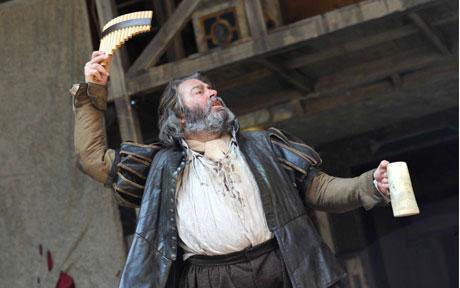
The image of Roger Allam in the role of Falstaff at the Globe Theatre in London.

Sunday Sonnet – 29 March 2015

Aemilia-Lanyer

With freezing rain pelting the countryside, today seems a good time for masochistic verse. Shakespeare’s Dark Lady Sonnet 141 enumerates all the faults of his lady love–her looks, her personality and even his own sin of nonetheless loving her: 

141

In faith, I do not love thee with mine eyes,
For they in thee a thousand errors note;
But ’tis my heart that loves what they despise,
Who in despite of view is pleased to dote;
Nor are mine ears with thy tongue’s tune delighted,
Nor tender feeling, to base touches prone,
Nor taste, nor smell, desire to be invited
To any sensual feast with thee alone:
But my five wits nor my five senses can
Dissuade one foolish heart from serving thee,
Who leaves unsway’d the likeness of a man,
Thy proud hearts slave and vassal wretch to be:
Only my plague thus far I count my gain,
That she that makes me sin awards me pain. 

Sonnets of Shakespeare’s time where largely written following the ‘Petrarchan Ideal’ of love–that is, that the object of your lovely sonnet should be a be chaste, beautiful aristocratic woman whom the Poet can never hope to posses. Shakespeare says the hell with that. 

Quite the opposite, the Dark Lady is not pleasant in appearance–‘I do not love thee with mine eyes, For they in thee a thousand errors note’; her voice is hardly pleasing–‘Nor are mine ears with thy tongue’s tune delighted’; and physical contact, even sexual, is not hot–‘Nor tender feeling, to base touches prone.’ 

However, despite all this or even the Poet’s own good sense, The Dark Lady still owns the Poet’s heart: ‘But my five wits nor my five senses can Dissuade one foolish heart from serving thee.’

Don’t choose this poem to read at Nuptials or to give to your beloved. 

The image is of Aemilia Lanier, an Elizabethan poet who supposedly had an affair with William Shakespeare. Some people believe she might’ve been the Dark Lady of the Sonnets. There’s scant evidence of this, and there’s even doubt this painting is her. Lanier was a woman who dared to publish a book of verse in Shakespeare’s time, so there aren’t many records left. She was a woman, after all, and except for obsessive and progressive minds like Mr. Shakespeare, Elizabethans didn’t much trouble themselves writing about real women, unless they could fit them into something like the ridiculous notion of the Petrarchan Ideal. Or if she was Queen.

Friday’s Maniacal Poe Quote – 27 March 2015

dental-keys

Today’s quote comes from a little known Poe yarn, “Berenice,” but in Poe circles it’s infamous for its excessive violence, brutality and horror: 

His looks were wild with terror, and he spoke to me in a voice tremulous, husky, and very low. What said he?—some broken sentences I heard. He told of a wild cry disturbing the silence of the night—of the gathering together of the household—of a search in the direction of the sound; and then his tones grew thrillingly distinct as he whispered me of a violated grave—of a disfigured body enshrouded, yet still breathing—still palpitating—still alive! 

He pointed to garments;—they were muddy and clotted with gore. I spoke not, and he took me gently by the hand: it was indented with the impress of human nails. He directed my attention to some object against the wall. I looked at it for some minutes: it was a spade. With a shriek I bounded to the table, and grasped the box that lay upon it. But I could not force it open; and in my tremor, it slipped from my hands, and fell heavily, and burst into pieces; and from it, with a rattling sound, there rolled out some instruments of dental surgery, intermingled with thirty-two small, white and ivory-looking substances that were scattered to and fro about the floor. 

–‘Berenice’ (1835) 

Yes, the narrator, Egaeus, is completely out of his mind, who suffers from catatonic episodes and epileptic seizures. He falls in love with his cousin, Berenice, who subsequently seems to die from some strange malady. As the story end, Egeaus’ servant informs Egaeus that in one of his catatonic episodes, he exhumed her grave and–using a set of barbaric 19th century dental instruments–tore out her teeth, teeth which he had become obsessed with. Of course–as is common in Poe stories–Berenice was unwittingly buried alive and is now screaming from her grave in terror and toothless agony. 

In this little gem of a story we can enjoy some reoccurring themes of Poe’s fiction and poetry: madness, incest, the death of a beautiful woman (or, in this case, a seeming death), episodes of shocking violence and premature burial. 

Readers complained to the editor of Southern Literary Messenger about the story’s violence, but Poe was unrepentant. 

The image is a set of late 18th to early 19th century dental instruments, likely the kind used to dig out Berenice’s teeth. No, the story makes no mention of anesthesia.

Hump Day Shakespearean Quote – 25 March 2015

prospero,medium

Today, I’d like to share a supremely beautiful speech from Shakespeare’s The Tempest. It almost seems as if Will Shakespeare himself is speaking through Prospero, ruminating on the power of his magic (Prospero the magician; Shakespeare the playwright) and thereby forgetting the mundane concerns of ordinary life: 

PROSPERO

…Our revels now are ended. These our actors,
As I foretold you, were all spirits and
Are melted into air, into thin air:
And, like the baseless fabric of this vision,
The cloud-capp’d towers, the gorgeous palaces,
The solemn temples, the great globe itself,
Ye all which it inherit, shall dissolve
And, like this insubstantial pageant faded,
Leave not a rack behind. We are such stuff
As dreams are made on, and our little life
Is rounded with a sleep. Sir, I am vex’d;
Bear with my weakness; my, brain is troubled:
Be not disturb’d with my infirmity:
If you be pleased, retire into my cell
And there repose: a turn or two I’ll walk,
To still my beating mind. 

The Tempest, Act 4, Scene i 

The Tempest, we’re pretty certain, is the last play Shakespeare wrote entirely himself. After this play, he went into semi-retirement, only to do a few collaborations with his protégé, John Fletcher. And so in many ways this play seems to be a farewell to the magic of playwrights and theatre. 

The insubstantial pageant fades, the great globe (a references to The Globe Theatre) shall dissolve. 

Of course, it’s these very words–this very play and the whole rest of Shakespeare’s canon–that outlived all of Mr. Shakespeare’s daily concerns, and will outlive all of ours. That’s the magic of Art. 

The image is of Patrick Stewart as Prospero from the Royal Shakespeare Company’s 2006 production of The Tempest.

Sunday Sonnet – 22 March 2015

RomeoJuliet

According to the movement of planets–that is, the Vernal Equinox–it’s supposed to be Spring. But in my particular part of the country, snow is coming this evening. So for today I’ve chosen a sonnet that bemoans the many common-day misfortunes that can befall any of us–and what the cure for that misfortune is.

29

When, in disgrace with fortune and men’s eyes,
I all alone beweep my outcast state
And trouble deaf heaven with my bootless cries
And look upon myself and curse my fate,
Wishing me like to one more rich in hope,
Featured like him, like him with friends possess’d,
Desiring this man’s art and that man’s scope,
With what I most enjoy contented least;
Yet in these thoughts myself almost despising,
Haply I think on thee, and then my state,
Like to the lark at break of day arising
From sullen earth, sings hymns at heaven’s gate;
For thy sweet love remember’d such wealth brings
That then I scorn to change my state with kings.

The Poet curses his bad fate, looking at others more fortunate than him, people with friends, art, possessions: “with friends possess’d, Desiring this man’s art and that man’s scope.” He even believes any prayers to God are falling on deaf ears: “And trouble deaf heaven with my bootless cries.” It almost seems the Poet is treading very close to apostasy here. But even in the Elizabethan era of a state-sanctioned religion and compulsory church attendance, I’m sure many, many people felt their constant prayers did no good.   Another example of Shakespeare’s ability to speak to the Everyman in each of us, and doing it without quite crossing the line.

In the end, Sonnet 29 holds a lesson for us, applicable even four centuries later: the love of your life can make you feel so wealthy, you wouldn’t trade him or her for being a king. This nice couplet turns it all around:

For thy sweet love remember’d such wealth brings
That then I scorn to change my state with kings.

So today, if things don’t go right–or if snow is coming to bury your sprouting irises and tulips, turn to that special person who loves you more than anything: that is the greatest treasure on Earth.

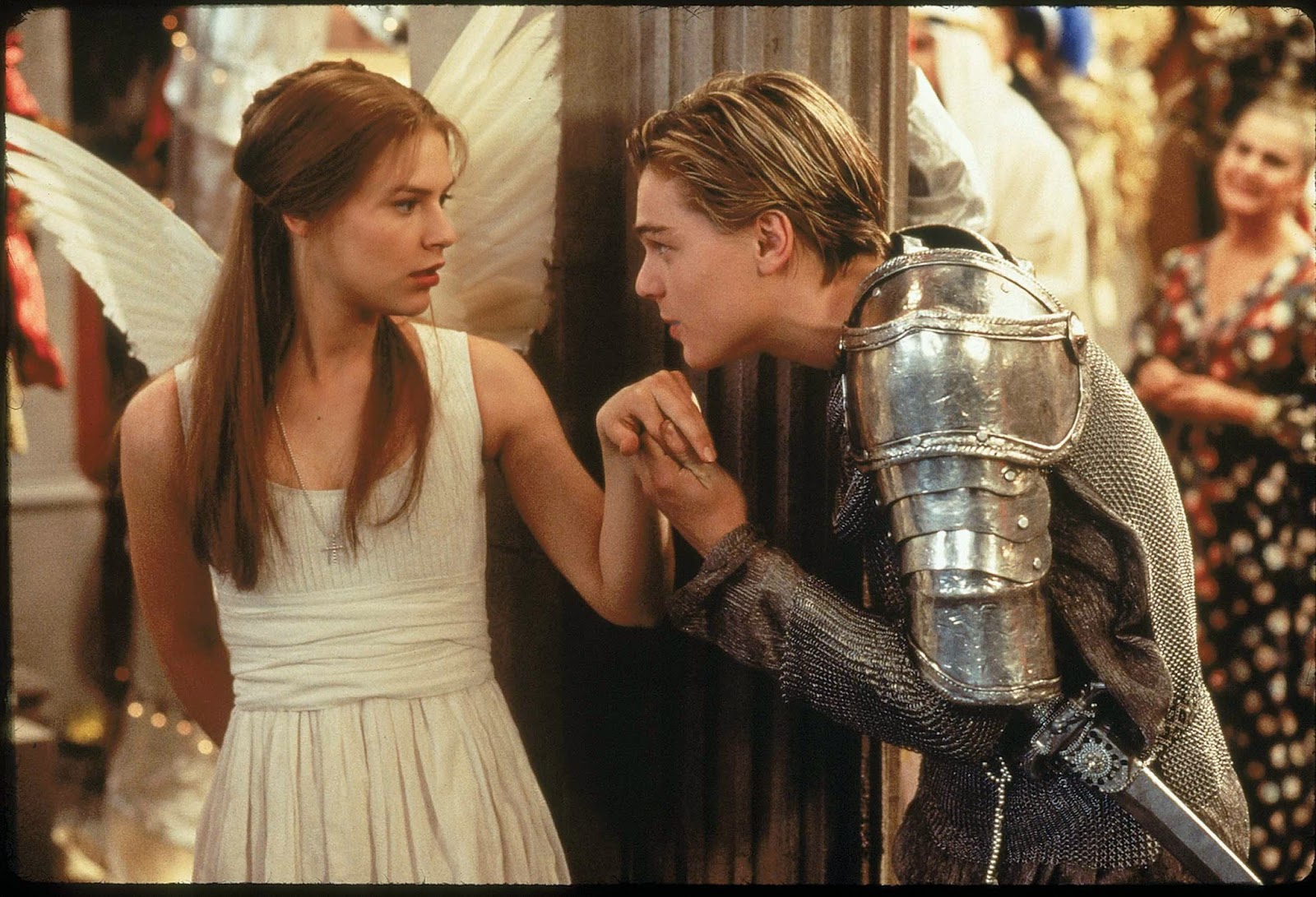
The image comes from the 1996 movie Romeo + Juliet, with Claire Danes and Leo DiCaprio, a good example of true love in the midst of growing troubles.

Hump Day Shakespearean Quote – 18 March 2015

stanley-tucci-puck

With this, the last Wednesday of winter, it’s time to celebrate. Spring is almost here and after that, Summer.   From one of The Bard’s most popular plays, performed more often today than just about any other, here’s the lovely and lyrical closing lines of A Midsummer Night’s Dream:

If we shadows have offended, 
Think but this, and all is mended,
That you have but slumbered here
While these visions did appear.
And this weak and idle theme,
No more yielding but a dream,
Gentles, do not reprehend:
If you pardon, we will mend:
And, as I am an honest Puck,
If we have unearned luck
Now to ‘scape the serpent’s tongue,
We will make amends ere long;
Else the Puck a liar call;
So, good night unto you all.
Give me your hands, if we be friends,
And Robin shall restore amends.  

A Midsummer Night’s Dream, Act 5, Scene i 

The ethereal spirit Puck delivers this postlude, which at first blush seems so much fluff.   But I think Shakespeare is saying something important here about the reality of theatre and the nature of Art. He has Puck urging the audience to pretend this was all but a dream–or is he? Shakespeare and Puck are playing with us: Puck, throughout the course of the play, has proven himself a trickster, yet he claims to be ‘honest Puck’; he admits the play’s themes are ‘weak and idle’ yet here we are, 400 years later, still parsing them out; the actors are shadows and the play ‘no more yielding than a dream’, yet they still have the power to offend–sending Puck out to address the audience directly to plead for amends. 

Such a strangely thoughtful ending, more than just a beautiful reel of couplets, it’s an evocative rumination on reality and dream, on memory and imagination.   And all of this at the tail end of a delightful fantasy-comedy.   

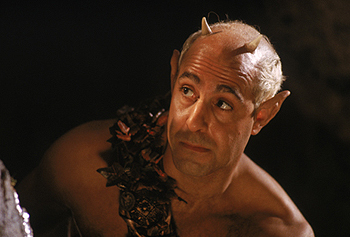
The image is of Stanley Tucci’s delightfully ridiculous Puck from the 1999 movie.

Sunday Sonnet – 15 March 2015

116 original

I attended the wedding yesterday of a young friend. The ceremony she and her newly minted husband wrote themselves, full of style, panache and sweetness. There’s wasn’t much old or traditional in their ceremony or reception–or was there? Of course there was: The love of true minds–a kind of love they promised one another which is never perfect but the most beautiful thing in the world. It’s complicated, and never in the course of human Art has that kind of love been better expressed than in Will Shakespeare’s Sonnet 116: 

Let me not to the marriage of true minds
Admit impediments. Love is not love
Which alters when it alteration finds,
Or bends with the remover to remove:
O no; it is an ever-fixed mark, 
That looks on tempests, and is never shaken;
It is the star to every wandering bark,
Whose worth’s unknown, although his height be taken.
Love’s not Time’s fool, though rosy lips and cheeks 
Within his bending sickle’s compass come; 
Love alters not with his brief hours and weeks, 
But bears it out even to the edge of doom.
   If this be error and upon me proved,
   I never writ, nor no man ever loved. 

There is such a timeliness beauty, eloquence and truth to this sonnet–so perfect in its realization of the Elizabethan sonnet form, so infinitely depthless in its meanings and cross-meanings, so breathtaking in its imagery–that it’s never been matched by another poet. And yet–if one knows nothing of poetry, if one finds Shakespeare intimidating–even a cursory read or listen to these lines can raise your spirits and thrill your heart with its lyrical beauty. 

Read it aloud today with someone you love.

And to my young friends, congratulations. 

The image is the Elizabethan text of Sonnet 116, printed with the font and characters common to that era.