Friday’s Maniacal Poe Quote – 30 January 2015

weekly mirror

Edgar A. Poe’s over the top prose wasn’t limited to fiction. The Raven wrote crazy stuff in newspaper articles too, passing it off as reporting and as criticism. Poe was a well known literary critic, feared and hated. Back in the early 19th century, authors often rebutted their critics in the magazines and newspapers, and the critics often responded. Literary gadflies airing their laundry in public. Here’s a snippet of Poe trashing the early American literary giant, Henry Wadsworth Longfellow, who dared to respond. This is Poe responding to Longfellow: 

POST-NOTES BY THE CRITIC. — If ever a man had cause to ejaculate, “Heaven preserve me from my friends!” it is Mr. Longfellow.

            My ‘literary strictures’ on the poem consisted, generally, in the assertion, that it is the best of a collection of poems, one of which, at least, ‘should have been received with acclamation.’

            I defy Prof. Longfellow and his friend conjointly, to say a rational word in defense of the ‘identical illustration’ to which, as gently as possible, I objected.

            I deny that I misconceive either rhythm or metre–call for the proofs–and assert that Prof. Longfellow knows very little about either….

–Edgar A. Poe, excepted from the New York Weekly Mirror, January 25, 1845 

Poe’s savage pen ripped Longfellow repeatedly through the years, but his attacks also skewered James Fenimore Cooper and Washington Irving, yet praised Samuel Taylor Coleridge and Charles Dickens. So maybe Poe did have a critical eye that could see past the contemporary popularity or passing fads. 

Unfortunately, Poe paid a price for his unflinching honesty. Poe hated what he called “puffery”, where fellow poets and fiction writers would each trade positive reviews. And so later in life, after his beloved Virginia had died and Poe meandered in and out of poverty and near starvation, no one in the established literary landscape cared to give Poe the break he sought or the help he needed. He had made too many enemies. 

The image comes from the masthead of an actual Weekly Mirror from 1844, when Poe was a contributing writer.

Friday’s Maniacal Poe Quote – 23 January 2015

Maelstrom-Clarke

So many of Poe’s tales have been made into movies, and most of those movies have been dreadfully bad. There’s one Poe tale, however, that as far as I can tell, has never been adapted to film, but should be. “A Descent into the Maelström.” (There are a couple of films with this name, but they’ve nothing to do with the story.) With today’s CGI, this could be an exciting adventure, combing equal measures of science fiction, horror, sea-adventure and loads of period costumes: 

“Never shall I forget the sensations of awe, horror, and admiration with which I gazed about me. The boat appeared to be hanging, as if by magic, midway down, upon the interior surface of a funnel vast in circumference, prodigious in depth, and whose perfectly smooth sides might have been mistaken for ebony, but for the bewildering rapidity with which they spun around, and for the gleaming and ghastly radiance they shot forth, as the rays of the full moon, from that circular rift amid the clouds which I have already described, streamed in a flood of golden glory along the black walls, and far away down into the inmost recesses of the abyss.”

-from “A Descent into the Maelström” (1841) 

This wonderful little yarn from Poe is a mystery and a bit of science fiction. Weird physics, the bending of time, as well as a shipwreck yarn all wrapped into one. It’s an easy read, and full of the kind of purple prose only Poe could write. 

Finally, this story is another example of Poe’s ‘ratiocination’, his science of reason developed in “The Murders in the Rue Morgue” and “The Purloined Letter.” The science of reason and calm analysis, the kind of deductive thinking that invented the modern detective.

The image of the vortex (the ‘Maelström’) is from Harry Clarke’s illustration for the story from a 1919 edition. Notice the lack of CGI.

Friday’s Maniacal Poe Quote – 16 January 2015

MurdersInTheRueMorgue13

A gruesome and sensational description of a murder–or the invention of an entire genre of literature?

“Of Madame L’Espanaye no traces were here seen; but an unusual quantity of soot being observed in the fire-place, a search was made in the chimney, and (horrible to relate!) the corpse of the daughter, head downward, was dragged therefrom; it having been thus forced up the narrow aperture for a considerable distance. The body was quite warm. Upon examining it, many excoriations were perceived, no doubt occasioned by the violence with which it had been thrust up and disengaged. Upon the face were many severe scratches, and, upon the throat, dark bruises, and deep indentations of finger nails, as if the deceased had been throttled to death.” 

–from ‘The Murders in the Rue Morgue’ (1841)

With the publication of this short story in Graham’s Magazine, Poe unleashed upon the world a whole new novelty–a whole new realm of art and fiction: the literary detective, as well as ideas and practices extending far beyond fiction:

  • The science of ratiocination, and the birth of the modern detective–in fact and in fiction
  • The ‘closed room’ mystery; the bumbling apprentice; incompetent police.
  • The trope of the eccentric but brilliant detective. In this case, C. Auguste Dipun, who inspired the creation of Sherlock Holmes and Hercule Poirot.
  • Another example of Poe’s aesthetic notion that “the most poetical thing in the world is the death of a beautiful woman.” Alfred Hitchcock, a century later, would take this notion to outrageous extremes. 

Despite this lurid description of the poor woman stuffed up a chimney, this story (and the two other C. Auguste Dupin mysteries) concern themselves mainly with the intellectual exercise of unraveling a mystery.   An entire portion of the publishing industry has thrived on this simple notion for decades.   

In 1841, Poe was paid the not inconsiderable sum of $56 for this gruesome but intellectually stimulating yarn.  

The image is from the 1932 film Murders in the Rue Morgue, which had virtually nothing to do, plot-wise, with Poe’s story. But it did have Bela Lugosi, an ape, and the beautiful actress Sidney Fox.

Friday’s Maniacal Poe Quote – 09 January 2015

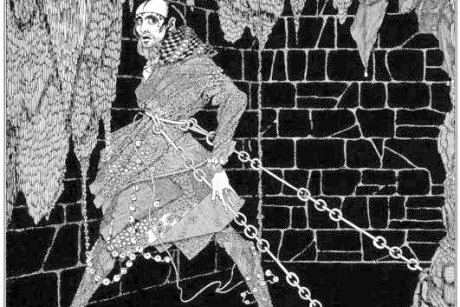
Amontillado

Want to delve into the mind of a murderer? 

Poe was a master of voice and dramatic irony.   In many of his tales he recreated the voice of a murderous madman.  And in each of these cases, that first-person narration makes it abundantly clear to the reader that the narrator is utterly out of his mind, which is a delicious kind of dramatic irony (that is, the reader’s knowledge of the individual surpasses that of the character). 

THE thousand injuries of Fortunato I had borne as I best could; but when he ventured upon insult, I vowed revenge. You, who so well know the nature of my soul, will not suppose, however, that I gave utterance to a threat. At length I would be avenged; this was a point definitively settled—but the very definitiveness with which it was resolved, precluded the idea of risk. I must not only punish, but punish with impunity. A wrong is unredressed when retribution overtakes its redresser. It is equally unredressed when the avenger fails to make himself felt as such to him who has done the wrong.

It must be understood, that neither by word nor deed had I given Fortunato cause to doubt my good will. I continued, as was my wont, to smile in his face, and he did not perceive that my smile now was at the thought of his immolation. 

–from ‘The Cask of Amontillado’ (1846) 

These are the opening lines of the story, and so Poe does yet another amazing thing with his tale: he grips the reader from the very first paragraph.    

Interestingly enough, we never really learn what Fortunato’s crime was, or what he did to insult Mentrosor, the murderer.  But judging by Fortunato’s comments about Amontillado and sherry, his crime may have been a simple vulgar ignorance of good wine.  In the end, what kind of rational justification can there be for revenge? There is none. And so, believe it or not, by not revealing Montresor’s ‘reason’ for revenge, ‘The Cask of Amontillado’ contains a moral lesson–especially applicable in today’s tragic world.

The image is taken from  Harry Clarke’s (1889-1931) illustration of poor Fortunato, chained up and ready to be sealed up alive.   

Happy Halloween from Edgar A. Poe!

Raven Poe

The Raven

Once upon a midnight dreary, while I pondered, weak and weary,

Over many a quaint and curious volume of forgotten lore—

    While I nodded, nearly napping, suddenly there came a tapping,

As of some one gently rapping, rapping at my chamber door.

“’Tis some visitor,” I muttered, “tapping at my chamber door—

            Only this and nothing more.”


    Ah, distinctly I remember it was in the bleak December;

And each separate dying ember wrought its ghost upon the floor.

    Eagerly I wished the morrow;—vainly I had sought to borrow

    From my books surcease of sorrow—sorrow for the lost Lenore—

For the rare and radiant maiden whom the angels name Lenore—

            Nameless here for evermore.


    And the silken, sad, uncertain rustling of each purple curtain

Thrilled me—filled me with fantastic terrors never felt before;

    So that now, to still the beating of my heart, I stood repeating

    “’Tis some visitor entreating entrance at my chamber door—

Some late visiter entreating entrance at my chamber door;—

            This it is and nothing more.”


    Presently my soul grew stronger; hesitating then no longer,

“Sir,” said I, “or Madam, truly your forgiveness I implore;

    But the fact is I was napping, and so gently you came rapping,

    And so faintly you came tapping, tapping at my chamber door,

That I scarce was sure I heard you”—here I opened wide the door;—

            Darkness there and nothing more.


    Deep into that darkness peering, long I stood there wondering, fearing,

Doubting, dreaming dreams no mortal ever dared to dream before;

    But the silence was unbroken, and the stillness gave no token,

    And the only word there spoken was the whispered word, “Lenore?”

This I whispered, and an echo murmured back the word, “Lenore!”—

            Merely this and nothing more.


    Back into the chamber turning, all my soul within me burning,

Soon again I heard a tapping somewhat louder than before.

    “Surely,” said I, “surely that is something at my window lattice;

      Let me see, then, what thereat is, and this mystery explore—

Let my heart be still a moment and this mystery explore;—

            ’Tis the wind and nothing more!”


    Open here I flung the shutter, when, with many a flirt and flutter,

In there stepped a stately Raven of the saintly days of yore;

    Not the least obeisance made he; not a minute stopped or stayed he;

    But, with mien of lord or lady, perched above my chamber door—

Perched upon a bust of Pallas just above my chamber door—

            Perched, and sat, and nothing more.


Then this ebony bird beguiling my sad fancy into smiling,

By the grave and stern decorum of the countenance it wore,

“Though thy crest be shorn and shaven, thou,” I said, “art sure no craven,

Ghastly grim and ancient Raven wandering from the Nightly shore—

Tell me what thy lordly name is on the Night’s Plutonian shore!”

            Quoth the Raven “Nevermore.”


    Much I marvelled this ungainly fowl to hear discourse so plainly,

Though its answer little meaning—little relevancy bore;

    For we cannot help agreeing that no living human being

    Ever yet was blessed with seeing bird above his chamber door—

Bird or beast upon the sculptured bust above his chamber door,

            With such name as “Nevermore.”


    But the Raven, sitting lonely on the placid bust, spoke only

That one word, as if his soul in that one word he did outpour.

    Nothing farther then he uttered—not a feather then he fluttered—

    Till I scarcely more than muttered “Other friends have flown before—

On the morrow he will leave me, as my Hopes have flown before.”

            Then the bird said “Nevermore.”


    Startled at the stillness broken by reply so aptly spoken,

“Doubtless,” said I, “what it utters is its only stock and store

    Caught from some unhappy master whom unmerciful Disaster

    Followed fast and followed faster till his songs one burden bore—

Till the dirges of his Hope that melancholy burden bore

            Of ‘Never—nevermore’.”


    But the Raven still beguiling all my fancy into smiling,

Straight I wheeled a cushioned seat in front of bird, and bust and door;

    Then, upon the velvet sinking, I betook myself to linking

    Fancy unto fancy, thinking what this ominous bird of yore—

What this grim, ungainly, ghastly, gaunt, and ominous bird of yore

            Meant in croaking “Nevermore.”


    This I sat engaged in guessing, but no syllable expressing

To the fowl whose fiery eyes now burned into my bosom’s core;

    This and more I sat divining, with my head at ease reclining

    On the cushion’s velvet lining that the lamp-light gloated o’er,

But whose velvet-violet lining with the lamp-light gloating o’er,

            She shall press, ah, nevermore!


    Then, methought, the air grew denser, perfumed from an unseen censer

Swung by Seraphim whose foot-falls tinkled on the tufted floor.

    “Wretch,” I cried, “thy God hath lent thee—by these angels he hath sent thee

    Respite—respite and nepenthe from thy memories of Lenore;

Quaff, oh quaff this kind nepenthe and forget this lost Lenore!”

            Quoth the Raven “Nevermore.”


    “Prophet!” said I, “thing of evil!—prophet still, if bird or devil!—

Whether Tempter sent, or whether tempest tossed thee here ashore,

    Desolate yet all undaunted, on this desert land enchanted—

    On this home by Horror haunted—tell me truly, I implore—

Is there—is there balm in Gilead?—tell me—tell me, I implore!”

            Quoth the Raven “Nevermore.”


    “Prophet!” said I, “thing of evil!—prophet still, if bird or devil!

By that Heaven that bends above us—by that God we both adore—

    Tell this soul with sorrow laden if, within the distant Aidenn,

    It shall clasp a sainted maiden whom the angels name Lenore—

Clasp a rare and radiant maiden whom the angels name Lenore.”

            Quoth the Raven “Nevermore.”


    “Be that word our sign of parting, bird or fiend!” I shrieked, upstarting—

“Get thee back into the tempest and the Night’s Plutonian shore!

    Leave no black plume as a token of that lie thy soul hath spoken!

    Leave my loneliness unbroken!—quit the bust above my door!

Take thy beak from out my heart, and take thy form from off my door!”

            Quoth the Raven “Nevermore.”


    And the Raven, never flitting, still is sitting, still is sitting

On the pallid bust of Pallas just above my chamber door;

    And his eyes have all the seeming of a demon’s that is dreaming,

    And the lamp-light o’er him streaming throws his shadow on the floor;

And my soul from out that shadow that lies floating on the floor

            Shall be lifted—nevermore!