Sunday Sonnet – 12 July 2015

William_Cecil

Today we return to Shakespeare’s early numbered sonnets, almost to the beginning, when the Poet is urging his Young Man to beget a child so that his beauty might be preserved. The poet, in comparing the Young Man to the very ascendancy and brilliance of the Sun itself, could be accused of hyperbole. But when the language is so lovely, perhaps we can forgive the Poet for reaching so high:

7

Lo! in the orient when the gracious light

Lifts up his burning head, each under eye

Doth homage to his new-appearing sight,

Serving with looks his sacred majesty;

And having climbed the steep-up heavenly hill,

Resembling strong youth in his middle age,

Yet mortal looks adore his beauty still,

Attending on his golden pilgrimage:

But when from highmost pitch, with weary car,

Like feeble age, he reeleth from the day,

The eyes, ‘fore duteous, now converted are

From his low tract, and look another way:

   So thou, thyself outgoing in thy noon

   Unlooked on diest unless thou get a son

If you read through to the end, it’s evident the Sun’s track through the heavens is a metaphor for all people–the passage of human life. And the play on ‘sun’ and ‘son’ is unmistakable.

There’s circumstantial evidence that Shakespeare might’ve been commissioned to write these early sonnets to the young Earl of Southampton, imploring the Young Man to procreate. Who would’ve paid Shakespeare to write these poems for such an unusual reason? It might’ve been none other than Queen Elizabeth’s own chief advisor and Secretary of State, William Cecil, Lord Burghley. Southampton didn’t have a lot of interest in marrying a woman, but it seems he and Shakespeare might’ve had an interest in each other. Later on, the sequence of the Poet’s sonnets to the Young Man move way beyond Burghley’s original (alleged) commission, into the realm of out-and-out romantic love poetry.

All of the prattle about possible historical connections to Sonnet 7 is just one example of Shakespeare’s 154 Sonnets’ historical connections: Beyond the majesty of their poetics and the sheer breadth and depth of being able to compose 154 connected verses, the historical and biographical questions these sonnets raise provide an unending quest for poets, readers, scholars and historians: Why did Shakespeare write 154 of them that when read together weave their own narrative, and why did Shakespeare himself never seek to publicly publish them?

The image is of William Cecil, Lord Burghley, whose connection to Shakespeare we’ll never really know. The painter is anonymous, but the original hangs in Britain’s National Portrait Gallery.  

Weekly Shakespeare Quote – 09 July 2015

2nd_Earl_of_Essex_by_Marcus_Gheeraerts_the_Younger

This week Shakespeare gives us a lesson on how to deliver a brilliant take-down.   John of Gaunt’s speech from Richard II unreels as a powerful and poetic testament to all that makes England great. But…

This royal throne of kings, this scepter’d isle,
This earth of majesty, this seat of Mars,
This other Eden, demi-paradise,
This fortress built by Nature for herself
Against infection and the hand of war,
This happy breed of men, this little world,
This precious stone set in the silver sea,
Which serves it in the office of a wall,
Or as a moat defensive to a house,
Against the envy of less happier lands,
This blessed plot, this earth, this realm, this England,
This nurse, this teeming womb of royal kings,
Fear’d by their breed and famous by their birth,
Renowned for their deeds as far from home,
For Christian service and true chivalry,
As is the sepulchre in stubborn Jewry,
Of the world’s ransom, blessed Mary’s Son,
This land of such dear souls, this dear dear land,
Dear for her reputation through the world,
Is now leased out, I die pronouncing it,
Like to a tenement or pelting farm:
England, bound in with the triumphant sea
Whose rocky shore beats back the envious siege
Of watery Neptune, is now bound in with shame,
With inky blots and rotten parchment bonds:
That England, that was wont to conquer others,
Hath made a shameful conquest of itself.
Ah, would the scandal vanish with my life,
How happy then were my ensuing death!

–from Richard II, Act II Scene i

In the end, however, at ‘Is now leased out, I die pronouncing it’, Gaunt turns his brilliant evocation of England’s beauty into a condemnation of Richard–to the King’s face. Gaunt delivers this speech from his deathbed, and after finishing it shambles off stage to die–before the infuriated Richard can have him killed.

More than just a turning point in the play, this speech is a great example of Shakespeare’s ability to set up expectations and then turn them on the audience. But rather than frustrate us, it surprises and delights.

Richard II was a risky play for Shakespeare. In Elizabethan times, any hint that a playwright might be criticizing the monarch could be taken the wrong way. In fact, years after the play was first produced, supporters of Robert Devereux, the 2nd Earl of Essex, arranged for a repeat performance of Richard II in connection with Essex’s attempted coup of Elizabeth’s throne. The Lord Chamberlain’s Men, including Shakespeare, had to do some fast taking to exonerate themselves, pleading ignorance of Essex’s plot. Eventually, Essex was executed for treason.

The image is of Robert Devereux, 2nd Earl of Essex, painted by Marcus Gheeraerts the Younger.

Sunday Sonnet – 05 July 2015

Sonnet 144

Let’s have some fun today. Some four hundred years Shakespeare evidently did, composing this delicious sonnet about the betrayals of a bisexual love triangle. Here the Young Man of the earlier sonnets intersects with the Dark Lady of the later sonnets. The Poet fears that the Dark Lady might have seduced the Poet’s sweet young boy away from him:

144

Two loves I have of comfort and despair,
Which like two spirits do suggest me still;
The better angel is a man right fair, 
The worser spirit a woman colour’d ill. 
To win me soon to hell, my female evil 
Tempteth my better angel from my side, 
And would corrupt my saint to be a devil, 
Wooing his purity with her foul pride. 
And whether that my angel be turn’d fiend 
Suspect I may, but not directly tell; 
But being both from me, both to each friend,
I guess one angel in another’s hell: 
Yet this shall I ne’er know, but live in doubt,
Till my bad angel fire my good one out.

The Poet’s obviously furious that his better angel–the sweet Young Man–is in all likelihood inside (in a sexual way) the Poet’s other angel–the devilish Dark Lady: ‘I guess one angel in another’s hell:’.   But it almost feels that Shakespeare shows his hand a bit here, for despite the Poet’s pique, the nest of puns and turns in this poem are delightful.

Beyond the fun of it all, this sonnet sings on multiple levels: two angels, one of comfort, one of despair, signifying the common internal struggle all humans share.   The very Elizabethan notion that the two forces which influence us, angel and devil, are delineated by gender: men being good and fair, women being evil and dark:

The better angel is a man right fair, 
The worser spirit a woman colour’d ill. 

Yet, amazingly so for the times, the Poet in this sonnet all but admits to bisexuality.

And while all this is going on, the sonnet itself is a superb example of the Elizabethan sonnet form, that in itself an achievement.   All of this makes Sonnet144 an enduring masterpiece: poetic, provocative, delicious, beautiful, insightful.  

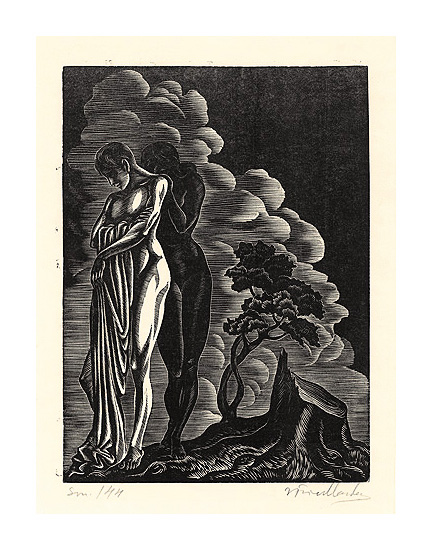
The gorgeous image comes from a wood engraving by Isac Friedlander, circa 1931, created specifically for Sonnet 144.

Friday’s Tragic Poe Quote – 03 July 2015

VirginiaPoe

Poe’s poem ‘Ulalume’ is a posthumous publication. Written in 1847, Poe couldn’t find a publisher for it during the last two years of his life.   This dreary, tragic verse adds to Poe’s street cred as a hardcore melancholy Romantic. The poem is not necessarily very deep with meaning, and in my opinion is best enjoyed read aloud for its rhythm and the hypnotic effect of its repetition of words, lines and sounds. It’s a kind of cousin to ‘The Raven’: mourning for a dead love.

The fascinating curiosity about this verse is its dramatic irony: that is, the speaker for much of the poem doesn’t remember that his beloved Ulalume is dead. Only when he revisits her tomb in the last verse, does the devastation of her death return to him. So in a sense, this poem is a story.

The skies they were ashen and sober;
The leaves they were crisped and sere – 
The leaves they were withering and sere;
It was night in the lonesome October
Of my most immemorial year:
It was hard by the dim lake of Auber,
In the misty mid region of Weir – 
It was down by the dank tarn of Auber,
In the ghoul-haunted woodland of Weir.

Here once, through and alley Titanic,
Of cypress, I roamed with my Soul – 
Of cypress, with Psyche, my Soul.
These were days when my heart was volcanic
As the scoriac rivers that roll – 
As the lavas that restlessly roll
Their sulphurous currents down Yaanek
In the ultimate climes of the pole – 
That groan as they roll down Mount Yaanek
In the realms of the boreal pole.

Our talk had been serious and sober,
But our thoughts they were palsied and sere – 
Our memories were treacherous and sere, – 
For we knew not the month was October,
And we marked not the night of the year
(Ah, night of all nights in the year!) – 
We noted not the dim lake of Auber
(Though once we had journeyed down here) – 
Remembered not the dank tarn of Auber,
Nor the ghoul-haunted woodland of Weir.

And now, as the night was senescent
And star-dials pointed to morn – 
As the star-dials hinted of morn – 
At the end of our path a liquescent
And nebulous lustre was born,
Out of which a miraculous crescent
Arose with a duplicate horn – 
Astarte’s bediamonded crescent
Distinct with its duplicate horn.

And I said: “She is warmer than Dian;
She rolls through an ether of sighs – 
She revels in a region of sighs:
She has seen that the tears are not dry on
These cheeks, where the worm never dies,
And has come past the stars of the Lion
To point us the path to the skies – 
To the Lethean peace of the skies – 
Come up, in despite of the Lion,
To shine on us with her bright eyes – 
Come up through the lair of the Lion,
With love in her luminous eyes.”

But Psyche, uplifting her finger,
Said: “Sadly this star I mistrust – 
Her pallor I strangely mistrust:
Ah, hasten! -ah, let us not linger!
Ah, fly! -let us fly! -for we must.”
In terror she spoke, letting sink her
Wings until they trailed in the dust – 
In agony sobbed, letting sink her
Plumes till they trailed in the dust – 
Till they sorrowfully trailed in the dust.

I replied: “This is nothing but dreaming:
Let us on by this tremulous light!
Let us bathe in this crystalline light!
Its Sybilic splendour is beaming
With Hope and in Beauty tonight! – 
See! -it flickers up the sky through the night!
Ah, we safely may trust to its gleaming,
And be sure it will lead us aright – 
We safely may trust to a gleaming,
That cannot but guide us aright,
Since it flickers up to Heaven through the night.”

Thus I pacified Psyche and kissed her,
And tempted her out of her gloom – 
And conquered her scruples and gloom;
And we passed to the end of the vista,
But were stopped by the door of a tomb – 
By the door of a legended tomb;
And I said: “What is written, sweet sister,
On the door of this legended tomb?”
She replied: “Ulalume -Ulalume – 
‘Tis the vault of thy lost Ulalume!”

Then my heart it grew ashen and sober
As the leaves that were crisped and sere – 
As the leaves that were withering and sere;
And I cried: “It was surely October
On this very night of last year
That I journeyed -I journeyed down here! – 
That I brought a dread burden down here – 
On this night of all nights in the year,
Ah, what demon hath tempted me here?
Well I know, now, this dim lake of Auber – 
This misty mid region of Weir – 
Well I know, now, this dank tarn of Auber,
This ghoul-haunted woodland of Weir.”

Some scholars and historians have wondered if this poem is autobiographical. That seems reasonable to me. Poe lost his beloved Virginia to tuberculosis. He was obsessed with the concept of ‘the most poetical thing in the world is the death of a beautiful woman.’ And he spend the last couple years of his life–when this poem was written–frantically trying find a new wife. The loneliness he suffered agonized him.

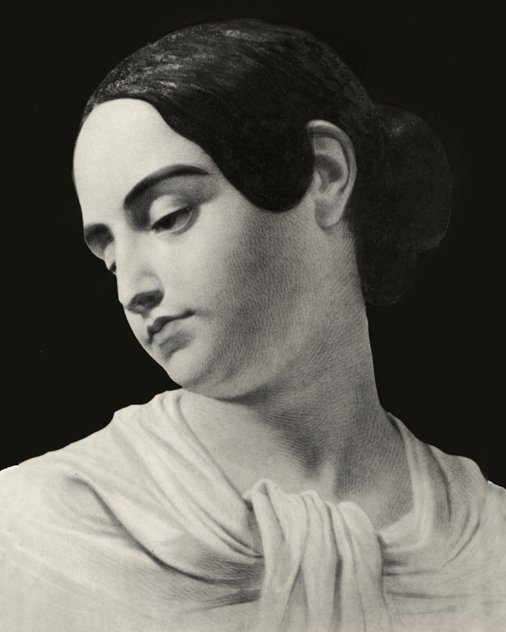
The image is of Poe’s dead wife, Virginia Eliza Clemm Poe, painted after her death. She was Poe’s first cousin, and married him when only 13. She died at the age of 24 in 1847 (the year ‘Ulalume’ was written). Many scholars believe they never consummated their marriage, though Poe loved her profoundly, and was, by all accounts, devastated by her early death.

Sunday Sonnet – 28 June 2015

Sonnet 129

Once again Shakespeare turns the Romantic ideal of a love sonnet on its head, bitterly attacking romantic love in Sonnet 129: a visceral attack against sensual love–an attack, really, against his sensual beloved, The Dark Lady.

129

The expense of spirit in a waste of shame
Is lust in action; and till action, lust
Is perjured, murderous, bloody, full of blame,
Savage, extreme, rude, cruel, not to trust,
Enjoy’d no sooner but despised straight,
Past reason hunted, and no sooner had
Past reason hated, as a swallow’d bait
On purpose laid to make the taker mad;
Mad in pursuit and in possession so;
Had, having, and in quest to have, extreme;
A bliss in proof, and proved, a very woe;
Before, a joy proposed; behind, a dream.
All this the world well knows; yet none knows well
To shun the heaven that leads men to this hell.

No, the Dark Lady isn’t mentioned by name or gender in this verse. But 129’s placement in the Dark Lady sequence, between a lovely sonnet where the Poet watches her play on a virginal (#128) and the delightful parody homage to her physically repellent nature (#130), this verse leaves no doubt as to whom it’s about.  

Or, better put, it leaves no doubt as to what it’s about: the luxury of sinful lovemaking. How extreme and crazed human behavior is before sex; how uncontrolled, yet delightful, it is during sex; how regretful it is after.

And please, read this sonnet aloud: its use of repetition, its deliciously ferocious language, the way it skips back and forth in time, all evoke the uncontrolled actions of lovers in the act.   Yet, strangely so, the sonnet remains so impersonal. In the end, the Poet regards what he and she did as only that: an impersonal act.

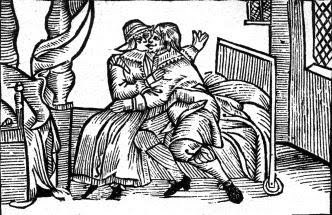
The image is an anonymous woodcut of an Elizabethan couple getting it on in a very unapproved manner: purchased sex in a brothel.

Weekly Shakespeare Quote – 25-June-2015

Paulinajpg

Characters fully fleshed out, exquisite language and a wide range of tales and adventures might’ve been enough to ensure Shakespeare’s immortality. But one other facet–in my humble estimation–seals the deal, placing him at the forefront of human literature: The great morality of Shakespeare’s works.   Take, for example, Paulina’s scathing speech from one of Shakespeare’s last plays, The Winter’s Tale:

Paulina

What studied torments, tyrant, hast for me? 
What wheels? racks? fires? what flaying? boiling?
In leads or oils? what old or newer torture
Must I receive, whose every word deserves
To taste of thy most worst? Thy tyranny
Together working with thy jealousies, 
Fancies too weak for boys, too green and idle
For girls of nine, O, think what they have done
And then run mad indeed, stark mad! for all
Thy by-gone fooleries were but spices of it.
That thou betray’dst Polixenes,’twas nothing; 
That did but show thee, of a fool, inconstant
And damnable ingrateful: nor was’t much,
Thou wouldst have poison’d good Camillo’s honour,
To have him kill a king: poor trespasses,
More monstrous standing by: whereof I reckon 
The casting forth to crows thy baby-daughter
To be or none or little; though a devil
Would have shed water out of fire ere done’t:
Nor is’t directly laid to thee, the death
Of the young prince, whose honourable thoughts, 
Thoughts high for one so tender, cleft the heart
That could conceive a gross and foolish sire
Blemish’d his gracious dam: this is not, no,
Laid to thy answer: but the last,—O lords,
When I have said, cry ‘woe!’ the queen, the queen, 
The sweet’st, dear’st creature’s dead,
and vengeance for’t
Not dropp’d down yet.

The Winter’s Tale, Act III Scene ii

King Leontes has spent much of the play as a tyrant. Shakespeare places Paulina’s grand condemnation and take down in the mouth a woman (which means when it first played in Shakespeare’s day, it was spoken by a boy). By this point in his career, Shakespeare was doing what no other playwright had done since the Ancient Greeks: empower a woman’s voice on a grand scale–the judgment of a tyrannical male ruler’s acts of cruelty, torture, while lauding the integrity and virtue of the servant he destroyed–you guessed it, also a woman.

In addition to all this, there’s a lot to love in this speech: beyond the list of tortures (an Elizabethan mainstay in Shakespeare’s world), Paulina treats us to searing language that in the hands of an accomplished actor, ignites the stage:

“More monstrous standing by: whereof I reckon

The casting forth to crows thy baby-daughter–”

“–cleft the heart

That could conceive a gross and foolish sire–”

The image comes from a 2010 production of The Winter’s Tale at Boston’s Shakespeare and Company, with Corinna May as Paulina. There is no great movie edition of The Winter’s Tale. It’s always been a difficult play to produce, what with its elements of romance, tragedy and comedy intertwined; and its plot, at first approach, seems derivative. But this play, when produced with care, craft and nuance, becomes a stunning morality tale about sin, grace and redemption. A 400 year old masterpiece that still defies convention to this very day.

Sunday Sonnet – Summer Solstice – 21 June 2015

Poster produced for the London, Midland & Scottish Railway (LMS) to promote rail travel to Stratford-upon-Avon, Warwickshire, and the LMS Welcombe Hotel, described as 'England's newest country house hotel'. As the birthplace of the playwright William Shakespeare (1564-1616), Stratford-upon-Avon was promoted extensively to the American market. c 1923. Artwork by Warwick Goble, who studied at Westminster School of Art and started out as a lithographer. He exhibited at the Royal Academy and other leading galleries. He illustrated many books and designed posters for the LMS and Great Western Railway (GWR).
Poster produced for the London, Midland & Scottish Railway (LMS) to promote rail travel to Stratford-upon-Avon, Warwickshire, and the LMS Welcombe Hotel, described as ‘England’s newest country house hotel’. As the birthplace of the playwright William Shakespeare (1564-1616), Stratford-upon-Avon was promoted extensively to the American market. c 1923. Artwork by Warwick Goble, who studied at Westminster School of Art and started out as a lithographer. He exhibited at the Royal Academy and other leading galleries. He illustrated many books and designed posters for the LMS and Great Western Railway (GWR).

In celebration of the Summer Solstice this morning, let’s enjoy The Bard’s sonnet famous for its seasons metaphor. Three winters have overcome three summers; and three springs have led to three autumns. It even references June:

104

To me, fair friend, you never can be old,
For as you were when first your eye I eyed,
Such seems your beauty still. Three winters cold
Have from the forests shook three summers’ pride,
Three beauteous springs to yellow autumn turn’d
In process of the seasons have I seen,
Three April perfumes in three hot Junes burn’d,
Since first I saw you fresh, which yet are green.
Ah! yet doth beauty, like a dial-hand,
Steal from his figure and no pace perceived;
So your sweet hue, which methinks still doth stand,
Hath motion and mine eye may be deceived:
For fear of which, hear this, thou age unbred;
Ere you were born was beauty’s summer dead.

Beyond the beauty and cleverness of the metaphorical seasonal changes–and the natural aging that comes with them–Shakespeare tantalizes us with what seems to be a time span of how long he’s known the Young Man. About three years (or, if you’re a numerologist or conspiracy theorist, 9 years or 12 years). And so for those of us who like to hope or believe that the Young Man was an actual person Will Shakespeare knew in real life, this sonnets seems to suggest that when this was written, Will had known his Young Man for three years.

But the important thing about this sonnet is its message, one Shakespeare obsessed over in many of the sonnets and in his plays: time, and how it so slowly steals away youth and beauty:

‘So your sweet hue, which methinks still doth stand,
Hath motion and mine eye may be deceived’

Yet, despite the aging of time, Love can blind us to those changes.

The image comes from a tourism poster for Stratford-upon-Avon (Shakespeare’s birthplace and home town), produced by the Midland and Scottish Railway, circa 1923.

Weekly Shakespearean Quote – 18 June 2015

vivien-leigh-cleopatra-2

Mortals though we be, only the most morbid of us think of our last breath and how we’ll face it. I’ll tell you something–I hope I can face it as bravely and nobly as Shakespeare’s Cleopatra. After her beloved Antony dies (of a self-inflicted wound, a la Romeo and Juliet), Cleopatra decides to follow Antony. She doesn’t have to die–Caesar offers a life of sorts, but it’d be a diminished existence. And so Cleopatra calls for her robe and crown, and thus poisoned with an Asp, embraces the afterlife:

CLEOPATRA

Give me my robe, put on my crown; I have

Immortal longings in me: now no more

The juice of Egypt’s grape shall moist this lip:

Yare, yare, good Iras; quick. Methinks I hear

Antony call; I see him rouse himself

To praise my noble act; I hear him mock

The luck of Caesar, which the gods give men

To excuse their after wrath: husband, I come:

Now to that name my courage prove my title!

I am fire and air; my other elements

I give to baser life. So; have you done?

Come then, and take the last warmth of my lips.

Farewell, kind Charmian; Iras, long farewell.

Kisses them. IRAS falls and dies

Have I the aspic in my lips? Dost fall?

If thou and nature can so gently part,

The stroke of death is as a lover’s pinch,

Which hurts, and is desired. Dost thou lie still?

If thus thou vanishest, thou tell’st the world

It is not worth leave-taking.

Antony and Cleopatra, Act V Scene ii

Shakespeare wrote Antony and Cleopatra in the latter part of his career, after the great tragedies of Othello, King Lear and Macbeth, after his female characters had become stronger, multifaceted, fully-fleshed humans. Shakespeare was at the height of his powers, and dared to do whatever he wished. Apparently he wished to create this powerful woman. Astonishing, considering the culture Shakespeare lived and wrote in, where women were considered not only inferior, but property.

Revel in the beauty of Cleopatra’s acts and words: After calling for her robe and crown, she kisses her servants Charmain and Iras to death, since the venom of an asp drips from her lips. As the fangs of the asp take her to death, she likens it to love: “The stroke of death is as a lover’s pinch.”

The image comes from the 1945 film Caesar and Cleopatra, with the ethereal Vivien Leigh as the immortal Queen.

Sunday Sonnet – 14 June 2015

Sonnet 1

Sonnet 1, the first verse of one of the most astonishing collections of poems ever published in Western Literature by one Poet, opens with the form and function of the rigidly controlled format of the ‘Elizabethan Sonnet’: fourteen lines, iambic pentameter, a dovetailing rhyme scheme, with the content’s central argument controlled by three quatrains and couplet. And yet, the content: it was revolutionary:

1

From fairest creatures we desire increase, 
That thereby beauty’s rose might never die, 
But as the riper should by time decease, 
His tender heir might bear his memory:
But thou, contracted to thine own bright eyes,
Feed’st thy light’s flame with self-substantial fuel,
Making a famine where abundance lies, 
Thyself thy foe, to thy sweet self too cruel.
Thou that art now the world’s fresh ornament 
And only herald to the gaudy spring, 
Within thine own bud buriest thy content 
And, tender churl, makest waste in niggarding. 
    Pity the world, or else this glutton be, 
    To eat the world’s due, by the grave and thee.

Was this sonnet a romantic verse penned by a male Elizabethan Poet to a beautiful and chaste mistress? Hardly. It’s penned by an older Poet to a younger man (though the identity of the recipient’s gender isn’t revealed till later sonnets, this business goes on for 126 sonnets!). Does it regale in the recipient’s beauty? Yes. However… Does the Poet beg for his recipient’s love? No! Rather, he begs the Young Man to breed, so this his beauty might be carried on. Very odd. Later, as more sonnets go on, a kind of narrative begins to reveal itself. For about the first 17 sonnets the Poet entreats the Young Man to preserve his beauty through marriage and procreation. But that begins to evolve into something else–into something that was illegal and very dangerous in Elizabethan England.

Despite the unusual and risqué subtext of this verse, its imagery and language are as sumptuous and profound as anything written in Elizabethan England (or, of course, even today):

‘Feed’st thy light’s flame with self-substantial fuel.’   My favorite line.

Does anyone write as beautifully in today’s world?

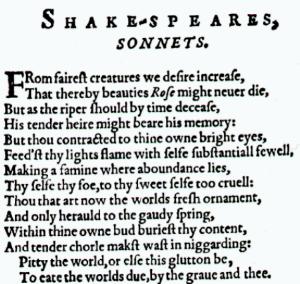
The image comes from a scan of the first publication of the Sonnets in 1609, taken, published and released without Shakespeare’s permission.

Friday’s Maniacal Poe Quote – 12 June 2015

The last poem Edgar A. Poe ever wrote, ‘Annabel Lee’ is the most explicit manifestation of his obsession with the idea that “The death of a beautiful woman is, unquestionably, the most poetical topic in the world.” This poem is brief and very much to the point. Perhaps its simplicity is part of what has made it such an enduring favorite:

It was many and many a year ago,

   In a kingdom by the sea,

That a maiden there lived whom you may know

   By the name of Annabel Lee;

And this maiden she lived with no other thought

   Than to love and be loved by me.

I was a child and she was a child,

   In this kingdom by the sea,

But we loved with a love that was more than love—

   I and my Annabel Lee—

With a love that the wingèd seraphs of Heaven

   Coveted her and me.

And this was the reason that, long ago,

   In this kingdom by the sea,

A wind blew out of a cloud, chilling

   My beautiful Annabel Lee;

So that her highborn kinsmen came

   And bore her away from me,

To shut her up in a sepulchre

   In this kingdom by the sea.

The angels, not half so happy in Heaven,

   Went envying her and me—

Yes!—that was the reason (as all men know,

   In this kingdom by the sea)

That the wind came out of the cloud by night,

   Chilling and killing my Annabel Lee.

But our love it was stronger by far than the love

   Of those who were older than we—

   Of many far wiser than we—

And neither the angels in Heaven above

   Nor the demons down under the sea

Can ever dissever my soul from the soul

   Of the beautiful Annabel Lee;

For the moon never beams, without bringing me dreams

   Of the beautiful Annabel Lee;

And the stars never rise, but I feel the bright eyes

   Of the beautiful Annabel Lee;

And so, all the night-tide, I lie down by the side

   Of my darling—my darling—my life and my bride,

   In her sepulchre there by the sea—

   In her tomb by the sounding sea.

Poe died in loneliness and without any friends. On his deathbed in Washington College Hospital, the presiding physician had difficulty finding anyone to visit Poe as he lay in his final delirium. Even at Poe’s burial, hardly anyone attended.

Poe lost his only wife, Virginia, to tuberculosis years earlier, and in Poe’s own final years he wooed a string of women. Perhaps it is only fitting that his final verse (not even published till after his death) would be a mournful remembrance about a lifelong love, a love greater than anything even the angels could comprehend.

The image comes from my visit to Poe’s grave several years ago in Baltimore.