Sonnet 23 is rarely counted among Shakespeare’s greatest, but I’m terribly fond of it for a couple reasons.
Its opening lines allude to Shakespeare’s own profession as an actor, which is tantalizing since we know so little about Shakespeare’s life. I also like this sonnet because it speaks to the power of the written word, and how that is more enduring than the power of the spoken word. If you think about it, that pretty much summarizes Shakespeare’s two artistic worlds: his theatre craft, the art of the spoken word, and his published verse, the power of the written word. Of course both of these get muddled: After Shakespeare’s death, his friends published his plays, preserving the Bard’s legacy in writing. And poetry? Many believe all verse is meant to be read aloud.
For the purposes of this sonnet, the Poet argues that the Young Man can find the truest expression of the Poet’s love in his written verse, and not in speech. Isn’t that true for many of us even today, in our modern world? Written words to a lover carry so much more weight. It’s one thing to throw off a clever quip, too often spat out with too much emotion; so much more clear and enduring it you can commit that emotion to pen and paper.
23
As an unperfect actor on the stage Who with his fear is put besides his part, Or some fierce thing replete with too much rage, Whose strength’s abundance weakens his own heart. So I, for fear of trust, forget to say The perfect ceremony of love’s rite, And in mine own love’s strength seem to decay, O’ercharged with burden of mine own love’s might. O, let my books be then the eloquence And dumb presagers of my speaking breast, Who plead for love and look for recompense More than that tongue that more hath more express’d. O, learn to read what silent love hath writ: To hear with eyes belongs to love’s fine wit.
Glorious, bawdy, androgynous and controversial, Sonnet # 20 is one of my favorites. The Poet is writing to the Young Man, and in this poem we get some hints of the Young Man’s physical attributes and the kind of sexuality he might’ve exuded: he evokes many qualities of a woman: ‘A woman’s face with Nature’s own hand painted / Hast thou’, ‘A woman’s gentle heart’ and ‘an eye more bright than theirs.’
As usual with Shakespeare’s sonnets, there’s a lot going on here. The Poet might be comparing his Young Man’s qualities to a woman’s, but at the same time he’s trashing women in general: ‘not acquainted / With shifting change, as is false women’s fashion’, and the Young Man’s eyes are brighter than woman’s, and ‘less false in rolling.’
Misogynistic? Yes, but this was the Elizabethan period. I’m not making the case that Shakespeare was a misogynist: many of his male characters were, but by the end of his career The Bard gave us some astonishing female characters. But for the purposes of this sonnet, it’s there and it’s hard to argue against.
Then there’s the bawdy part, and it’s not overt like some stuff in his later sonnets. It’s sly. Nature has made the Young Man very much like a woman, except for that small detail of ‘one thing.’ And in case you don’t get what that one thing is, Shakespeare can’t resist slipping in a delicious pun in the final couplet ‘But since she prick’d thee out for women’s pleasure.’
Reading this sonnet, it’s also wise to remember that Shakespeare loved to change up gender roles; his plays have many instances of the sexes getting mixed up. Here, of course, it’s not an intentional disguise that’s mixing up the sexes, it’s Nature herself.
So what’s the Poet to do with this mix up? He pretty much doesn’t know–for the moment he’s satisfied to take the Young Man’s love, letting women take the ‘one thing’ the Poet has no use for.
The intricacies don’t stop there. An examination of the poem’s iambic pentameter show that in this sonnet, Shakespeare gave what’s known in poetic circles as feminine endings to his lines: that is, an extra syllable at the end. ‘Painted’ and ‘acquainted’, so on and so forth.
Finally, there’s the historical and critical controversy over Sonnet #20. Does it suggest Shakespeare might’ve been gay? Are the Sonnets numbered in an intentional sequence and thus tell a story–making #20 key? If so, is that story autobiographical? Who knows? Just go and enjoy this masterpiece!
20
A woman’s face with Nature’s own hand painted Hast thou, the master-mistress of my passion; A woman’s gentle heart, but not acquainted With shifting change, as is false women’s fashion; An eye more bright than theirs, less false in rolling, Gilding the object whereupon it gazeth; A man in hue, all ‘hues’ in his controlling, Much steals men’s eyes and women’s souls amazeth. And for a woman wert thou first created; Till Nature, as she wrought thee, fell a-doting, And by addition me of thee defeated, By adding one thing to my purpose nothing. But since she prick’d thee out for women’s pleasure, Mine be thy love and thy love’s use their treasure.
As the sequence of Shakespeare’s 154 sonnets dives into its second section–the love poems to the Young Man–in number 19 we get a taste of Shakespeare’s sense of ‘Time.’ It’s nice to be right (in my own life I’m occasionally right) but here Shakespeare was right now only when he wrote this sonnet, but he’s still right four hundred years later: the only thing that can combat the destruction of Time is the power of Art.
This sonnet is not considered to be among his greatest, but I think it’s fantastic for its vivid animal imagery describing time’s devouring power. It starts with:
And Earth devour her own sweet brood;
Pluck the keen teeth from the fierce tiger’s jaws…
In addition to being a sonnet that’s a lot of fun to read aloud, if you remember my little tutorial from a week ago, Sonnet 19 breaks one of the rules of the Shakespearean sonnet. The ‘turn’ in the argument begins one line early; not at the start of the third quatrain, but in the last line of the second quatrain:
But I forbid thee one most heinous crime.
I don’t know if this should be considered a ‘flaw’ in this sonnet or not. Certainly Shakespeare was aware of it; perhaps for the sake of balance and argument, he chose to place the turn in his argument one line early. Or I perhaps it was too hard to fix. That I kind of doubt–he was the master of this form. I’ve tried writing Shakespearean sonnets, and it’s incredibly difficult to construct anything that makes sense, reads well, doesn’t mix metaphors, follows the proscribed meter and rhyme, follows the sonnet form, and is good enough to still be read four hundred years later.
Flaw or not, Time devours everything but Art.
19
Devouring Time, blunt thou the lion’s paws, And make the earth devour her own sweet brood; Pluck the keen teeth from the fierce tiger’s jaws, And burn the long-lived phoenix in her blood; Make glad and sorry seasons as thou fleet’st, And do whate’er thou wilt, swift-footed Time, To the wide world and all her fading sweets; But I forbid thee one most heinous crime: O, carve not with thy hours my love’s fair brow, Nor draw no lines there with thine antique pen; Him in thy course untainted do allow For beauty’s pattern to succeeding men. Yet, do thy worst, old Time: despite thy wrong, My love shall in my verse ever live young.
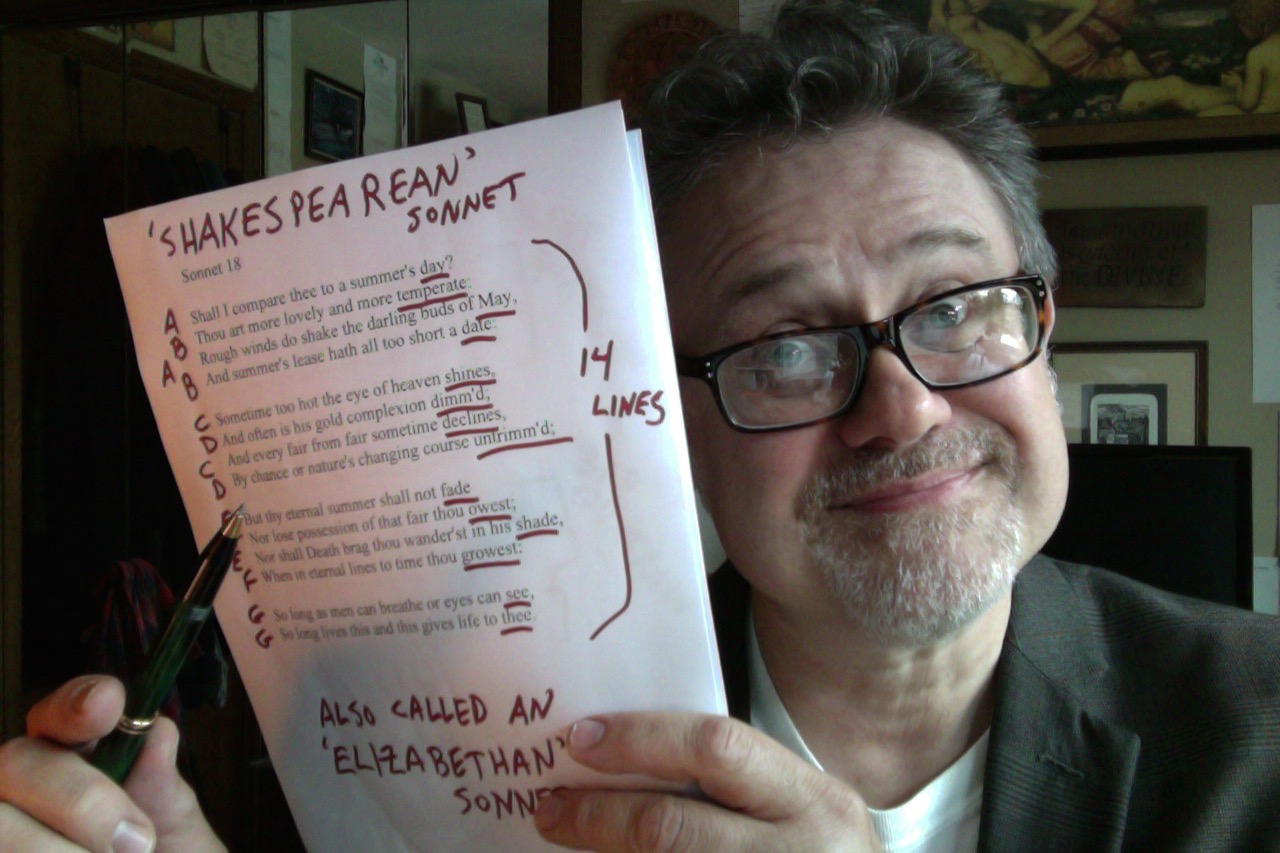
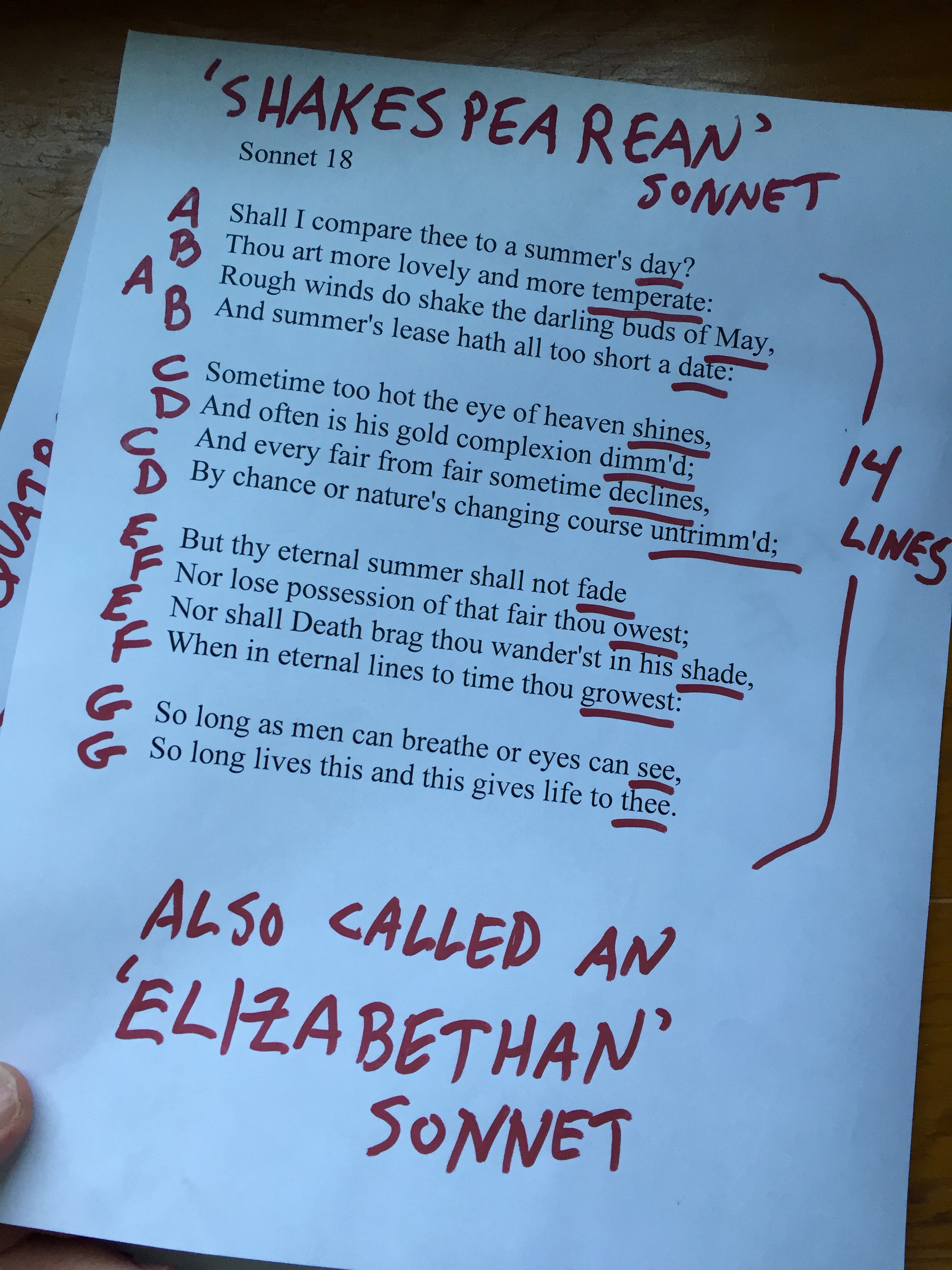
For today’s reading, I’ve taken a suggestion from my former college Shakespeare professor (thank you, Dr. Sommer) to talk a little bit about the form of the Sonnet. Don’t worry–I’ve tried to keep it simple and very, very basic, even though the sonnet form is crazy intricate. My little chat misses a thousand things, just scratching the surface.
I’d like to make one comment before letting my video do my work for me. The intricacies of the Elizabethan sonnet were more than just for fun, more than a Sudoku puzzle, more than just the pleasure of, say, solving the Sunday New York Times Crossword. All the crazy rules of the sonnet form together–and Shakespeare’s mastery over all those elements–have combined together to make Shakespeare’s sonnets so enduring.
Find a few brief section headers from my chat below.
Cathedral of the Written Word
Wherein I rant a bit why I’m so obsessed with Shakespeare’s sonnets.
14 lines with a specific rhyme scheme
A bit about the very specific rhyme scheme.
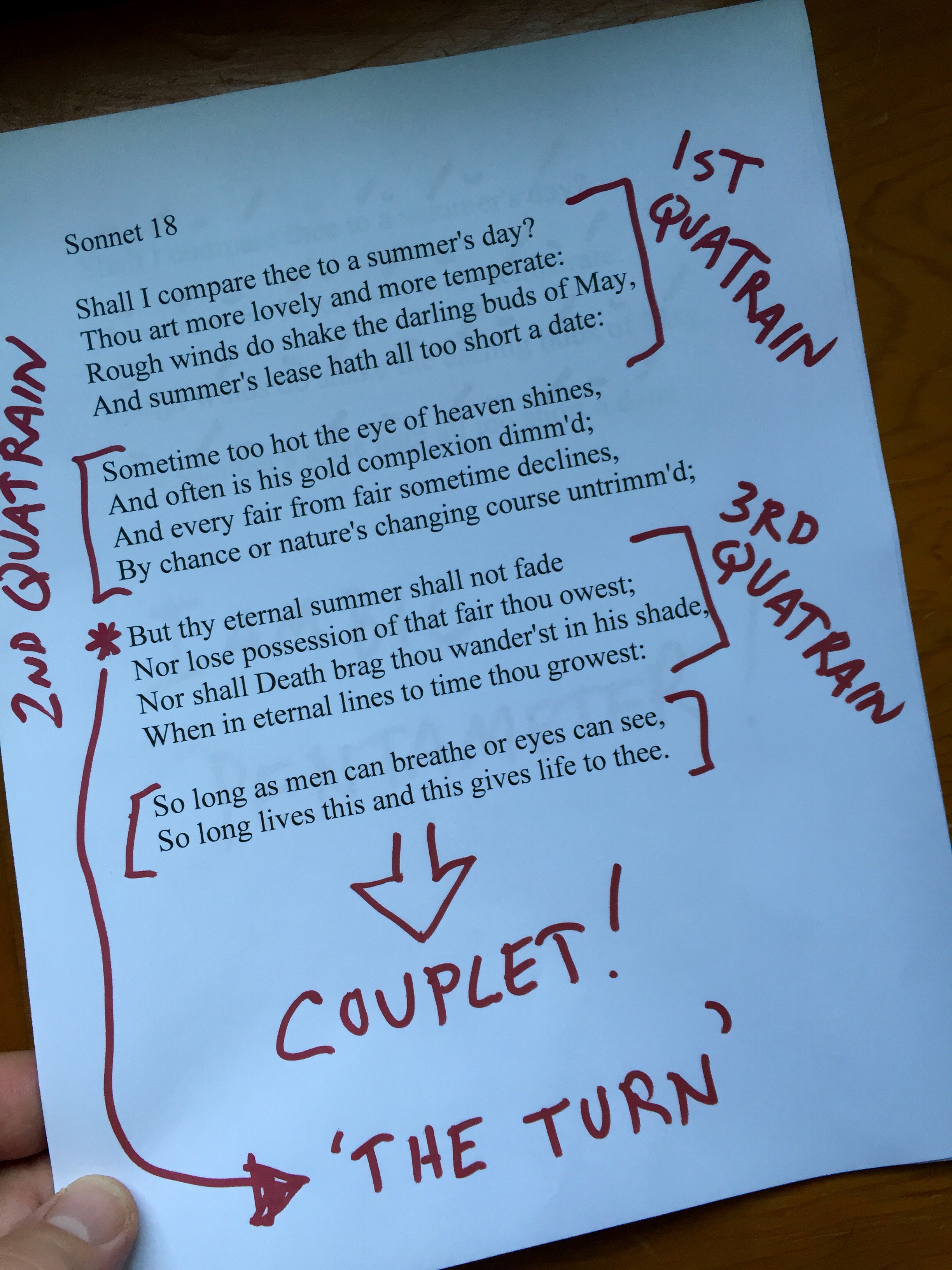
3 Quatrains, the Turn and a Couplet
The basic organization of the sonnet, which helps make each sonnet an ‘argument.’
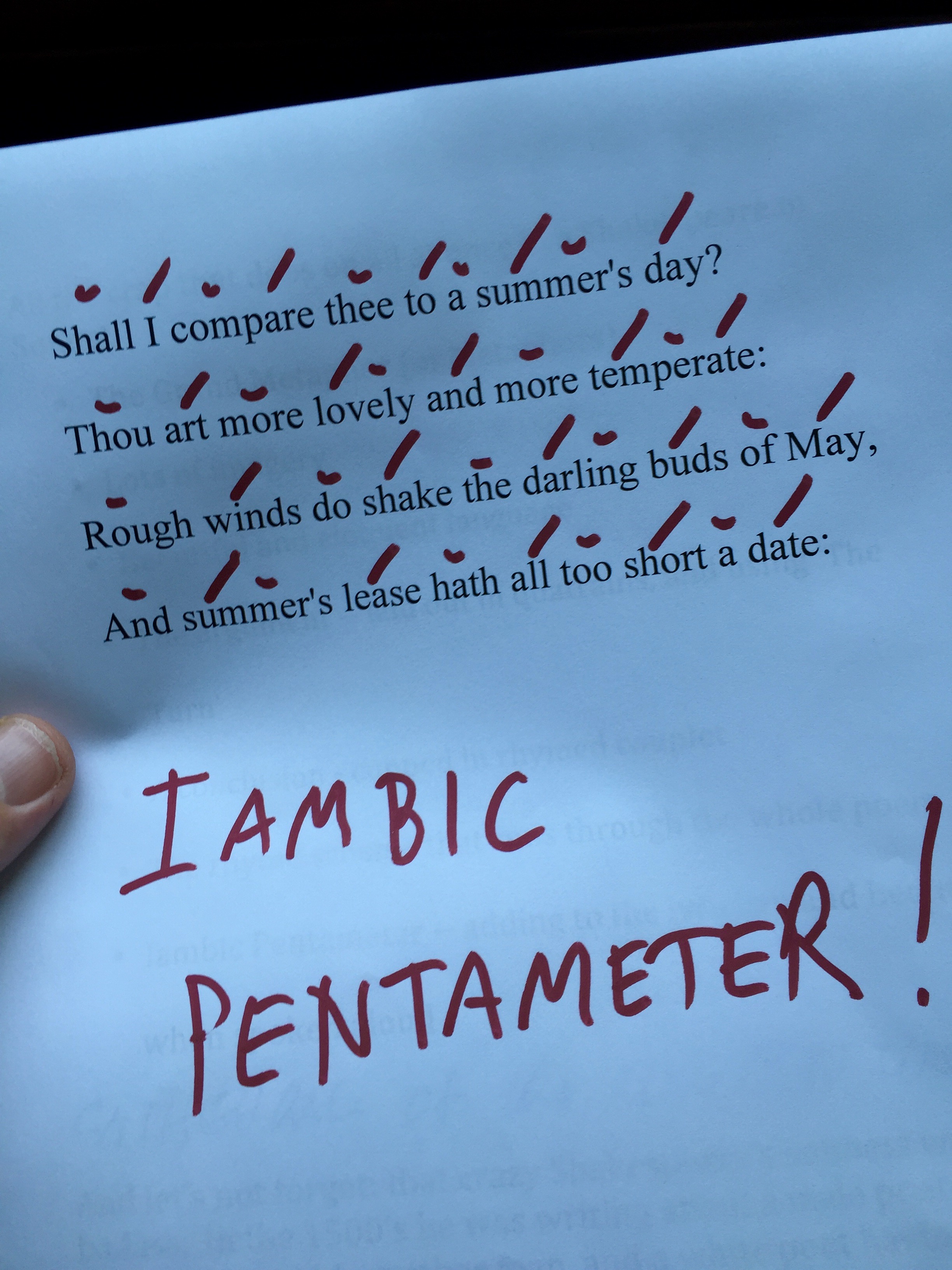
Iambic Pentameter
This is all metered verse. Here I don’t even scratch the surface. But trust me, metered verse adds to its lyricism, and especially comes to play when this poetry is spoken aloud.
Thank you to everyone today who watched my mini lecture.
Shakespeare’s Sonnet # 18, written over 400 years ago, is a miracle. Often quoted, it is regarded by many to be the quintessential love sonnet. Summer and the cycles of seasons are the grand metaphor here, with the Poet comparing his love to the beauty of a summer’s day. But, like a summer’s day, that beauty passes. The argument of this sonnet is sublimely simple: fear not, for your beauty, and my love for you, will be preserved in the lines of this verse.
Oftentimes this sonnet is read at weddings. What folks often forget or don’t even realize is that the Poet wrote this sonnet to another man. Extraordinary for something from the Elizabethan era. In the cycle of 154 Sonnets, this is the first turning point–where the Poet first admits he loves the Young Man. What a way to proclaim it!
What’s truly lovely about this sonnet, I think, is that it’s perfect for any wedding, heterosexual or otherwise, and for any era; wonderfully suited to any couple in love, regardless of their makeup, and a timeless expression of life, death and Art, evoking one of the most beautiful of human qualities–rapture for another human.
18
Shall I compare thee to a summer’s day? Thou art more lovely and more temperate: Rough winds do shake the darling buds of May, And summer’s lease hath all too short a date: Sometime too hot the eye of heaven shines, And often is his gold complexion dimm’d; And every fair from fair sometime declines, By chance or nature’s changing course untrimm’d; But thy eternal summer shall not fade Nor lose possession of that fair thou owest; Nor shall Death brag thou wander’st in his shade, When in eternal lines to time thou growest: So long as men can breathe or eyes can see, So long lives this and this gives life to thee.
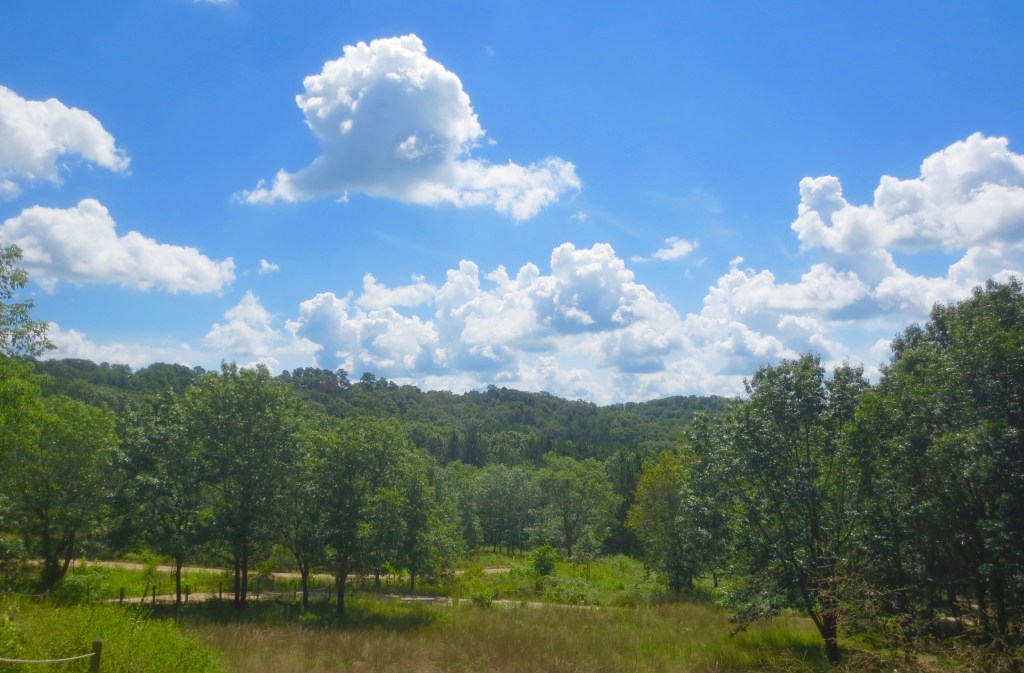
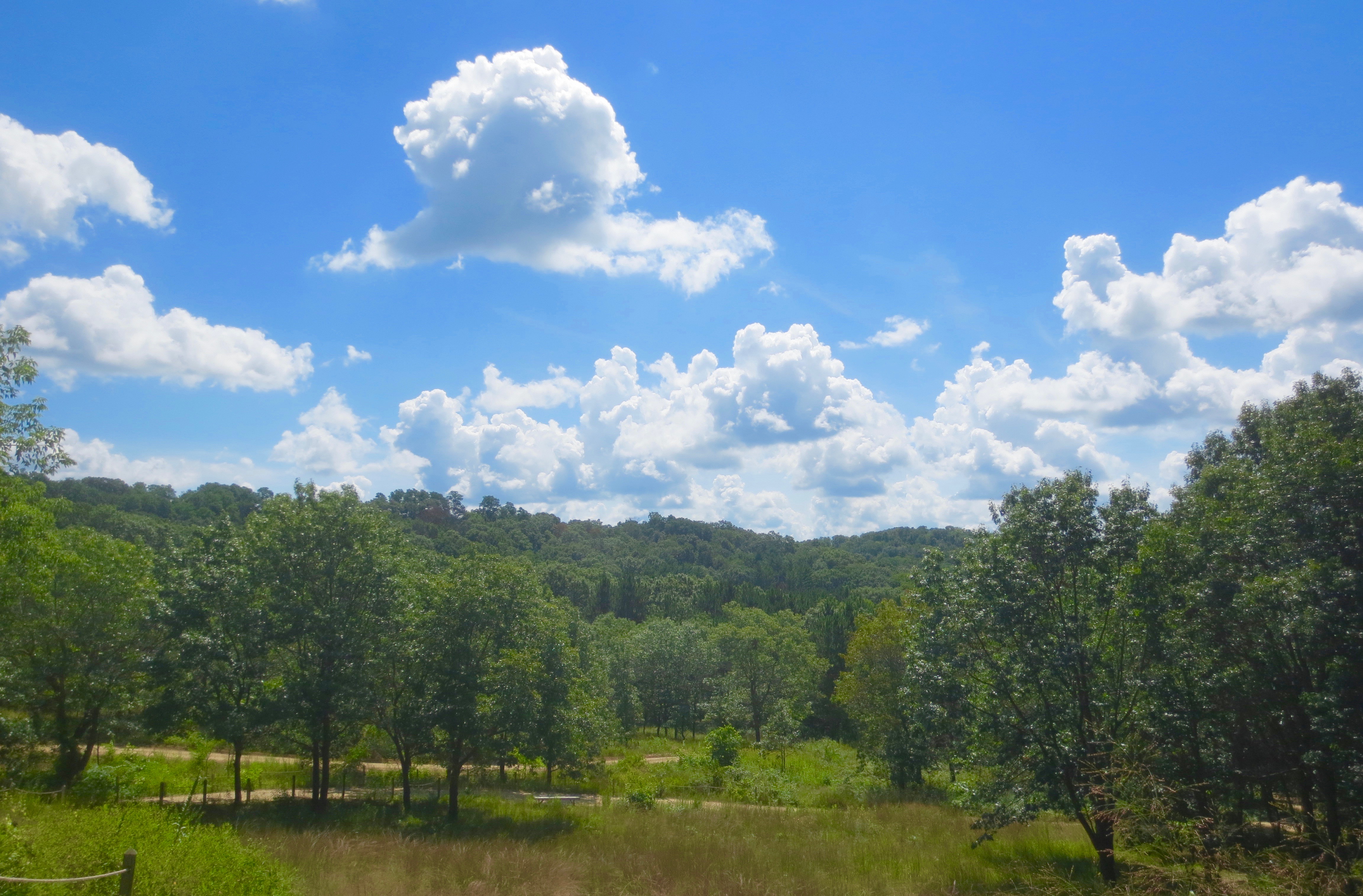
Much thanks to my dear old mom, who let me record this in her back forty, on a late summer day.
What can defeat death? Medicine? Religious faith? Neither of these seem to do the trick for Shakespeare. No, for the Bard, only Art defeats death.
Shakespeare’s sonnet sequence of 154 verses, if read as a whole, reveal a kind of narrative thread. If you follow that thread, number 17 marks the end of the first part. The poet is just about fed up with trying to convince the beautiful Young Man to preserve his beauty by producing a beautiful child, and instead for the first time suggests that maybe the poet’s own poetic Art might be the only thing to overcome the power of death.
The suggestion is hesitant at first, for the Poet seems to disparage the veracity of his poetic art–‘The Poet lies’. But by the end of this sonnet he seems more certain of Art’s power: ‘You should live twice; in it and in my rhyme.’
There’s some truly beautiful language in this sonnet, and I always find it a challenge to read aloud.
17
Who will believe my verse in time to come, If it were fill’d with your most high deserts? Though yet, heaven knows, it is but as a tomb Which hides your life and shows not half your parts. If I could write the beauty of your eyes And in fresh numbers number all your graces, The age to come would say ‘This poet lies: Such heavenly touches ne’er touch’d earthly faces.’ So should my papers yellow’d with their age Be scorn’d like old men of less truth than tongue, And your true rights be term’d a poet’s rage And stretched metre of an antique song: But were some child of yours alive that time, You should live twice; in it and in my rhyme.
I love Sonnet 15. It marks a turn in Shakespeare’s great sequence of 154 sonnets. The poet turns from trying to convince the Young Man that he needs to father a child in order to preserve his beauty. You see, there’s another way to preserve the Young Man’s beauty: the Poet’s power of verse! On this point the Poet was most certainly correct. Over four hundred years later we’re still reading these words, but have no idea if the Young Man’s line survived or not. There’s even doubt about who the Young Man was.
Note the lovely imagery throughout, and the exquisite multilayered play on words in the last line.
15
When I consider every thing that grows Holds in perfection but a little moment, That this huge stage presenteth nought but shows Whereon the stars in secret influence comment; When I perceive that men as plants increase, Cheered and cheque’d even by the self-same sky, Vaunt in their youthful sap, at height decrease, And wear their brave state out of memory; Then the conceit of this inconstant stay Sets you most rich in youth before my sight, Where wasteful Time debateth with Decay, To change your day of youth to sullied night; And all in war with Time for love of you, As he takes from you, I engraft you new.
For the first dozen or so of Shakespeare’s amazing sonnet sequence of 154 poems, the Poet’s been trying to get the Young Man to marry a woman and reproduce to preserve his beauty. But now, by Sonnet 14, things start changing. Slowly but surely, the Poet is falling in love with the Young Man. In the Elizabethan era, this is wild and dangerous stuff!
It starts when the Poet likens the beautiful Young Man’s eyes to stars–a common poetic image nowadays. Not unlike the dreamy infatuation between young lovers we see everywhere. But what’s so cool here is that on its surface, the Poet seems to be talking about the Young Man’s eyes, he’s really revealing himself: Line 9 starts to spells it out: ‘But from thine eyes my knowledge I derive.’ Reason or good sense be damned, the Poet derives real truth and beauty from the eyes of the person he’s become infatuated with. We’ve all seen that before, haven’t we? And most of us have lived it.
14
Not from the stars do I my judgment pluck; And yet methinks I have astronomy, But not to tell of good or evil luck, Of plagues, of dearths, or seasons’ quality; Nor can I fortune to brief minutes tell, Pointing to each his thunder, rain and wind, Or say with princes if it shall go well, By oft predict that I in heaven find: But from thine eyes my knowledge I derive, And, constant stars, in them I read such art As truth and beauty shall together thrive, If from thyself to store thou wouldst convert; Or else of thee this I prognosticate: Thy end is truth’s and beauty’s doom and date.
When William Shakespeare’s troupe of actors, The Lord Chamberlain’s Men, erected the Globe Theatre in 1599, did Will ever imagine his plays would still be performed four centuries later half a world away? Of course they are. And here in Southern Wisconsin, we’re very lucky that one of the top professional Shakespearean acting companies in the world, American Players Theatre, calls Wisconsin its home.
This weekend I was lucky enough to tour all of the myriad backstage places and outbuildings of what amounts to a small city tucked away in the woods. American Players Theatre (APT), is a classical repertory theatre that performs Western stage classics. APT covers about 100 or so acres of forestland along the Wisconsin River, not far from Frank Lloyd Wright’s Taliesin. The APT campus houses two theatres–a gigantic outdoor venue that seats over a 1000, and a small intimate theatre for about 200. APT puts on about 8 shows per season, and typically 2 or 3 of those shows are Shakespearean.
Putting on high quality professional classical theatre is no mean feat. Putting on 8 shows over the course of a season is tantamount to planning an invasion. Here are a few glimpses behind the scenes.
Wisconsin River country on the edge of the Driftless region. This is a view of APT’s forestland from the summit of their ‘Up the Hill’ theatre. Three thespians founded this troupe back in 1980, when they discovered that the bowl of this hill created a natural acoustic amphitheater.
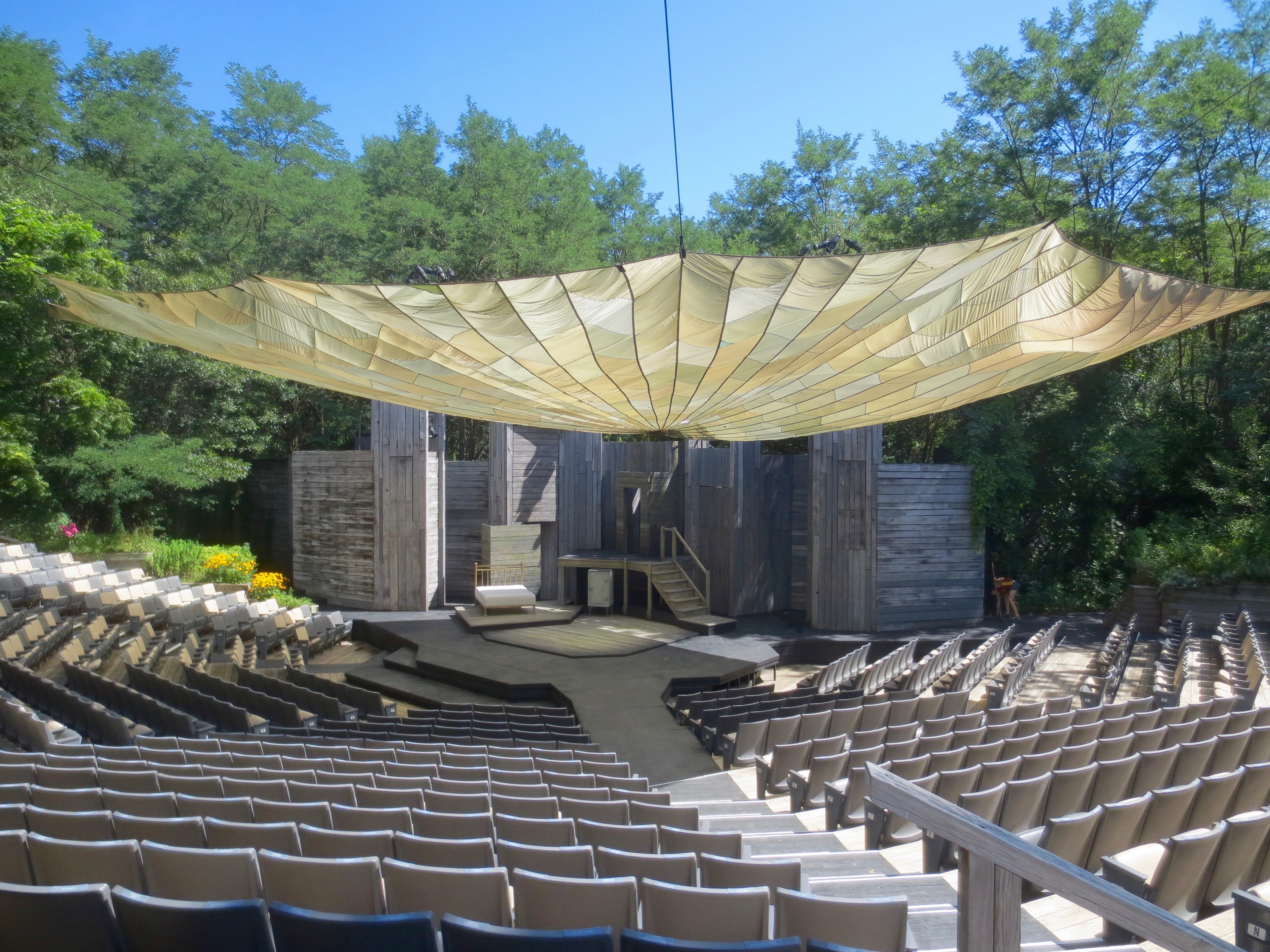
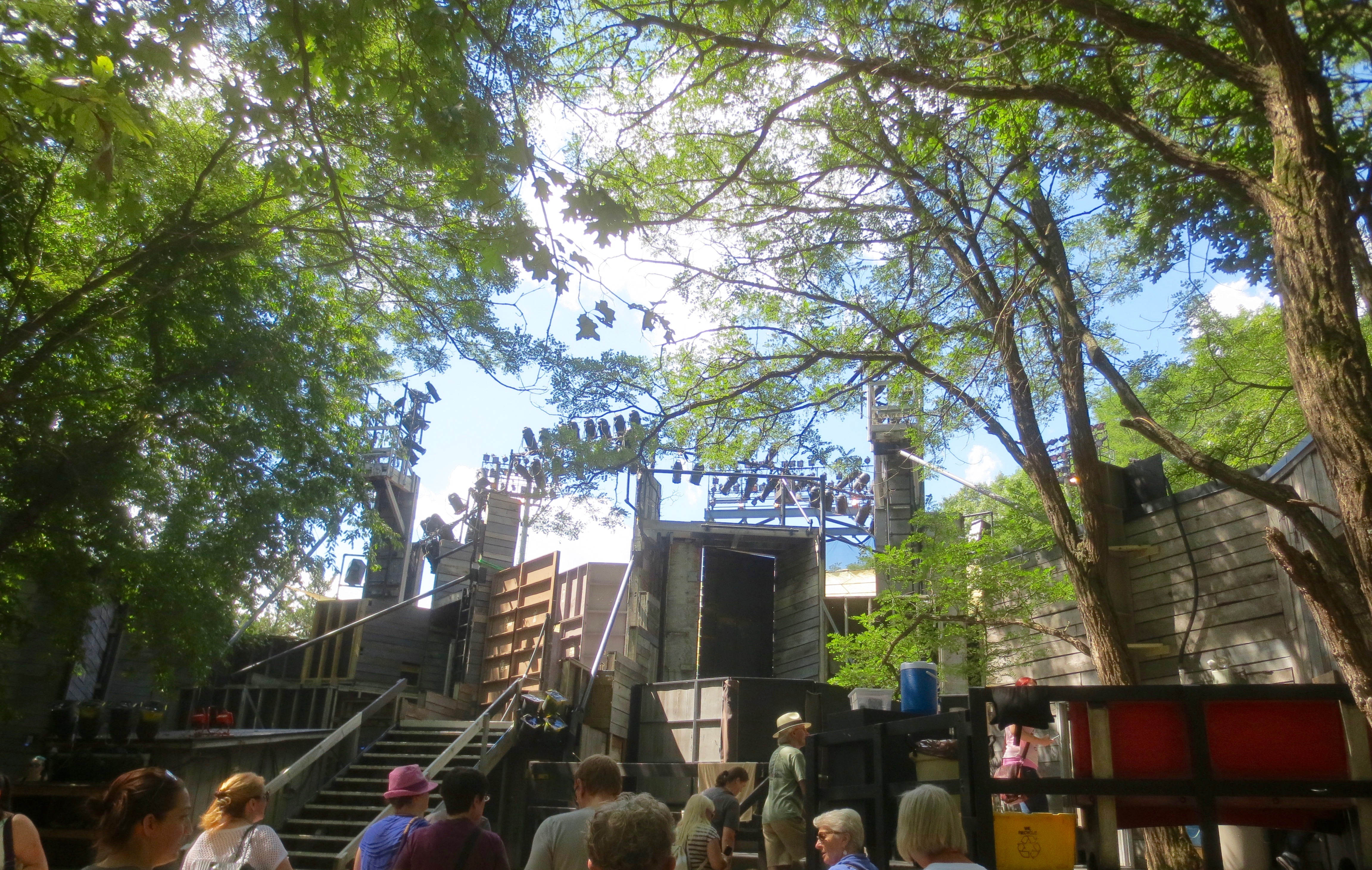
The ‘Up the Hill’ theatre. For 36 years this has been the heart and soul of APT. Most of the shows I’ve seen here through the years I’ve seen at night, under the stars. For matinees they spread out a parachute to shade the stage. Everything in the theatre–the seats, the sets, the lights–has to be rain-proof. But age has taken its toll, and after this season the whole Up the Hill theatre will be rebuilt, adding new rehearsal space, a better outdoor lobby, while preserving the natural aspects of this outdoor wonder.
The actors use more than the stage, they run up and down the amphitheater aisles. At night the actors must skirt along these hidden forest pathways to make entrances from behind the audience: Lit only by blue lights, it can be treacherous–especially if you’re wearing heels or carrying a sword.
One of the dressing rooms for the Up the Hill theatre. In the rebuild, these very old facilities will get replaced. But for now, this is what some world class actors use to get ready for their world class performances: I’m not exaggerating. APT has been written up in the New York Times, and its Artistic Directors travel to New York every year looking for talent.
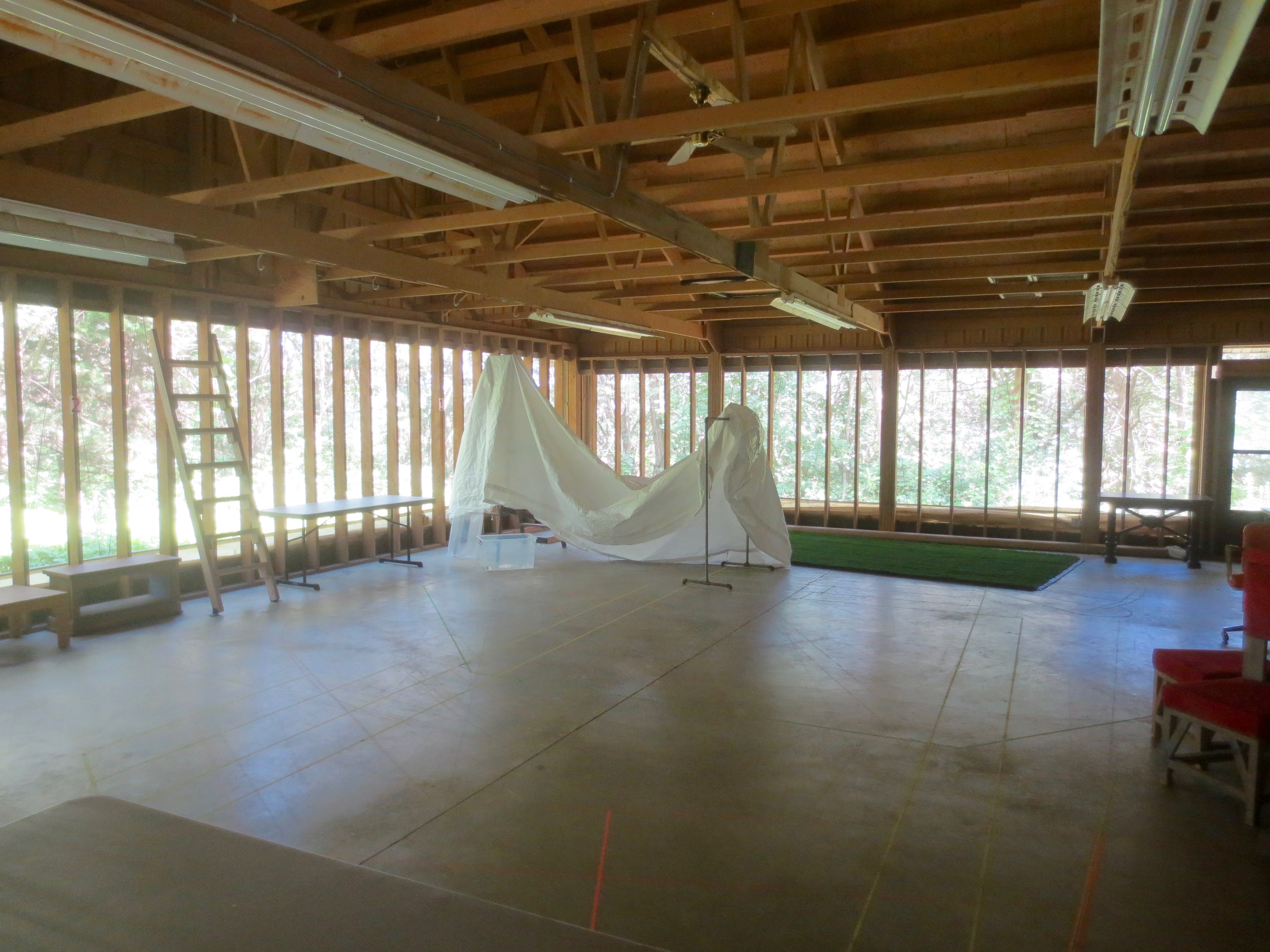
Another reason the Up the Hill section need rebuilding. APT’s campus has several rehearsal spaces, but this rickety old barn with screens for walls really needs an update. It’s in there they were probably rehearsing scenes for this year’s King Lear. I imagine it wasn’t that much different than what Will Shakespeare had to use.
The view from backstage in the Up the Hill theatre. I can’t count the number of steps, switchbacks, turns, aisles and crooks I climbed over. These actors and the tech crews typically navigate all of this at night.
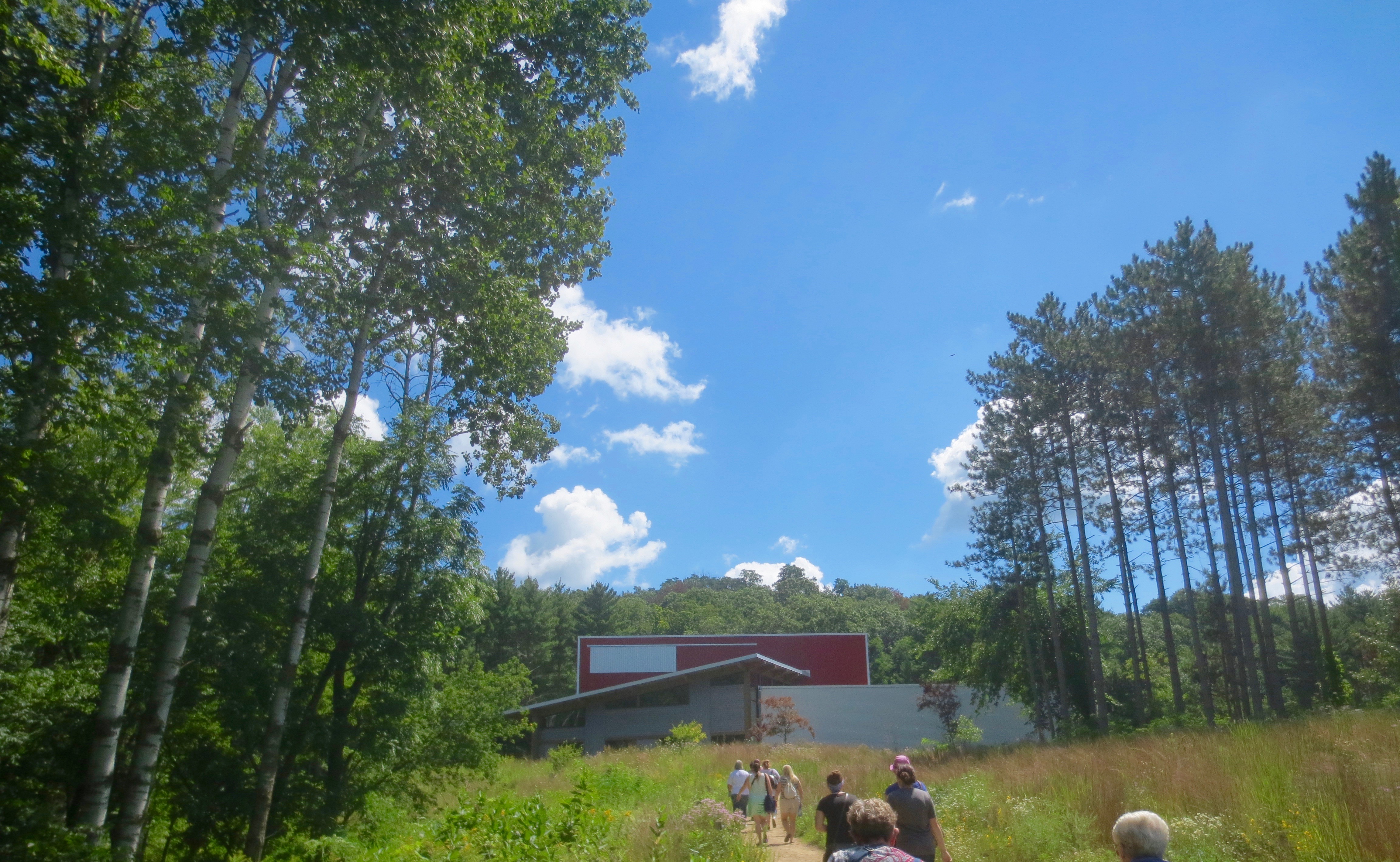
Once finished with our Up the Hill tour, we hiked through the woods to APT’s other venue, the indoor Touchstone Theatre. It sits in the middle of the woods overlooking a wide swatch of restored prairie. This theatre is only about five years old, unlike its granddaddy up on the hill.
The inside of the Touchstone has allowed APT to really expand it repertoire. They can put on much smaller plays, and it also allows APT to stretch their season into November–after the Up the Hill has been iced over.
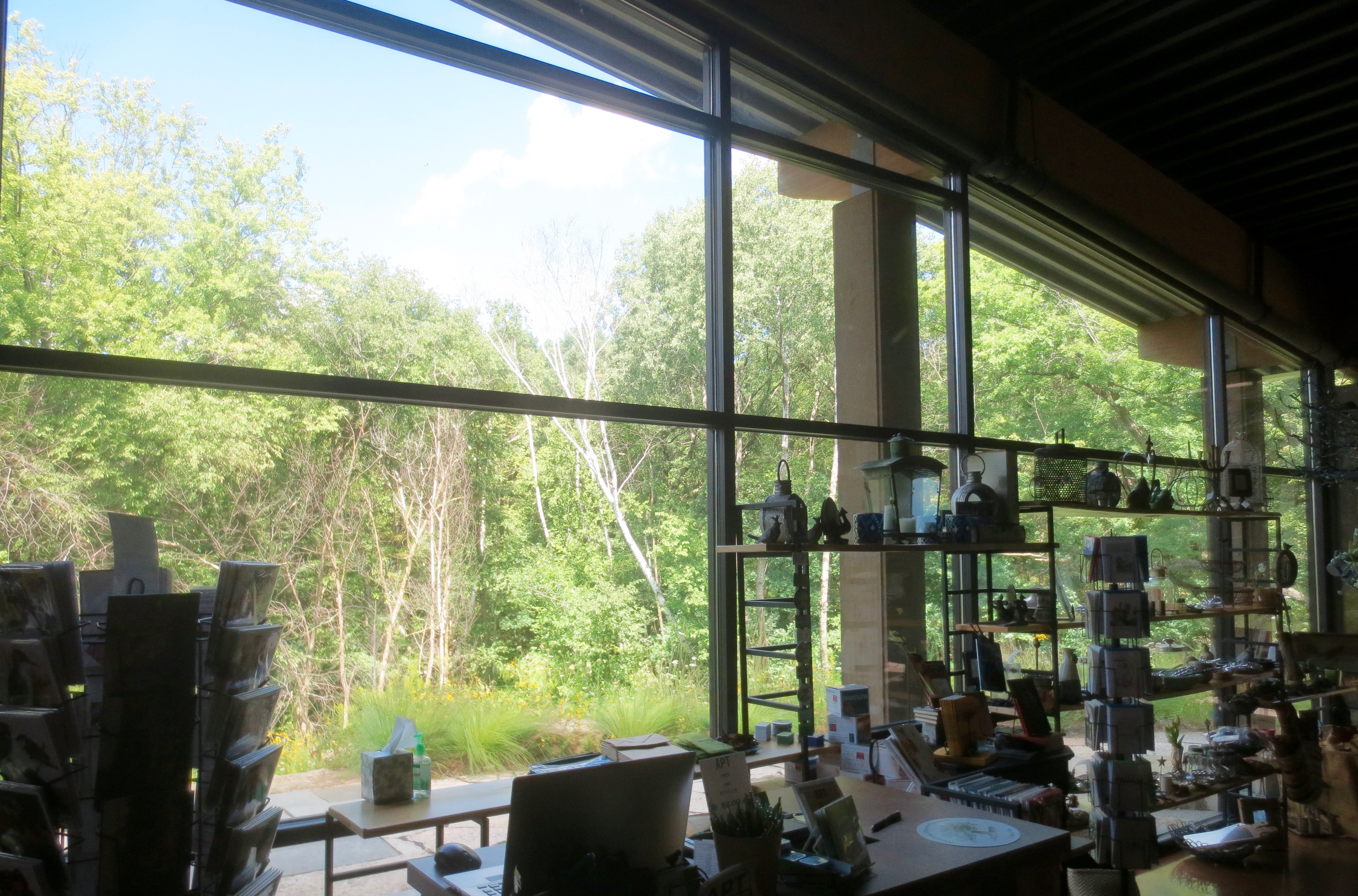
The Touchstone lobby. Though this is indoor, APT wanted to dovetail this theatre with its environment: wide windows letting in the light and gorgeous views of the forestland.
The backside of the Touchstone shows just how world class it is: all of the environmental mechanicals reside outside of the building, allowing the company to maintain complete silence in the performance space, controlling every aspect of the environment in order to bring theatrical illusions to life.
The scene shop. APT has two support buildings called Alpha and Bravo, and these house state-of-the-art rehearsal spaces, scene shops, paint shops, prop shops, costume shops, millenaries, laundries, offices and storage. Going through all of these spaces made me realize even more that the old Up the Hill theatre is really overdue for an upgrade.
The costume shop. There are a million universes in this place.
All of these skilled professionals work like hell to put on these shows, but they also have a sense of humor. Here’s mock up of an actual actor from Julius Caesar hanging from the wall of the prop shop, from a production of just a few years ago.
The costume storage seems infinite. APT builds from scratch about a third of the costumes they need for a season. They lift from the prodigious collection for another third, and have to rent or buy the last third. They are also in the business of renting costumes to other theatres in the Midwest.
Here is the grand old oak that inspired APT’s logo. She’s getting sick now, and not long for this world. But if you look to the right of this giant oak, you’ll see her successor has been growing for a few years now. A great analogy for the company and its future.
Not all of Shakespeare’s 154 Sonnets are written to the same lovers or for the same reasons, and their topics and tenors vary. But the overriding arc of the entire sonnet sequence is, I’d say, the destructive power of Time. This obsession over Time first comes to a fore in a big way in number 12, a powerful and beautiful sonnet. Written to the Young Man, the Poet warns him that time will destroy him and any memory of his beauty…if he doesn’t reproduce! Note the striking and evocative imagery of Nature’s destructive cycle–and how the progression of the seasons dovetails with the image of an aging human face. I suppose my aging face is as good an example as any.
12
When I do count the clock that tells the time, And see the brave day sunk in hideous night; When I behold the violet past prime, And sable curls all silver’d o’er with white; When lofty trees I see barren of leaves Which erst from heat did canopy the herd, And summer’s green all girded up in sheaves Borne on the bier with white and bristly beard, Then of thy beauty do I question make, That thou among the wastes of time must go, Since sweets and beauties do themselves forsake And die as fast as they see others grow; And nothing ‘gainst Time’s scythe can make defence Save breed, to brave him when he takes thee hence.








 Art is My Religion