Hump Day Shakespearean Quotes – 07 January 2015

Cassius & Brutus 2

Rationalizing cold-blooded murder is something for sick minds and for the greatest of writers.   Shakespeare was able to imagine how a flawed personality might rationalize the assassination of a friend for something the intended victim had not yet done, but might do. Amoral? Sick? Reprehensible? Yes, all of these. And also the topic for the first great soliloquy Shakespeare ever wrote:

Brutus
It must be by his death, and, for my part,
I know no personal cause to spurn at him,
But for the general. He would be crown’d:
How that might change his nature, there’s the question.
It is the bright day that brings forth the adder
And that craves wary walking. Crown him that,
And then, I grant, we put a sting in him
That at his will he may do danger with.
The abuse of greatness is when it disjoins
Remorse from power, and, to speak truth of Caesar,
I have not known when his affections sway’d
More than his reason. But ’tis a common proof
That lowliness is young ambition’s ladder,
Whereto the climber-upward turns his face;
But when he once attains the upmost round,
He then unto the ladder turns his back,
Looks in the clouds, scorning the base degrees
By which he did ascend. So Caesar may;
Then, lest he may, prevent. And, since the quarrel
Will bear no color for the thing he is,
Fashion it thus: that what he is, augmented,
Would run to these and these extremities;
And therefore think him as a serpent’s egg
Which hatch’d would as his kind grow mischievous,
And kill him in the shell.

Julius Caesar, Act 2, Scene 1

Before we get to the why this soliloquy is the first of its kind, note the imagery: There are two metaphors here. Caesar as a serpent, and Caesar as a ladder-climber. The ladder-climber has become part of our common vernacular today–“climb the corporate ladder.” The other metaphor, though–Caesar as the adder–is the creepier of the two, and Shakespeare has Brutus return to that image in the final, decisive line: “And kill him in the shell.”

That metaphor allows Brutus to develop the rationalization to murder Caesar not for anything he has done, but for what he might do. That is, kill the snake in its shell. As cold-blooded as you can get. Yet–it’s okay, he’s rationalized it.

Finally, as mentioned above, this was Shakespeare’s first great soliloquy. The idea of being able to convey on-stage a character’s innermost thoughts was something never before done in theatre until Shakespeare tried it out in Julius Caesar–all the way back in 1599. This speech is the first one. 

It worked so well for Shakespeare–it so illuminated the inner workings of his characters–that he then refined the practice. To this very day, we remember even greater soliloquys that followed in his later plays: ‘To be or not to be’ from Hamlet, or ‘Tomorrow, and tomorrow, and tomorrow’ from Macbeth, just to name two. This technique changed the nature of art forever. Need examples? It’s used today in popular culture: think of ‘The Office’ or ‘Modern Family’, where characters are given the opportunity to speak directly to the audience.

The image comes from the 1953 film version of Julius Caesar, with James Mason as Brutus (right) and John Gielgud as Cassius (left). Note their post-assassination bloodstained tunics, in glorious black and white.
Sunday Sonnet – 28 December 2014

sonnet 19

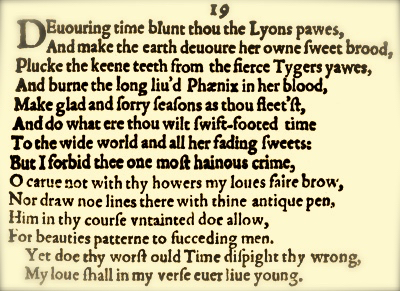
As this old year meanders to a close, I thought it appropriate to share one of Shakespeare’s  ‘Time’ sonnets.  In this one, The Bard treats Time like a character, whom the Poet addresses directly with a series of vivid metaphors.  These images describe how Time ultimately destroys everything, no matter how powerful or sublime.

Sonnet 19:

Devouring Time, blunt thou the lion’s paws,

And make the earth devour her own sweet brood;

Pluck the keen teeth from the fierce tiger’s jaws,

And burn the long-liv’d phoenix, in her blood;

Make glad and sorry seasons as thou fleet’st,

And do whate’er thou wilt, swift-footed Time,

To the wide world and all her fading sweets;

But I forbid thee one most heinous crime:

O! carve not with thy hours my love’s fair brow,

Nor draw no lines there with thine antique pen;

Him in thy course untainted do allow

For beauty’s pattern to succeeding men.

Yet, do thy worst old Time: despite thy wrong,

My love shall in my verse ever live young.

For me, this sonnet marks a turn in the Young Man sequence of verses.  The Poet has now given up on his earlier arguments: that the Young Man should procreate to preserve his own beauty.  Now the Poet employs something more powerful than nature’s gift to humans—the ability to reproduce.  Starting with the Sonnets in the late teens, the Poet summons power the Art, specifically Poetry.  Shakespeare’s poem itself shall preserve the Young Man’s beauty for eternity, thereby defeating Time’s ‘worst’.

Could Shakespeare have know how right he was?  Could he have dreamt that over 400 years later, his beloved would still live on in the lines of these immortal words?  Possibly not.  Scholarly evidence suggests fairly convincingly that the Sonnets were published without Shakespeare’s permission.  He likely intended for all of 154 of these verses—to the Young Man and the Dark Lady alike—to never see the public eye.  They were risqué, dangerous in the Elizabethan world of religious morality and homophobia.   Thankfully, today, at the close of 2014, they are regarded as the epitome of the poetic form in the English Language.  They have defeated Time’s ‘most heinous crime.’

The image is from Thomas Thorpe’s unauthorized publication of ‘SHAKES-SPEARES SONNETS’ from 1609.

Hump Day Shakespearean Quote – Christmas Eve 2014

Cobbe_portrait_of_Shakespeare

Shakespeare and the mention of Christmas don’t much intersect for two main reasons. One, back in Elizabethan times, Christmas wasn’t the big commercial deal it is today. And two, the Bard was very, very careful about religion in his plays and poetry: Elizabethan England was a police state, and one of the supreme crimes–after treason–were crimes of faith. Even with the even-minded Elizabeth, who tried to bring everyone together, the extreme believers on either end would have none of it.   The Papists and Puritans hated one another, and Shakespeare wisely gave Christianity a wide berth. 

Some say that ever ‘gainst that season comes
Wherein our Saviour’s birth is celebrated,
The bird of dawning singeth all night long:
And then, they say, no spirit dare stir abroad;
The nights are wholesome; then no planets strike,
No fairy takes, nor witch hath power to charm,
So hallowed and so gracious is the time.

Hamlet, Act I Scene i 

That’s it. Shakespeare’s only explicit reference to Christmas, and he doesn’t even say the word. It’s from Hamlet, and here Shakespeare only uses the idea of Christmas to set up the idea that evil is one its way. A holy day, when even ghosts are not allowed to haunt and witches aren’t allowed to spin charms. Ah, but a vengeful ghost is coming, and with him we’ll bring down tragedy and woe upon the entire castle of Elsinore.   

Merry Christmas, one and all, and enjoy this holiday, with the hopes that tonight and tomorrow might, indeed, ward off evil and spirits for just a while.

Postscript: And no, the play Twelfth Night doesn’t refer to Christmas either. It was the last night of the big Christmas season, traditionally reserved for performances, to which the title refers.

The image is from the ‘Cobbe Portrait’ of Shakespeare. There’s strong evidence that is the only portrait ever commissioned of the Bard during his lifetime. Artist unknown, but this Jacobean painting was discovered with a painting of another Elizabethan, Henry Wriothesley, the 3rd Earl of Southampton. Who was he? Why, most Shakespeare’s Young Man of the Sonnets.

Sunday Sonnet – Winter Solstice 2014

Sonnet 2

With today’s Solstice, I think of this sonnet, where the ravages of age will be counted in the number of winters the battered face of the Poet’s lovely Young Man might endure. 

Sonnet II

When forty winters shall besiege thy brow,

And dig deep trenches in thy beauty’s field,

Thy youth’s proud livery so gazed on now,

Will be a totter’d weed of small worth held:

Then being asked, where all thy beauty lies,

Where all the treasure of thy lusty days;

To say, within thine own deep sunken eyes,

Were an all-eating shame, and thriftless praise.

How much more praise deserv’d thy beauty’s use,

If thou couldst answer ‘This fair child of mine

Shall sum my count, and make my old excuse,’

Proving his beauty by succession thine!

   This were to be new made when thou art old,

   And see thy blood warm when thou feel’st it cold.

This second poem of Shakespeare’s long sequence of sonnets establish many of themes that would be revisited–and touch upon many truths that we still have trouble facing today: beauty never lasts; your cloak of youth will fade; there is a reason why we have children.  

What’s truly astonishing about all this, is that this sonnet–and most of the early Young Man sonnets–Shakespeare very likely wrote under commission. In other words, he might have been paid to write them on just this topic.  

Lord Burghley was Queen Elizabeth’s Lord Treasurer, and Burghley had a young ward he was in charge of–none other than the Earl of Southampton, very probably Shakespeare’s ‘Young Man’.   Southampton did not want to marry (The reasons for this are numerous and speculative, but one is that Southampton had no interest in women). What’s odd is that the first 17 sonnets all urge the Young Man to procreate. Never before had the Romantic form of the Sonnet been used for such an odd endeavor: that is a male Poet urging another male–a beautiful and lovely male–to procreate. But Shakespeare makes it work. I mean–how else to convince a vain, spoiled and possibly gay Earl to marry up and reproduce? Flatter him. 

Alas, after Sonnet 17, things turn for the Poet (that is, Will Shakespeare), and he finds himself falling in love with this vain, beautiful creature.   But for today, let’s revel in Number 2, and its lovely, varied imagery. And remember: braving these cold winters will only dig deep the trenches in our fields of beauty. 

The image is from the northern woods of Wisconsin, of a dear old place I’ll very likely never be able to visit again.

Happy Halloween from Edgar A. Poe!

Raven Poe

The Raven

Once upon a midnight dreary, while I pondered, weak and weary,

Over many a quaint and curious volume of forgotten lore—

    While I nodded, nearly napping, suddenly there came a tapping,

As of some one gently rapping, rapping at my chamber door.

“’Tis some visitor,” I muttered, “tapping at my chamber door—

            Only this and nothing more.”


    Ah, distinctly I remember it was in the bleak December;

And each separate dying ember wrought its ghost upon the floor.

    Eagerly I wished the morrow;—vainly I had sought to borrow

    From my books surcease of sorrow—sorrow for the lost Lenore—

For the rare and radiant maiden whom the angels name Lenore—

            Nameless here for evermore.


    And the silken, sad, uncertain rustling of each purple curtain

Thrilled me—filled me with fantastic terrors never felt before;

    So that now, to still the beating of my heart, I stood repeating

    “’Tis some visitor entreating entrance at my chamber door—

Some late visiter entreating entrance at my chamber door;—

            This it is and nothing more.”


    Presently my soul grew stronger; hesitating then no longer,

“Sir,” said I, “or Madam, truly your forgiveness I implore;

    But the fact is I was napping, and so gently you came rapping,

    And so faintly you came tapping, tapping at my chamber door,

That I scarce was sure I heard you”—here I opened wide the door;—

            Darkness there and nothing more.


    Deep into that darkness peering, long I stood there wondering, fearing,

Doubting, dreaming dreams no mortal ever dared to dream before;

    But the silence was unbroken, and the stillness gave no token,

    And the only word there spoken was the whispered word, “Lenore?”

This I whispered, and an echo murmured back the word, “Lenore!”—

            Merely this and nothing more.


    Back into the chamber turning, all my soul within me burning,

Soon again I heard a tapping somewhat louder than before.

    “Surely,” said I, “surely that is something at my window lattice;

      Let me see, then, what thereat is, and this mystery explore—

Let my heart be still a moment and this mystery explore;—

            ’Tis the wind and nothing more!”


    Open here I flung the shutter, when, with many a flirt and flutter,

In there stepped a stately Raven of the saintly days of yore;

    Not the least obeisance made he; not a minute stopped or stayed he;

    But, with mien of lord or lady, perched above my chamber door—

Perched upon a bust of Pallas just above my chamber door—

            Perched, and sat, and nothing more.


Then this ebony bird beguiling my sad fancy into smiling,

By the grave and stern decorum of the countenance it wore,

“Though thy crest be shorn and shaven, thou,” I said, “art sure no craven,

Ghastly grim and ancient Raven wandering from the Nightly shore—

Tell me what thy lordly name is on the Night’s Plutonian shore!”

            Quoth the Raven “Nevermore.”


    Much I marvelled this ungainly fowl to hear discourse so plainly,

Though its answer little meaning—little relevancy bore;

    For we cannot help agreeing that no living human being

    Ever yet was blessed with seeing bird above his chamber door—

Bird or beast upon the sculptured bust above his chamber door,

            With such name as “Nevermore.”


    But the Raven, sitting lonely on the placid bust, spoke only

That one word, as if his soul in that one word he did outpour.

    Nothing farther then he uttered—not a feather then he fluttered—

    Till I scarcely more than muttered “Other friends have flown before—

On the morrow he will leave me, as my Hopes have flown before.”

            Then the bird said “Nevermore.”


    Startled at the stillness broken by reply so aptly spoken,

“Doubtless,” said I, “what it utters is its only stock and store

    Caught from some unhappy master whom unmerciful Disaster

    Followed fast and followed faster till his songs one burden bore—

Till the dirges of his Hope that melancholy burden bore

            Of ‘Never—nevermore’.”


    But the Raven still beguiling all my fancy into smiling,

Straight I wheeled a cushioned seat in front of bird, and bust and door;

    Then, upon the velvet sinking, I betook myself to linking

    Fancy unto fancy, thinking what this ominous bird of yore—

What this grim, ungainly, ghastly, gaunt, and ominous bird of yore

            Meant in croaking “Nevermore.”


    This I sat engaged in guessing, but no syllable expressing

To the fowl whose fiery eyes now burned into my bosom’s core;

    This and more I sat divining, with my head at ease reclining

    On the cushion’s velvet lining that the lamp-light gloated o’er,

But whose velvet-violet lining with the lamp-light gloating o’er,

            She shall press, ah, nevermore!


    Then, methought, the air grew denser, perfumed from an unseen censer

Swung by Seraphim whose foot-falls tinkled on the tufted floor.

    “Wretch,” I cried, “thy God hath lent thee—by these angels he hath sent thee

    Respite—respite and nepenthe from thy memories of Lenore;

Quaff, oh quaff this kind nepenthe and forget this lost Lenore!”

            Quoth the Raven “Nevermore.”


    “Prophet!” said I, “thing of evil!—prophet still, if bird or devil!—

Whether Tempter sent, or whether tempest tossed thee here ashore,

    Desolate yet all undaunted, on this desert land enchanted—

    On this home by Horror haunted—tell me truly, I implore—

Is there—is there balm in Gilead?—tell me—tell me, I implore!”

            Quoth the Raven “Nevermore.”


    “Prophet!” said I, “thing of evil!—prophet still, if bird or devil!

By that Heaven that bends above us—by that God we both adore—

    Tell this soul with sorrow laden if, within the distant Aidenn,

    It shall clasp a sainted maiden whom the angels name Lenore—

Clasp a rare and radiant maiden whom the angels name Lenore.”

            Quoth the Raven “Nevermore.”


    “Be that word our sign of parting, bird or fiend!” I shrieked, upstarting—

“Get thee back into the tempest and the Night’s Plutonian shore!

    Leave no black plume as a token of that lie thy soul hath spoken!

    Leave my loneliness unbroken!—quit the bust above my door!

Take thy beak from out my heart, and take thy form from off my door!”

            Quoth the Raven “Nevermore.”


    And the Raven, never flitting, still is sitting, still is sitting

On the pallid bust of Pallas just above my chamber door;

    And his eyes have all the seeming of a demon’s that is dreaming,

    And the lamp-light o’er him streaming throws his shadow on the floor;

And my soul from out that shadow that lies floating on the floor

            Shall be lifted—nevermore!


Sunday Sonnet – 26 Oct 2015

Medieval-Bath

Sonnet 153

Cupid laid by his brand, and fell asleep:
A maid of Dian’s this advantage found,
And his love-kindling fire did quickly steep
In a cold valley-fountain of that ground;
Which borrow’d from this holy fire of Love
A dateless lively heat, still to endure,
And grew a seething bath, which yet men prove
Against strange maladies a sovereign cure.
But at my mistress’ eye Love’s brand new-fired,
The boy for trial needs would touch my breast;
I, sick withal, the help of bath desired,
And thither hied, a sad distemper’d guest,
But found no cure: the bath for my help lies
Where Cupid got new fire–my mistress’ eyes.

Venereal Disease?

In the traditional parsing out of Shakespeare’s sonnets, the Bard’s last two sonnets, 153 and 154, are not lumped in with the Dark Lady sequence, which includes sonnets 127 – 152. However, if one reads between the lines, it quickly become obvious there are double entendres here. Why doubt it? Shakespeare was the master of weaving multiple meanings into lines.

The ‘lively heat’ of a ‘seething bath’ ‘against strange maladies’ that lead to ‘a sovereign cure’ seem to unmistakably refer to one of the two most common Elizabethan cures for syphilis: severely hot baths. (And the references to venereal disease continue in Sonnet 154, which I’ll save for another day).

A ho-hum love sonnet with fairly tepid classical references? Or a whole lot more? We’re talking about Shakespeare here! If this sonnet is multilayered, the irony becoming inescapable.   At first blush Sonnet 153 poses as a traditional paean to love, with its references to classical Greek mythology. But Shakespeare, in so many of his great works, was rarely only traditional; his calling card was to take the a traditional source, then meld it, mold it, twist it, to his own purposes. I believe this sonnet bemoans the contraction of an STD, with its unpleasant cure, all of which is not quite enough to prevent the Poet to keep yearning for a return to the delicious but diseased arms of his lover:  

But found no cure: the bath for my help lies
Where Cupid got new fire–my mistress’ eyes.

Hump Day Shakespearean Insult – 22 Oct 2014

swordplay

Today we enjoy one of the all time great Shakespearean insults–Kent from King Lear lays into Oswald. But more than just one of the all time great take-downs, this doesn’t end with just a diatribe. It escalates into an exchange, until finally Kent beats the living daylights out of Oswald. I recommend using this today in a professional office setting.

Oswald
What dost thou know me for?
Kent
A knave; a rascal; an eater of broken meats; a
base, proud, shallow, beggarly, three-suited,
hundred-pound, filthy, worsted-stocking knave; a
lily-livered, action-taking knave, a whoreson,
glass-gazing, super-serviceable finical rogue;
one-trunk-inheriting slave; one that wouldst be a
bawd, in way of good service, and art nothing but
the composition of a knave, beggar, coward, pandar,
and the son and heir of a mongrel bitch: one whom I
will beat into clamorous whining, if thou deniest
the least syllable of thy addition.
Oswald
Why, what a monstrous fellow art thou, thus to rail
on one that is neither known of thee nor knows thee!
Kent
What a brazen-faced varlet art thou, to deny thou
knowest me! Is it two days ago since I tripped up
thy heels, and beat thee before the king? Draw, you
rogue: for, though it be night, yet the moon
shines; I’ll make a sop o’ the moonshine of you:
draw, you whoreson cullionly barber-monger, draw.
Drawing his sword
Oswald
Away! I have nothing to do with thee.
Kent
Draw, you rascal: you come with letters against the
king; and take vanity the puppet’s part against the
royalty of her father: draw, you rogue, or I’ll so
carbonado your shanks: draw, you rascal; come your ways.
Oswald
Help, ho! murder! help!
Kent
Strike, you slave; stand, rogue, stand; you neat
slave, strike.
Beating him
–From King Lear, Act II, Scene ii

Cobbe Portrait of William Shakespeare

william-shakespeare

This gorgeously lush painting of an Elizabethan gentleman is believed by many to be the only authentic painting of William Shakespeare. As with most historical detritus concerning The Bard, it’s subject to controversy, and isn’t 100% authenticated. But there’s plenty of circumstantial evidence to suggest that this is a painting of a sitting William Shakespeare as he looked later in life, after having achieved his fame as a playwright and successful business owner.

Cobbe_portrait_of_Shakespeare

A few facts and suppositions:

  • Called ‘The Cobbe Portrait’ because the original (newly rediscovered in 2006) was confirmed by the Cobbe family as being owned by their ancestor, Charles Cobbe, Church of Ireland, Archbishop of Dublin, 1686 to 1765.
  • The portrait descended through the family along with a painting of Shakespeare’s patron, Henry Wriothesley, 3rd Earl of Southamption (and possibly the ‘Young Man’ of the Sonnets).

Henry_Wriothesley,_3rd_Earl_of_Southampton

  • The Latin inscription ‘Principum Amicitias!’ means ‘Alliances of Princes”, which could certainly describe Shakespeare, whose Lord Chamberlain’s Men (later, the King’s Men) played for both Queen Elizabeth and King James.
  • Scientific testing places the portrait’s creation sometime after 1595, and the collar on the gentleman is the style of the early 1600’s.