Sunday Sonnet – 14 June 2015

Sonnet 1

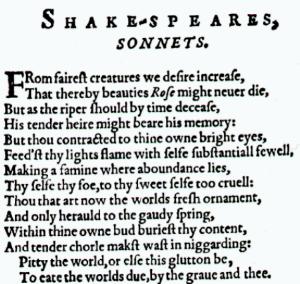
Sonnet 1, the first verse of one of the most astonishing collections of poems ever published in Western Literature by one Poet, opens with the form and function of the rigidly controlled format of the ‘Elizabethan Sonnet’: fourteen lines, iambic pentameter, a dovetailing rhyme scheme, with the content’s central argument controlled by three quatrains and couplet. And yet, the content: it was revolutionary:

1

From fairest creatures we desire increase, 
That thereby beauty’s rose might never die, 
But as the riper should by time decease, 
His tender heir might bear his memory:
But thou, contracted to thine own bright eyes,
Feed’st thy light’s flame with self-substantial fuel,
Making a famine where abundance lies, 
Thyself thy foe, to thy sweet self too cruel.
Thou that art now the world’s fresh ornament 
And only herald to the gaudy spring, 
Within thine own bud buriest thy content 
And, tender churl, makest waste in niggarding. 
    Pity the world, or else this glutton be, 
    To eat the world’s due, by the grave and thee.

Was this sonnet a romantic verse penned by a male Elizabethan Poet to a beautiful and chaste mistress? Hardly. It’s penned by an older Poet to a younger man (though the identity of the recipient’s gender isn’t revealed till later sonnets, this business goes on for 126 sonnets!). Does it regale in the recipient’s beauty? Yes. However… Does the Poet beg for his recipient’s love? No! Rather, he begs the Young Man to breed, so this his beauty might be carried on. Very odd. Later, as more sonnets go on, a kind of narrative begins to reveal itself. For about the first 17 sonnets the Poet entreats the Young Man to preserve his beauty through marriage and procreation. But that begins to evolve into something else–into something that was illegal and very dangerous in Elizabethan England.

Despite the unusual and risqué subtext of this verse, its imagery and language are as sumptuous and profound as anything written in Elizabethan England (or, of course, even today):

‘Feed’st thy light’s flame with self-substantial fuel.’   My favorite line.

Does anyone write as beautifully in today’s world?

The image comes from a scan of the first publication of the Sonnets in 1609, taken, published and released without Shakespeare’s permission.


Hump Day Shakespearean Quote – 03 June 2015

Macbeth dagger

One of the great soliloquies of Western Art comes from the imagination of Macbeth, contemplating regicide. This speech is a miracle of eloquent verse, vivid imagery, psychological progression and foreshadowing. If Shakespeare had written no other plays, he’d still be remembered today for this bloody masterpiece:

Is this a dagger which I see before me,

The handle toward my hand? Come, let me clutch thee.

I have thee not, and yet I see thee still.

Art thou not, fatal vision, sensible

To feeling as to sight? Or art thou but

A dagger of the mind, a false creation,

Proceeding from the heat-oppressèd brain?

I see thee yet, in form as palpable

As this which now I draw.

Thou marshall’st me the way that I was going,

And such an instrument I was to use.

Mine eyes are made the fools o’ th’ other senses,

Or else worth all the rest. I see thee still,

And on thy blade and dudgeon gouts of blood,

Which was not so before. There’s no such thing.

It is the bloody business which informs

Thus to mine eyes. Now o’er the one half-world

Nature seems dead, and wicked dreams abuse

The curtained sleep. Witchcraft celebrates

Pale Hecate’s offerings, and withered murder,

Alarumed by his sentinel, the wolf,

Whose howl’s his watch, thus with his stealthy pace,

With Tarquin’s ravishing strides, towards his design

Moves like a ghost. Thou sure and firm-set earth,

Hear not my steps, which way they walk, for fear

Thy very stones prate of my whereabout,

And take the present horror from the time,

Which now suits with it. Whiles I threat, he lives.

Words to the heat of deeds too cold breath gives. 

Macbeth, Act II Scene i 

Is the dagger real? It is a hallucination? Is Macbeth mad? What a delicious mix of ambition, fear, temptation and eloquence. Honestly–to hell with what it means: just read it aloud and revel in its lyrical brilliance. Then read the play or watch a movie of it, and there, in context, the many meanings of this ruinous foreshadow will open up for you. 

Macbeth knows he plots murder, but hedges when he sees the apparition of a bloody dagger. It causes him pause, until he can–despite the warning of the apparition–steel himself to proceed with his planned murder. For in the end Macbeth cannot discern the meaning of what he sees, and thus its warning is lost on him.   

The image is of Patrick Stewart in his great turn as the cursed Macbeth in the 2010 film.

Sunday Sonnet – 31 May 2015

lovely Will

The Spring morning breaks bright and beautiful here in Southern Wisconsin, and so it seems a perfect time to enjoy Shakespeare’s Sonnet 33, which features a complex metaphor about the shining sun–but that sun’s not always what it seems: 

33

Full many a glorious morning have I seen
Flatter the mountain-tops with sovereign eye,
Kissing with golden face the meadows green,
Gilding pale streams with heavenly alchemy;
Anon permit the basest clouds to ride
With ugly rack on his celestial face,
And from the forlorn world his visage hide,
Stealing unseen to west with this disgrace:
Even so my sun one early morn did shine
With all triumphant splendor on my brow;
But out, alack! he was but one hour mine;
The region cloud hath mask’d him from me now.
Yet him for this my love no whit disdaineth;
Suns of the world may stain when heaven’s sun staineth.

Despite the poem’s bright opening, this verse is mournful. Apparently the Young Man had rejected the Poet. This sonnet, and the ones following, seem to relate to a specific episode of genuine grief, casting an autobiographical aspect to the Sonnets. These episodes don’t hold the structural majesty of a Hamlet or an Othello, but seem to muddy through a betrayal, hurt feelings, and ambivalent (but beautifully poetic) metaphoric imagery. 

Anyhow, what a splendid, lovely image: the rising sun beautifies the mountains and meadows, brightens the streams, only to be blotted out by a cloud, so that the sun must sneak away into sunset.   Likewise, the Young Man, a shining beauty, has let something blot his beauty–betraying himself and the Poet.   

The image is of William Shakespeare, the recently rediscovered ‘Cobbe Family’ portrait. Scholars suppose this anonymous portrait of the Bard was commissioned later in his life–after Will had achieved fame–yet was painted as a representation of how Will might’ve looked in his younger years, when he was first storming the London stage.

Sunday Sonnet – 24 May 2015

Elizabeth_I_(Armada_Portrait)

Shakespeare’s 154 Sonnets are famous and enduring for many reasons: their beauty; their poetic genius of lyricism and form; their originality and refusal to bend to conventions, whether Elizabethan or modern; the fact that some of them express love for a man, and other express love for an arguably unlovable woman. But what also makes these great are their varied metaphors. One of the most unlikely set are Sonnets 123 and 124, which use the world of politics and state to make their case. 124 is full of politics. 

124

If my dear love were but the child of state,
It might for Fortune’s bastard be unfather’d’
As subject to Time’s love or to Time’s hate,
Weeds among weeds, or flowers with flowers gather’d.
No, it was builded far from accident;
It suffers not in smiling pomp, nor falls
Under the blow of thralled discontent,
Whereto the inviting time our fashion calls:
It fears not policy, that heretic,
Which works on leases of short-number’d hours,
But all alone stands hugely politic,
That it nor grows with heat nor drowns with showers.
To this I witness call the fools of time,
Which die for goodness, who have lived for crime. 

Few of us today are experts in Elizabethan history and politics. Reading this poem simply for its argument–that love is greater than all human-created conventions or ideals–is evident enough. But scholars and historians have, for centuries, tried to parse out all of the specific political references. In the hands of a lesser poet, such references might cripple the work, forever rendering it anachronistic. But with Shakespeare, these references also work in a general sense. Some examples: 

‘were but the child of state’: if you were something created only for profit or power (meaning, but you, dear love, are not)

‘for Fortune’s bastard be unfather’d’: the political world of Europe was littered with bastards of royal birth (meaning, but your love is true born)

‘it suffers not in smiling pomp’; the falseness of Courtly and political life (meaning, but your love shows true)

‘But all alone stands hugely politic’: politics dictate what’s important at the moment (meaning, but your love stands beyond the rage or worry of the moment) 

This sonnet is full of many more examples. 

So even today, any person woefully ignorant of Elizabethan goings-on can listen to or read Shakespeare’s great sonnets and come away with a sense of wonder, enlightenment and the sonnet’s central message: that love conquers time and anything man can build.

The image is of the prevailing head of state for most of Shakespeare’s life, Queen Elizabeth. The artist is uncertain, but what is certain is that this painting was commissioned by the state as political propaganda after Elizabeth’s defeat of the Armanda.  

Hump Day Shakespearean Quote – 20 May 2015

merchant_of_venice13

There’s a growing circle of folks in the world who are starting to regard the canon of Shakespeare’s works to be the greatest and most eloquent repository on how humans should live their lives. That is: what makes us human? And what precepts should guide our hearts and minds–and the way we treat others? One great example of this is Portia’s speech to Shylock on the merits of mercy:

Portia

The quality of mercy is not strain’d, 
It droppeth as the gentle rain from heaven 
Upon the place beneath: it is twice blest; 
It blesseth him that gives and him that takes: 
‘Tis mightiest in the mightiest: it becomes 
The throned monarch better than his crown; 
His sceptre shows the force of temporal power, 
The attribute to awe and majesty, 
Wherein doth sit the dread and fear of kings;
But mercy is above this sceptred sway; 
It is enthroned in the hearts of kings, 
It is an attribute to God himself; 
And earthly power doth then show likest God’s
When mercy seasons justice. Therefore, Jew, 
Though justice be thy plea, consider this, 
That, in the course of justice, none of us 
Should see salvation: we do pray for mercy; 
And that same prayer doth teach us all to render
The deeds of mercy. I have spoke thus much 
To mitigate the justice of thy plea; 
Which if thou follow, this strict court of Venice 
Must needs give sentence ‘gainst the merchant there. 

–from The Merchant of Venice, Act IV, Scene i 

Beyond its eloquence and poetic beauty, this speech is fascinating because Shakespeare puts this very learned and moral examination of the qualities of mercy on the lips of a woman.  

As we know from many of my past posts, women were regarded as chattel in Elizabethan England. And while Shakespeare’s treatment of women in his plays was an evolving process–from bigoted to enlightened–The Merchant of Venice comes relatively early in Shakespeare’s career. Moreover, Portia’s great speech is delivered when she is disguised as a man. It’s as if no other character in the play would give truck to such revelatory words unless they were spoken from the mouth of…a man. 

Read the speech again now: its truths are as valid today as they were over 400 years ago. 

The image comes from the 2004 film of The Merchant of Venice, with the great Lynn Collins as the clever–and morally astute–Portia.

Sunday Sonnet – 17 May 2015

anne-hathaway2

Today’s installment in the Dark Lady sequence of sonnets is rather an ugly one, and I mean that in more ways than one.

137

Thou blind fool, Love, what dost thou to mine eyes,
That they behold, and see not what they see?
They know what beauty is, see where it lies,
Yet what the best is take the worst to be.
If eyes corrupt by over-partial looks
Be anchor’d in the bay where all men ride,
Why of eyes’ falsehood hast thou forged hooks,
Whereto the judgment of my heart is tied?
Why should my heart think that a several plot
Which my heart knows the wide world’s common place?
Or mine eyes seeing this, say this is not,
To put fair truth upon so foul a face?
In things right true my heart and eyes have erred,
And to this false plague are they now transferr’d.

As Shakespeare did with so many of his sonnets–both to the Young Man and the Dark Lady–he turns the Petrarchan Ideal of Romantic Love on its head: he doesn’t flatter his love, rather he tells her (or him in the case of the Young Man), and the entire world, the truth.

The truth in Sonnet 137 is that the Poet regards the Dark Lady as an unfaithful tramp; yet still he loves her.   Unfortunately, this misogynistic meme had continued to this very day, over four centuries later, in so much of our Blues and Rock ‘n’ Roll. I can forgive Shakespeare for this, since he a) was largely a product of his time and b) he was the first writer in Western Literature to create thoroughly realistic and empathic female characters–especially in his later plays. And so he grew into a kind of gender enlightenment.

But back to Sonnet 137. The Poet uses some entertaining imagery to describe how Love has blinded him to his lady’s faults:

  • ‘Be anchored in the bay were all men ride’: a scathing condemnation of the Dark Lady’s promiscuity.
  • ‘Which my heart knows the wide world’s common place’: that which my heart loves is available to the whole world for the taking.
  • The vicious couplet: ‘In things true my heart and eyes have erred, / And to this false plague are they now transferred’: My eyes and heart have been fooled; for they love a lying and diseased woman.

So the next time your lover betrays you (be they male, female, the same gender as you or different), instead of sending them a Sam Smith song, send them this sonnet.

The image is reputed to be of Shakespeare’s wife, Anne Hathaway (though we can never really know), whom Shakespeare probably betrayed often. But back in those days, outside the realm of Petrarchan poetry, marriages were more of a practical contract than any kind of romantic or sexual hook-up.

Hump Day Shakespearean Quote – 13 May 2015

Macbeth

One of the remarkable things about Shakespeare was how sublimely eloquent he could make his villains. And some of his villains weren’t very lovable. Take Macbeth for instance: plotter, mass-murderer, arguably a coward, and certainly overshadowed by the powerful presence of his wife, Lady Macbeth. And yet, when his wife dies, he gives one the greatest soliloquys ever put to pen: 

She should have died hereafter;
There would have been a time for such a word.
— To-morrow, and to-morrow, and to-morrow,
Creeps in this petty pace from day to day,
To the last syllable of recorded time;
And all our yesterdays have lighted fools
The way to dusty death. Out, out, brief candle!
Life’s but a walking shadow, a poor player
That struts and frets his hour upon the stage
And then is heard no more. It is a tale
Told by an idiot, full of sound and fury
Signifying nothing. 

Macbeth, Act V, Scene v 

Macbeth has just found out Lady Macbeth is dead. And so comes this famous and astonishing speech, so eloquent, that many of its parts have been borrowed, copied and repeated to this very day.   

The speech is a striking contemplation about the futility of life. Lady Macbeth? She would’ve died anyway. Such tragedies have marched on for ever. Our time on the stage and our struggles are meaningless! Everything is brief. And all our struggles and passions? They signify nothing. 

Breathtaking nihilism.   

The images comes from Orson Welles’ 1948 crazed and twisted film version of the Scottish play. It’s worth a view.

Hump Day Shakespearean Quote – 06 May 2015

DKingJohn-4035

One of my favorite Shakespearean speeches isn’t very famous.

CONSTANCE

Thou art not holy to belie me so;
I am not mad: this hair I tear is mine;
My name is Constance; I was Geffrey’s wife;
Young Arthur is my son, and he is lost:
I am not mad: I would to heaven I were!
For then, ’tis like I should forget myself:
O, if I could, what grief should I forget!
Preach some philosophy to make me mad,
And thou shalt be canonized, cardinal;
For being not mad but sensible of grief,
My reasonable part produces reason
How I may be deliver’d of these woes,
And teaches me to kill or hang myself:
If I were mad, I should forget my son,
Or madly think a babe of clouts were he:
I am not mad; too well, too well I feel
The different plague of each calamity. 

–from King John, Act III Scene iv 

King John’s an early play, when the Bard had not fully perfected the soliloquy, and when his ideas and notions on women had not yet fully matured. Shakespeare was writing in a very patriarchal society where women couldn’t own property and certainly couldn’t perform on stage.

Despite all that, Shakespeare breaths a realistic and searing grief into the character of Constance–the heartbreaking despair over the loss of her child.   

How did Shakespeare understand all this? His own son, Hamnet, who did at the age of 11, we’re pretty sure was still alive when this play was written. Beyond Shakespeare’s genius with language and craft, he exhibited a deep empathy and emotive power on the page, showing he would imagine the hearts of beings–that is, females–who some Elizabethans believed did not even have souls.   

The image comes from a Utah Shakespeare Festival’s production of King John, with Melinda Pfundstein as the beleaguered Constance.

Sunday Sonnet – 26 April 2015

courthouse

Today a sonnet to friendship seems appropriate to me because this weekend I’m briefly seeing a lot of friends I seldom get to visit.   Part of the Young Man sequence of sonnets, this beautiful poem speaks to the melancholy of departed friends, and the memories you take with you:

30

When to the sessions of sweet silent thought
I summon up remembrance of things past,
I sigh the lack of many a thing I sought,
And with old woes new wail my dear time’s waste:
Then can I drown an eye, unused to flow,
For precious friends hid in death’s dateless night,
And weep afresh love’s long since cancell’d woe,
And moan the expense of many a vanish’d sight:
Then can I grieve at grievances foregone,
And heavily from woe to woe tell o’er
The sad account of fore-bemoaned moan,
Which I new pay as if not paid before.
But if the while I think on thee, dear friend,
All losses are restored and sorrows end. 

One of the remarkable things about this poem it its use of Elizabethan courtroom language: ‘Sessions’; ‘cancell’d’; ‘expense’; ‘grievances’; ‘account’; ‘pay’ and ‘paid’; ‘losses are restored’. The love for separated friends and courtroom lingo don’t seem an obvious match, but Shakespeare makes it work.

Lost chances, lost friends, the death of friends or loved ones brings the Poet to tears. However, all he has to do is think upon his dear friend–in this case the Young Man–and all his sorrows end. 

Finally, ‘remembrance of things past’ from the gorgeous pair of opening lines is a phrase made famous by the translated English title of Proust’s 20th century classic novel.   

The image is of the Hawkshead Courthouse in the Lake District, an example of what many courthouses might have looked like in the time of Shakespeare.

Happy Shakespeare’s Birthday!

shake

Our revels now are ended. These our actors,

As I foretold you, were all spirits and

Are melted into air, into thin air:

And, like the baseless fabric of this vision,

The cloud-capp’d towers, the gorgeous palaces,

The solemn temples, the great globe itself,

Yea, all which it inherit, shall dissolve

And, like this insubstantial pageant faded,

Leave not a rack behind. We are such stuff

As dreams are made on, and our little life

Is rounded with a sleep.

–William Shakespeare

From The Tempest, Act 4 Scene 1