Sunday Sonnet – 08 February 2015

Tennant

The delicious and dark eroticism of the Dark Lady sonnets reaches its peak, I think, in Number 132.   Oh, how the Poet loves and lusts for the Dark Lady, though she doesn’t love him.   That unrequited love is epitomized in Shakespeare’s pun of the words ‘morning’ and ‘mourning.’ And what of the Elizabethan perception of female beauty? Plain and simple, it was misogynistic and racist. Will Shakespeare turns that on its head: for the Poet, black is sublimely beautiful, and this beautiful woman is more powerful than the Poet himself. 

132

Thine eyes I love, and they, as pitying me,
Knowing thy heart torments me with disdain,
Have put on black and loving mourners be,
Looking with pretty ruth upon my pain.
And truly not the morning sun of heaven
Better becomes the grey cheeks of the east,
Nor that full star that ushers in the even
Doth half that glory to the sober west,
As those two mourning eyes become thy face:
O, let it then as well beseem thy heart
To mourn for me, since mourning doth thee grace,
And suit thy pity like in every part.
Then will I swear beauty herself is black
And all they foul that thy complexion lack. 

So odd, so strange that these sonnets were written in the Elizabethan era–the late 1500’s and the very earliest years of the new century. As I’ve said before, Will Shakespeare never published these sonnets–they were printed without his permission. Little wonder. What was going that he should write such dangerous stuff–verses that were surely shocking in their time? 

It all makes me wonder–and believe–that there was more than just imagination behind all the sonnets to the ‘Young Man’ (homoerotic and very much against he the law), and more than imagination behind all the sonnets to this magnificently dark and angry and beautiful ‘Dark Lady.’ 

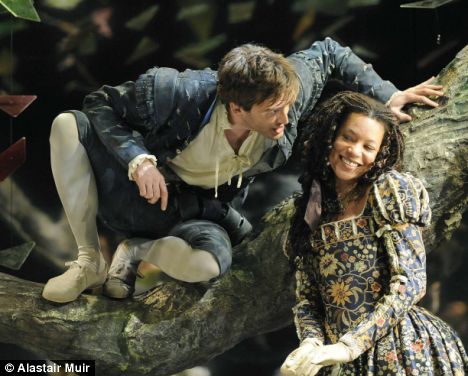
The image is of David Tennant and Nina Sosanya in a Royal Shakespeare Company production of As You Like It. They look lovely together, don’t they? If the Dark Lady sonnets were indeed autobiographical, might there once have been a scene like this played out in Shakespeare’s own life? We’ll never know for certain.

Hump Day Shakespearean Quote – 04 February 2015

gertrude kissing

Queen Gertrude, Hamlet’s mother, had a lot to deal with, not the least of which is her seeming mad son Hamlet speaking to ghosts in her own bedchamber.  

HAMLET

How is it with you, lady? 

GERTRUDE  

Alas, how is’t with you,
That you do bend your eye on vacancy
And with the incorporal air do hold discourse?
Forth at your eyes your spirits wildly peep;
And, as the sleeping soldiers in the alarm,
Your bedded hair, like life in excrements,
Starts up, and stands on end. O gentle son,
Upon the heat and flame of thy distemper
Sprinkle cool patience. Whereon do you look? 

HAMLET

On him, on him! Look you, how pale he glares!
His form and cause conjoin’d, preaching to stones,
Would make them capable. Do not look upon me;
Lest with this piteous action you convert
My stern effects: then what I have to do
Will want true colour; tears perchance for blood.

Gertrude

To whom do you speak this?

Hamlet, Act 3, Scene iv

Ah, ‘that you do bend your eye on vacancy…’   What a lovely line. In so many ways, Gertrude’s little speech is the whole great play writ small. Who was Gertrude, though? Shakespeare never reveals much about her. What’s really important is how Hamlet sees her, and the view through that lens is dark and twisted.

Was Gertrude an adulteress? Complicit in her husband’s murder? Incestuous because she married her dead husband’s brother? All of these accusations are Hamlet’s suspicions, but a close reading of the lines of the play (in all of their various versions) doesn’t conclusively affirm any of these accusations.

I believe Gertrude was an innocent, doing what she had to do for her Kingdom (that is, marry Claudius after her husband the King had died). Her innocence parallels Ophelia’s innocence. They are the only two female speaking roles in the play: and neither are treated well by Hamlet. But can we blame Hamlet? The evil done to his father–like most evils perpetrated in this world–are seeds sown, spreading calamity (which brings to mind a great line by Hamlet in another scene, ‘Tis an unweeded garden That grows to seed.’ King Claudius’ evil act jaundiced Hamlet’s view of the world and, I believe, how he saw his mother.

The image is of the great Glenn Close from the 1990 version of Hamlet, an excellent version I think, and very much worth a view. Here she is kissing her son, Hamlet (Mel Gibson) flirting with the various incestuous memes running through this stupendous play.

Hump Day Shakespearean Quote – 28 January 2015

Ophelia

Innocent, virtuous, obedient and lovely Ophelia, swept over by the tragic events of life and the machinations of the corrupt Danish court. Her mother is not present–possibly having died giving birth to Ophelia. And soon Ophelia’s father, Polonius, will die by Hamlet’s sword. And Hamlet? It seems he once expressed love for sweet Ophelia. But now that has passed, and Ophelia laments the madness that has taken Prince Hamlet:

OPHELIA

O, what a noble mind is here o’erthrown!

The courtier’s, soldier’s, scholar’s, eye, tongue, sword;

The expectancy and rose of the fair state,

The glass of fashion and the mould of form,

The observed of all observers, quite, quite down!

And I, of ladies most deject and wretched,

That suck’d the honey of his music vows,

Now see that noble and most sovereign reason,

Like sweet bells jangled, out of tune and harsh;

That unmatch’d form and feature of blown youth

Blasted with ecstasy: O, woe is me,

To have seen what I have seen, see what I see! 

Hamlet, Act 3, Scene 1 

A beautiful soliloquy, where she bemoans Hamlet’s passing greatness, and pities herself, a lady ‘most deject and wretched.’ Bemoans the love he once expressed to her: ‘that suck’d the honey of his music vows.’ 

The character of Ophelia has spurred debate for centuries, and for this brief blog post, any opinion I offer I do so at my peril. Suffice it to say that for this me, a man, Ophelia has always proven tantalizing, mysterious, and somehow incomplete. Certainly Shakespeare intended that, in this play, his most developed and rewritten masterpiece. Yes, I think Shakespeare intended that. For Ophelia stands as strong counterpoint to the only other female role in the play, Hamlet’s mother, Gertrude, who has married her husband’s murderer. 

Was Prince Hamlet a misogynist? A strong argument can made for that. Was Shakespeare? Some argument has been made for that also, but I don’t think so. Shakespeare had no control over the fact that Elizabethan law did not allow women to act on stage. Shakespeare had to cast boys as his women. There’s compelling evidence–judging by the roles for women in his plays, and the order in which the plays were produced–that Shakespeare populated his plays with female roles depending on the talent at hand. For Hamlet, he had two extraordinary gifted boys. And in the 400 years since, many extraordinary women have played Ophelia and Gertrude.

Ophelia has spawned endless debate. Go watch some Ophelia. Two fairly recent movie versions of Hamlet include excellent Ophelias, as portrayed by Kate Winslet and Helena Bonham Carter. 

The image is of Helena Bonham-Carter as Ophelia in the 1990 version of Hamlet.   In this scene it appears Ophelia has already lost her marbles.

Hump Day Shakespearean Quote – 21 January 2015

Hamlet

Shakespeare’s Hamlet is the crown jewel of Western Art: the superlatives thrown at it are innumerable and pretty over-the-top: ‘the greatest tragedy written in 2000 years’; ‘the first manic-depressive hero of Western Literature’; 170 new words introduced to the English language; and that freaking great ‘to be or not to be’ speech that Mel Brooks put to music.   Well, here’s a bit of Hamlet for you (there’ll be more, much more, on my blog as time goes by). The opening of Hamlet’s first soliloquy, Act I, Scene ii: 

Oh, that this too, too sullied flesh would melt,

Thaw, and resolve itself into a dew,

Or that the Everlasting had not fixed

His canon ‘gainst self-slaughter! O God, God!

How weary, stale, flat, and unprofitable

Seem to me all the uses of this world!

Fie on ’t, ah fie! ‘Tis an unweeded garden

That grows to seed. Things rank and gross in nature

Possess it merely. That it should come to this.

But two months dead—nay, not so much, not two.

So lovely, dark and eloquent.  

Going forward, for each Hamlet quote I share, I’ll share a few choice tidbits about this play or its history. 

Today? Hamlet is too long to perform! If you take all the versions from all the Quartos and the First Folio and mash them up all together, the play runs over four hours long, and the character Hamlet no longer makes any damned sense. In my opinion, many critics and literary historians throughout the centuries have done a disservice to this play. What does makes sense is that we’re dealing with revisions upon revisions. Yes, even Shakespeare revised his work. It just didn’t spring out of his head like, say, Mozart’s.

You see, Hamlet was first performed in the Globe Theatre in about 1600, an outdoor theatre, and because of available light, the Lord Chamberlain’s Men couldn’t perform plays over 3000 lines. Hamlet–if you add in all the different versions and texts into one giant baggy monster–is over 4000 lines long. It had to be cut. Which is why the editors of the First Folio–Shakespeare’s own fellow actors–included a shortened version of the play. In all likelihood, there were probably several acting versions of the play, all under 3000 lines.

Still, we can see by all the different versions, and the various changes and the contrary soliloquys, that the writing and creating of Hamlet gave Shakespeare a lot of trouble. What has happened over the centuries is that critics and scholars have been so beside themselves with academic ecstasy, that they just couldn’t bare to have only one of these shortened ‘performance versions’. And thus we modern theatre-goers are inflicted with monstrosities like Kenneth Branagh’s ‘complete’ movie version of Hamlet.

So–it’s okay to go and enjoy an ‘abbreviated’ or shortened Hamlet. That’s how it was presented back in Shakespeare’s time. We don’t know exactly which version or versions were performed (there were probably several). But Hamlet was always been bigger than anything: too big for performance, too big for critics and–judging by all the revision documents–too big for its author. Will Shakespeare was discovering something new as he wrote Hamlet. It changed literature; and if we look at the rest of Shakespeare’s plays, it changed him.  

The image is taken from an ‘abbreviated’ film version of Hamlet, Mel Gibson’s very excellent turn as the depressed Dane (here pictured with the superb Glenn Close as Gertrude). Perhaps Mel’s performance was so good because the actor himself pretty much went nuts later on in life.   Anyhow, don’t let Mel’s antics keep you from renting or streaming this fantastic version. It’s really lovely, dark and eloquent.   

Hump Day Shakespearean Quote – 14 January 2015

touchstone

For the date of my birth anniversary I choose to celebrate that most magnificent of Shakespearean creations, the Fool. Fools, or Clowns, in Shakespeare were usually the smartest characters on stage. One of my favorite Fool speeches comes from As You Like It, where the Fool Touchstone enumerates the parts of an argument, and how to win any argument.   

JAQUES

Can you nominate in order now the degrees of the lie?

TOUCHSTONE

O sir, we quarrel in print, by the book; as you have
books for good manners: I will name you the degrees.
The first, the Retort Courteous; the second, the
Quip Modest; the third, the Reply Churlish; the
fourth, the Reproof Valiant; the fifth, the
Countercheque Quarrelsome; the sixth, the Lie with
Circumstance; the seventh, the Lie Direct. All
these you may avoid but the Lie Direct; and you may
avoid that too, with an If. I knew when seven
justices could not take up a quarrel, but when the
parties were met themselves, one of them thought but
of an If, as, ‘If you said so, then I said so;’ and
they shook hands and swore brothers. Your If is the
only peacemaker; much virtue in If. 

As You Like It, Act V, Scene iv 

As if all arguments in the world could be parsed out into a simple formula, he lectures the character Jaques (much stupider than Touchstone) on the finer points of debate: For instance, the ‘Retort Courteous’; the ‘Quip Modest’; the ‘Reply Churlish’; the ‘Reproof Valiant’ and so on. And as if this weren’t enough, Touchstones seals the list with the Power Word–the one word that can win any argument: ‘If’.  (If you continue with this scene, Touchstone goes on to give examples of how well ‘If’ works.)

As You Like It is filled with grand wit, and was one of Shakespeare’s most risky plays: for its wittiest character is a woman–Rosalind. Elizabethans, as a rule, considered woman property and grossly inferior to men. But Rosalind was by no means a fool, and I’ll reserve her for another day. 

Some other infamous and favorite Shakespearean Fools include Trinculo in The Tempest, Bottom in A Midsummer Night’s Dream, The Fool in King Lear and, of course, Falstaff from Henry IV, Parts 1 and 2 and The Merry Wives of Windsor.  

The image comes from the Royal Shakespeare Company’s production of As You Like It from 1996 with David Tennant as the Fool Touchstone.

Hump Day Shakespearean Quotes – 07 January 2015

Cassius & Brutus 2

Rationalizing cold-blooded murder is something for sick minds and for the greatest of writers.   Shakespeare was able to imagine how a flawed personality might rationalize the assassination of a friend for something the intended victim had not yet done, but might do. Amoral? Sick? Reprehensible? Yes, all of these. And also the topic for the first great soliloquy Shakespeare ever wrote:

Brutus
It must be by his death, and, for my part,
I know no personal cause to spurn at him,
But for the general. He would be crown’d:
How that might change his nature, there’s the question.
It is the bright day that brings forth the adder
And that craves wary walking. Crown him that,
And then, I grant, we put a sting in him
That at his will he may do danger with.
The abuse of greatness is when it disjoins
Remorse from power, and, to speak truth of Caesar,
I have not known when his affections sway’d
More than his reason. But ’tis a common proof
That lowliness is young ambition’s ladder,
Whereto the climber-upward turns his face;
But when he once attains the upmost round,
He then unto the ladder turns his back,
Looks in the clouds, scorning the base degrees
By which he did ascend. So Caesar may;
Then, lest he may, prevent. And, since the quarrel
Will bear no color for the thing he is,
Fashion it thus: that what he is, augmented,
Would run to these and these extremities;
And therefore think him as a serpent’s egg
Which hatch’d would as his kind grow mischievous,
And kill him in the shell.

Julius Caesar, Act 2, Scene 1

Before we get to the why this soliloquy is the first of its kind, note the imagery: There are two metaphors here. Caesar as a serpent, and Caesar as a ladder-climber. The ladder-climber has become part of our common vernacular today–“climb the corporate ladder.” The other metaphor, though–Caesar as the adder–is the creepier of the two, and Shakespeare has Brutus return to that image in the final, decisive line: “And kill him in the shell.”

That metaphor allows Brutus to develop the rationalization to murder Caesar not for anything he has done, but for what he might do. That is, kill the snake in its shell. As cold-blooded as you can get. Yet–it’s okay, he’s rationalized it.

Finally, as mentioned above, this was Shakespeare’s first great soliloquy. The idea of being able to convey on-stage a character’s innermost thoughts was something never before done in theatre until Shakespeare tried it out in Julius Caesar–all the way back in 1599. This speech is the first one. 

It worked so well for Shakespeare–it so illuminated the inner workings of his characters–that he then refined the practice. To this very day, we remember even greater soliloquys that followed in his later plays: ‘To be or not to be’ from Hamlet, or ‘Tomorrow, and tomorrow, and tomorrow’ from Macbeth, just to name two. This technique changed the nature of art forever. Need examples? It’s used today in popular culture: think of ‘The Office’ or ‘Modern Family’, where characters are given the opportunity to speak directly to the audience.

The image comes from the 1953 film version of Julius Caesar, with James Mason as Brutus (right) and John Gielgud as Cassius (left). Note their post-assassination bloodstained tunics, in glorious black and white.

Hump Day Shakespearean Quote – Christmas Eve 2014

Cobbe_portrait_of_Shakespeare

Shakespeare and the mention of Christmas don’t much intersect for two main reasons. One, back in Elizabethan times, Christmas wasn’t the big commercial deal it is today. And two, the Bard was very, very careful about religion in his plays and poetry: Elizabethan England was a police state, and one of the supreme crimes–after treason–were crimes of faith. Even with the even-minded Elizabeth, who tried to bring everyone together, the extreme believers on either end would have none of it.   The Papists and Puritans hated one another, and Shakespeare wisely gave Christianity a wide berth. 

Some say that ever ‘gainst that season comes
Wherein our Saviour’s birth is celebrated,
The bird of dawning singeth all night long:
And then, they say, no spirit dare stir abroad;
The nights are wholesome; then no planets strike,
No fairy takes, nor witch hath power to charm,
So hallowed and so gracious is the time.

Hamlet, Act I Scene i 

That’s it. Shakespeare’s only explicit reference to Christmas, and he doesn’t even say the word. It’s from Hamlet, and here Shakespeare only uses the idea of Christmas to set up the idea that evil is one its way. A holy day, when even ghosts are not allowed to haunt and witches aren’t allowed to spin charms. Ah, but a vengeful ghost is coming, and with him we’ll bring down tragedy and woe upon the entire castle of Elsinore.   

Merry Christmas, one and all, and enjoy this holiday, with the hopes that tonight and tomorrow might, indeed, ward off evil and spirits for just a while.

Postscript: And no, the play Twelfth Night doesn’t refer to Christmas either. It was the last night of the big Christmas season, traditionally reserved for performances, to which the title refers.

The image is from the ‘Cobbe Portrait’ of Shakespeare. There’s strong evidence that is the only portrait ever commissioned of the Bard during his lifetime. Artist unknown, but this Jacobean painting was discovered with a painting of another Elizabethan, Henry Wriothesley, the 3rd Earl of Southampton. Who was he? Why, most Shakespeare’s Young Man of the Sonnets.

Sunday Sonnet – Winter Solstice 2014

Sonnet 2

With today’s Solstice, I think of this sonnet, where the ravages of age will be counted in the number of winters the battered face of the Poet’s lovely Young Man might endure. 

Sonnet II

When forty winters shall besiege thy brow,

And dig deep trenches in thy beauty’s field,

Thy youth’s proud livery so gazed on now,

Will be a totter’d weed of small worth held:

Then being asked, where all thy beauty lies,

Where all the treasure of thy lusty days;

To say, within thine own deep sunken eyes,

Were an all-eating shame, and thriftless praise.

How much more praise deserv’d thy beauty’s use,

If thou couldst answer ‘This fair child of mine

Shall sum my count, and make my old excuse,’

Proving his beauty by succession thine!

   This were to be new made when thou art old,

   And see thy blood warm when thou feel’st it cold.

This second poem of Shakespeare’s long sequence of sonnets establish many of themes that would be revisited–and touch upon many truths that we still have trouble facing today: beauty never lasts; your cloak of youth will fade; there is a reason why we have children.  

What’s truly astonishing about all this, is that this sonnet–and most of the early Young Man sonnets–Shakespeare very likely wrote under commission. In other words, he might have been paid to write them on just this topic.  

Lord Burghley was Queen Elizabeth’s Lord Treasurer, and Burghley had a young ward he was in charge of–none other than the Earl of Southampton, very probably Shakespeare’s ‘Young Man’.   Southampton did not want to marry (The reasons for this are numerous and speculative, but one is that Southampton had no interest in women). What’s odd is that the first 17 sonnets all urge the Young Man to procreate. Never before had the Romantic form of the Sonnet been used for such an odd endeavor: that is a male Poet urging another male–a beautiful and lovely male–to procreate. But Shakespeare makes it work. I mean–how else to convince a vain, spoiled and possibly gay Earl to marry up and reproduce? Flatter him. 

Alas, after Sonnet 17, things turn for the Poet (that is, Will Shakespeare), and he finds himself falling in love with this vain, beautiful creature.   But for today, let’s revel in Number 2, and its lovely, varied imagery. And remember: braving these cold winters will only dig deep the trenches in our fields of beauty. 

The image is from the northern woods of Wisconsin, of a dear old place I’ll very likely never be able to visit again.

Sunday Sonnet – 26 Oct 2015

Medieval-Bath

Sonnet 153

Cupid laid by his brand, and fell asleep:
A maid of Dian’s this advantage found,
And his love-kindling fire did quickly steep
In a cold valley-fountain of that ground;
Which borrow’d from this holy fire of Love
A dateless lively heat, still to endure,
And grew a seething bath, which yet men prove
Against strange maladies a sovereign cure.
But at my mistress’ eye Love’s brand new-fired,
The boy for trial needs would touch my breast;
I, sick withal, the help of bath desired,
And thither hied, a sad distemper’d guest,
But found no cure: the bath for my help lies
Where Cupid got new fire–my mistress’ eyes.

Venereal Disease?

In the traditional parsing out of Shakespeare’s sonnets, the Bard’s last two sonnets, 153 and 154, are not lumped in with the Dark Lady sequence, which includes sonnets 127 – 152. However, if one reads between the lines, it quickly become obvious there are double entendres here. Why doubt it? Shakespeare was the master of weaving multiple meanings into lines.

The ‘lively heat’ of a ‘seething bath’ ‘against strange maladies’ that lead to ‘a sovereign cure’ seem to unmistakably refer to one of the two most common Elizabethan cures for syphilis: severely hot baths. (And the references to venereal disease continue in Sonnet 154, which I’ll save for another day).

A ho-hum love sonnet with fairly tepid classical references? Or a whole lot more? We’re talking about Shakespeare here! If this sonnet is multilayered, the irony becoming inescapable.   At first blush Sonnet 153 poses as a traditional paean to love, with its references to classical Greek mythology. But Shakespeare, in so many of his great works, was rarely only traditional; his calling card was to take the a traditional source, then meld it, mold it, twist it, to his own purposes. I believe this sonnet bemoans the contraction of an STD, with its unpleasant cure, all of which is not quite enough to prevent the Poet to keep yearning for a return to the delicious but diseased arms of his lover:  

But found no cure: the bath for my help lies
Where Cupid got new fire–my mistress’ eyes.

Hump Day Shakespearean Insult – 22 Oct 2014

swordplay

Today we enjoy one of the all time great Shakespearean insults–Kent from King Lear lays into Oswald. But more than just one of the all time great take-downs, this doesn’t end with just a diatribe. It escalates into an exchange, until finally Kent beats the living daylights out of Oswald. I recommend using this today in a professional office setting.

Oswald
What dost thou know me for?
Kent
A knave; a rascal; an eater of broken meats; a
base, proud, shallow, beggarly, three-suited,
hundred-pound, filthy, worsted-stocking knave; a
lily-livered, action-taking knave, a whoreson,
glass-gazing, super-serviceable finical rogue;
one-trunk-inheriting slave; one that wouldst be a
bawd, in way of good service, and art nothing but
the composition of a knave, beggar, coward, pandar,
and the son and heir of a mongrel bitch: one whom I
will beat into clamorous whining, if thou deniest
the least syllable of thy addition.
Oswald
Why, what a monstrous fellow art thou, thus to rail
on one that is neither known of thee nor knows thee!
Kent
What a brazen-faced varlet art thou, to deny thou
knowest me! Is it two days ago since I tripped up
thy heels, and beat thee before the king? Draw, you
rogue: for, though it be night, yet the moon
shines; I’ll make a sop o’ the moonshine of you:
draw, you whoreson cullionly barber-monger, draw.
Drawing his sword
Oswald
Away! I have nothing to do with thee.
Kent
Draw, you rascal: you come with letters against the
king; and take vanity the puppet’s part against the
royalty of her father: draw, you rogue, or I’ll so
carbonado your shanks: draw, you rascal; come your ways.
Oswald
Help, ho! murder! help!
Kent
Strike, you slave; stand, rogue, stand; you neat
slave, strike.
Beating him
–From King Lear, Act II, Scene ii