Month: December 2014

  • Sunday Sonnet – 28 December 2014

    sonnet 19

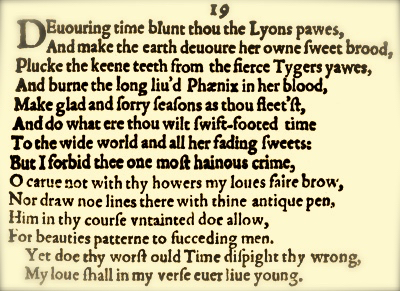
    As this old year meanders to a close, I thought it appropriate to share one of Shakespeare’s  ‘Time’ sonnets.  In this one, The Bard treats Time like a character, whom the Poet addresses directly with a series of vivid metaphors.  These images describe how Time ultimately destroys everything, no matter how powerful or sublime.

    Sonnet 19:

    Devouring Time, blunt thou the lion’s paws,

    And make the earth devour her own sweet brood;

    Pluck the keen teeth from the fierce tiger’s jaws,

    And burn the long-liv’d phoenix, in her blood;

    Make glad and sorry seasons as thou fleet’st,

    And do whate’er thou wilt, swift-footed Time,

    To the wide world and all her fading sweets;

    But I forbid thee one most heinous crime:

    O! carve not with thy hours my love’s fair brow,

    Nor draw no lines there with thine antique pen;

    Him in thy course untainted do allow

    For beauty’s pattern to succeeding men.

    Yet, do thy worst old Time: despite thy wrong,

    My love shall in my verse ever live young.

    For me, this sonnet marks a turn in the Young Man sequence of verses.  The Poet has now given up on his earlier arguments: that the Young Man should procreate to preserve his own beauty.  Now the Poet employs something more powerful than nature’s gift to humans—the ability to reproduce.  Starting with the Sonnets in the late teens, the Poet summons power the Art, specifically Poetry.  Shakespeare’s poem itself shall preserve the Young Man’s beauty for eternity, thereby defeating Time’s ‘worst’.

    Could Shakespeare have know how right he was?  Could he have dreamt that over 400 years later, his beloved would still live on in the lines of these immortal words?  Possibly not.  Scholarly evidence suggests fairly convincingly that the Sonnets were published without Shakespeare’s permission.  He likely intended for all of 154 of these verses—to the Young Man and the Dark Lady alike—to never see the public eye.  They were risqué, dangerous in the Elizabethan world of religious morality and homophobia.   Thankfully, today, at the close of 2014, they are regarded as the epitome of the poetic form in the English Language.  They have defeated Time’s ‘most heinous crime.’

    The image is from Thomas Thorpe’s unauthorized publication of ‘SHAKES-SPEARES SONNETS’ from 1609.

  • Hump Day Shakespearean Quote – Christmas Eve 2014

    Cobbe_portrait_of_Shakespeare

    Shakespeare and the mention of Christmas don’t much intersect for two main reasons. One, back in Elizabethan times, Christmas wasn’t the big commercial deal it is today. And two, the Bard was very, very careful about religion in his plays and poetry: Elizabethan England was a police state, and one of the supreme crimes–after treason–were crimes of faith. Even with the even-minded Elizabeth, who tried to bring everyone together, the extreme believers on either end would have none of it.   The Papists and Puritans hated one another, and Shakespeare wisely gave Christianity a wide berth. 

    Some say that ever ‘gainst that season comes
    Wherein our Saviour’s birth is celebrated,
    The bird of dawning singeth all night long:
    And then, they say, no spirit dare stir abroad;
    The nights are wholesome; then no planets strike,
    No fairy takes, nor witch hath power to charm,
    So hallowed and so gracious is the time.

    Hamlet, Act I Scene i 

    That’s it. Shakespeare’s only explicit reference to Christmas, and he doesn’t even say the word. It’s from Hamlet, and here Shakespeare only uses the idea of Christmas to set up the idea that evil is one its way. A holy day, when even ghosts are not allowed to haunt and witches aren’t allowed to spin charms. Ah, but a vengeful ghost is coming, and with him we’ll bring down tragedy and woe upon the entire castle of Elsinore.   

    Merry Christmas, one and all, and enjoy this holiday, with the hopes that tonight and tomorrow might, indeed, ward off evil and spirits for just a while.

    Postscript: And no, the play Twelfth Night doesn’t refer to Christmas either. It was the last night of the big Christmas season, traditionally reserved for performances, to which the title refers.

    The image is from the ‘Cobbe Portrait’ of Shakespeare. There’s strong evidence that is the only portrait ever commissioned of the Bard during his lifetime. Artist unknown, but this Jacobean painting was discovered with a painting of another Elizabethan, Henry Wriothesley, the 3rd Earl of Southampton. Who was he? Why, most Shakespeare’s Young Man of the Sonnets.

  • Sunday Sonnet – Winter Solstice 2014

    Sonnet 2

    With today’s Solstice, I think of this sonnet, where the ravages of age will be counted in the number of winters the battered face of the Poet’s lovely Young Man might endure. 

    Sonnet II

    When forty winters shall besiege thy brow,

    And dig deep trenches in thy beauty’s field,

    Thy youth’s proud livery so gazed on now,

    Will be a totter’d weed of small worth held:

    Then being asked, where all thy beauty lies,

    Where all the treasure of thy lusty days;

    To say, within thine own deep sunken eyes,

    Were an all-eating shame, and thriftless praise.

    How much more praise deserv’d thy beauty’s use,

    If thou couldst answer ‘This fair child of mine

    Shall sum my count, and make my old excuse,’

    Proving his beauty by succession thine!

       This were to be new made when thou art old,

       And see thy blood warm when thou feel’st it cold.

    This second poem of Shakespeare’s long sequence of sonnets establish many of themes that would be revisited–and touch upon many truths that we still have trouble facing today: beauty never lasts; your cloak of youth will fade; there is a reason why we have children.  

    What’s truly astonishing about all this, is that this sonnet–and most of the early Young Man sonnets–Shakespeare very likely wrote under commission. In other words, he might have been paid to write them on just this topic.  

    Lord Burghley was Queen Elizabeth’s Lord Treasurer, and Burghley had a young ward he was in charge of–none other than the Earl of Southampton, very probably Shakespeare’s ‘Young Man’.   Southampton did not want to marry (The reasons for this are numerous and speculative, but one is that Southampton had no interest in women). What’s odd is that the first 17 sonnets all urge the Young Man to procreate. Never before had the Romantic form of the Sonnet been used for such an odd endeavor: that is a male Poet urging another male–a beautiful and lovely male–to procreate. But Shakespeare makes it work. I mean–how else to convince a vain, spoiled and possibly gay Earl to marry up and reproduce? Flatter him. 

    Alas, after Sonnet 17, things turn for the Poet (that is, Will Shakespeare), and he finds himself falling in love with this vain, beautiful creature.   But for today, let’s revel in Number 2, and its lovely, varied imagery. And remember: braving these cold winters will only dig deep the trenches in our fields of beauty. 

    The image is from the northern woods of Wisconsin, of a dear old place I’ll very likely never be able to visit again.