In today’s world, trying to read a poem scribed in rhymed couplets (or triplets) can sound cloying. But give this little verse from Edgar A. Poe a try; don’t pause on the rhymed words, follow the punctuation. If you can do that, a mournful lyricism comes to life.
The Valley of Unrest
Once it smiled a silent dell
Where the people did not dwell;
They had gone unto the wars,
Trusting to the mild-eyed stars,
Nightly, from their azure towers,
To keep watch above the flowers,
In the midst of which all day
The red sun-light lazily lay.
Now each visitor shall confess
The sad valley’s restlessness.
Nothing there is motionless—
Nothing save the airs that brood
Over the magic solitude.
Ah, by no wind are stirred those trees
That palpitate like the chill seas
Around the misty Hebrides!
Ah, by no wind those clouds are driven
That rustle through the unquiet Heaven
Uneasily, from morn till even,
Over the violets there that lie
In myriad types of the human eye—
Over the lilies there that wave
And weep above a nameless grave!
They wave:—from out their fragrant tops
External dews come down in drops.
They weep:—from off their delicate stems
Perennial tears descend in gems.
–Edgar A. Poe (1831, revised 1845)
This poem may not be overtly profound, but like the best examples of Dark Romanticism, a subgenre which Poe helped perpetuate, this verse stirs up the favorite indulgences of Dark Romantics: I’m a social outcast, my torments are both external and internal, and the very nature of man certainly dooms me. Oh–and these curses might just be supernatural…
The poem was originally longer and published under a different name, ‘The Valley Nis’. It’s a verse Poe obviously thought of through the years, until he published its revision in 1845, just four years before his death. We don’t think of it often today, but I believe it opens a window into Poe’s melancholic heart.
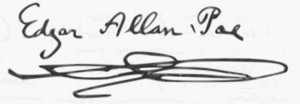
The image is one of many surviving examples of Poe’s signature.
 Art is My Religion