Tag: The Tempest

  • Happy Halloween from William Shakespeare!

    halloween-2016

    Halloween as we know it today didn’t exist in Shakespeare’s time.  Our dark and costumed celebration evolved from many sources, including the Celtic ‘Samhain’ and the ongoing cultural and religious clashes between the pagan practices of the British Isles and the invasion of Christianity.  And so plenty of end-of-harvest rituals with pagan origins were practiced in Elizabethan times, especially in Ireland, Scotland and Wales. 

    Certainly Shakespeare was aware of these, for his plays contain many examples of pagan and Christian myths, all mashed up. Judging by the way Shakespeare could chill and terrify his audiences, could one be blamed if they thought Shakespeare invented this holiday?  Of course he didn’t, but The Bard knew how to mix myth, superstition, paganism, Christianity, monsters, ghosts and curses.  Here are four of some my favorite creepy speeches from Shakespeare, my way of wishing everyone a very Bardic Halloween.  Enjoy! 

    Caliban, from The Tempest, Act 2, Scene 2:

    All the infections that the sun sucks up

    From bogs, fens, flats, on Prosper fall and make him

    By inchmeal a disease! His spirits hear me

    And yet I needs must curse. But they’ll nor pinch,

    Fright me with urchin-shows, pitch me i’ th’ mire,

    Nor lead me like a firebrand in the dark

    Out of my way, unless he bid ’em. But

    For every trifle are they set upon me,

    Sometime like apes that mow and chatter at me,

    And after bite me, then like hedgehogs which

    Lie tumbling in my barefoot way and mount

    Their pricks at my footfall. Sometime am I

    All wound with adders who with cloven tongues

    Do hiss me into madness.


    Iago, from Othello, Act 2 Scene 3:

    How am I then a villain

    To counsel Cassio to this parallel course,

    Directly to his good? Divinity of hell!

    When devils will the blackest sins put on

    They do suggest at first with heavenly shows

    As I do now. For whiles this honest fool

    Plies Desdemona to repair his fortune

    And she for him pleads strongly to the Moor,

    I’ll pour this pestilence into his ear:


    The Ghost, from Hamlet, Act 1 Scene 5:

    I am thy father’s spirit,

    Doom’d for a certain term to walk the night,

    And for the day confin’d to fast in fires,

    Till the foul crimes done in my days of nature

    Are burnt and purg’d away. But that I am forbid

    To tell the secrets of my prison house,

    I could a tale unfold whose lightest word

    Would harrow up thy soul, freeze thy young blood,

    Make thy two eyes, like stars, start from their spheres…


    Lady Macbeth, from Macbeth, Act 1 Scene 5:

    Come, you spirits

    That tend on mortal thoughts, unsex me here,

    And fill me from the crown to the toe top-full

    Of direst cruelty. Make thick my blood.

    Stop up the access and passage to remorse,

    That no compunctious visitings of nature

    Shake my fell purpose, nor keep peace between

    The effect and it! Come to my woman’s breasts,

    And take my milk for gall, you murd’ring ministers,

    Wherever in your sightless substances

    You wait on nature’s mischief. Come, thick night,

    And pall thee in the dunnest smoke of hell,

    That my keen knife see not the wound it makes,

    Nor heaven peep through the blanket of the dark

    To cry “Hold, hold!”
     

  • Sunday Shakespeare – 03 April 2016


    Waterhouse_miranda_the_tempest1

    Today my daily walk took me through some very blustery Spring air: the clouds and trees moved and tossed and moaned and whistled with unsettled ease. It seemed a tempest might brew. That brings me to today’s brief notes: Shakespeare’s The Tempest. The opening scene of this play shows a tempest shipwrecking a vessel. In the second scene we meet the author of that tempest, the mighty Sorcerer Prospero. But how mighty is he? His own daughter takes him to task:

    MIRANDA

    If by your art, my dearest father, you have

    Put the wild waters in this roar, allay them.

    The sky, it seems, would pour down stinking pitch,

    But that the sea, mounting to th’ welkin’s cheek,

    Dashes the fire out. Oh, I have suffered

    With those that I saw suffer. A brave vessel

    Who had, no doubt, some noble creature in her

    Dashed all to pieces. Oh, the cry did knock

    Against my very heart! Poor souls, they perished.

    Had I been any god of power, I would

    Have sunk the sea within the earth or ere

    It should the good ship so have swallowed and

    The fraughting souls within her.

    PROSPERO

         Be collected.

    No more amazement. Tell your piteous heart

    There’s no harm done.

    MIRANDA

        Oh, woe the day!

    PROSPERO

          No harm.

    I have done nothing but in care of thee,

    Of thee, my dear one—thee my daughter, who

    Art ignorant of what thou art, naught knowing

    Of whence I am, nor that I am more better

    Than Prospero, master of a full poor cell

    And thy no greater father.

    MIRANDA

        More to know

    Did never meddle with my thoughts.

    The Tempest, Act I Scene ii


    May I highlight what I think is the most the lovely part of Miranda’s opening speech?

    …you have

    Put the wild waters in this roar, allay them.

    The sky, it seems, would pour down stinking pitch,

    But that the sea, mounting to th’ welkin’s [heaven’s] cheek,

    Dashes the fire out.

    Isn’t it great?

    Anyhow, for years I wondered why I keep coming back to this opening scene between the sorcerer Prospero and his daughter Miranda and I think I’ve figured it out.

    Miranda loves her father, but nonetheless knows he created the storm and that it has apparently sunk a ship, killing the men on board. He responds with vague promises that no harm was done and that he’s only doing it for her, and that she doesn’t know everything. Sounds like lame excuses.

    And yet Prospero, by play’s end, ascends to be one of Shakespeare’s greatest protagonists. And that’s why I like this beginning: It’s a great lesson for writers. The best writers set up their heroes for failure: heroes who are flawed and seem incapable of redemption.

    Shakespeare introduces one of his greatest characters by having him taken down by the very sympathetic Miranda, she motivated by the most noble of principles: she cares for her fellow men–even strangers. Shakespeare doubles down on this technique later in the scene when he introduces Ariel and Caliban, Prospero’s two magical servants. They’re really slaves. By scene’s end we see Prospero treating Caliban with contempt, and basically admitting to Ariel that he’s broken his promises to the creature.

    Back to Miranda. She’s innocent and naïve, yet brave, not afraid to disagree with her father. And she’s honest–when she sees Ferdinand for the first time, she doesn’t hesitate to admit she loves him. But I guess what I really love about Miranda is at play’s end, Shakespeare chooses her to utter these immortal lines:

    O, wonder!


    How many goodly creatures are there here!


    How beauteous mankind is! O brave new world,


    That has such people in’t!

    The Tempest, Act V Scene i

    The Tempest is arguably the capstone of Shakespeare’s works, coming as does near the end of his career. And despite all the travails of the harsh Elizabethan world, and all the tragedies of Shakespeare’s own life, he prefers to release, on the lips of a Miranda, a message of hope and belief in the nature of mankind.

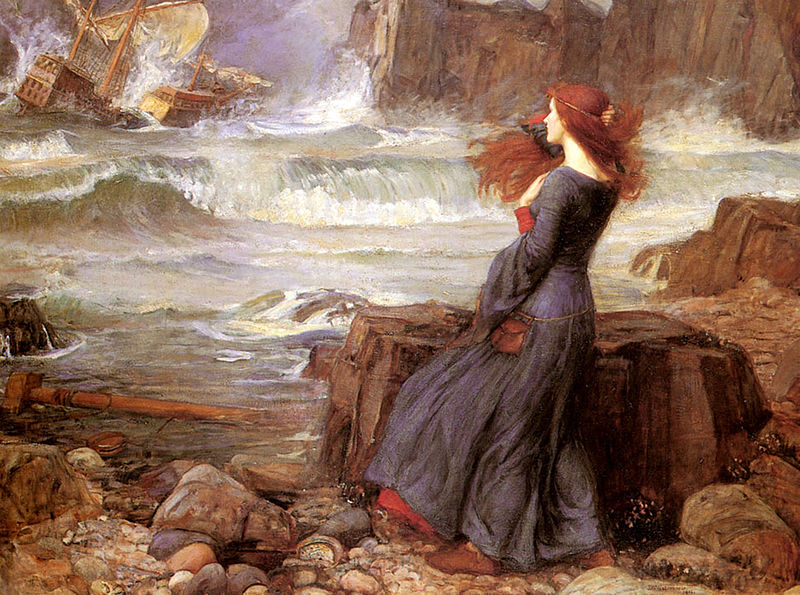
    The image of John William Waterhouse’s painting Miranda – The Tempest, 1916, one of Waterhouses’ last Pre-Raphaelite influenced masterpieces, showing the sorcerer’s daughter witnessing the ships destruction. Apparently Shakespeare’s scene can inspire both writers and painters alike.


  • Midweek Shakespearean Quote – 12 August 2015

    Kenneth Albers and Susan Shunk, The Tempest, 2011.
    Kenneth Albers and Susan Shunk, The Tempest, 2011.

    It’s been a beautiful summer here in Southern Wisconsin. Such delightful, gentle days bring to mind a snippet of verse from The Tempest, where the forces of Nature, including Prospero’s magical island, almost act as one of the characters. Caliban and Ariel, both preternatural creatures, are manifestations of that island, and in the opening of the final act, Ariel sings a song:

    Where the bee sucks, there suck I:

    In a cowslip’s bell I lie;

    There I couch when owls do cry.

    On the bat’s back I do fly

    After summer merrily.  

    Merrily, merrily shall I live now

    Under the blossom that hangs on the bough.

    –The Tempest, Act V, Scene i

    And why shouldn’t Ariel sing? For it’s in this scene that Prospero promises Ariel her freedom after decades of servitude the Prospero the Sorcerer.  

    The image comes from Southern Wisconsin’s very own American Players Theatre, with Susan Shunk as Ariel and Kenneth Albers as Propsero from the troupe’s 2011 production of The Tempest.

  • Hump Day Shakespearean Quote – 29 April 2015

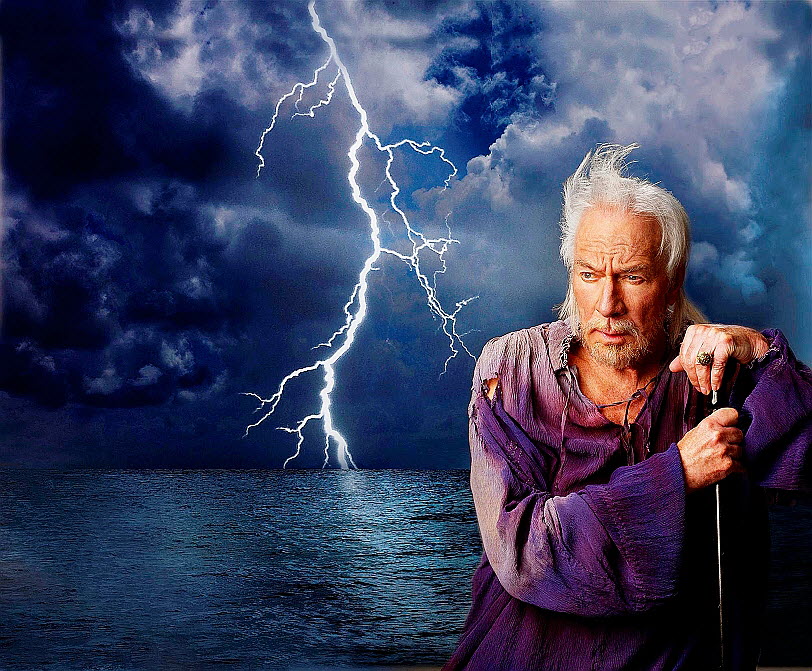
    >Christopher Plummer as Prospero: The filmed version of his live performance in The Tempest is the next best thing to being at Stratford.

    Some believe this is the greatest Shakespearean speech ever. Which, if true, would make it one of the great speeches in English literature:

    PROPERO:

    Ye elves of hills, brooks, standing lakes and groves,
    And ye that on the sands with printless foot
    Do chase the ebbing Neptune and do fly him
    When he comes back; you demi-puppets that
    By moonshine do the green sour ringlets make,
    Whereof the ewe not bites, and you whose pastime
    Is to make midnight mushrooms, that rejoice
    To hear the solemn curfew; by whose aid,
    Weak masters though ye be, I have bedimm’d
    The noontide sun, call’d forth the mutinous winds,
    And ‘twixt the green sea and the azured vault
    Set roaring war: to the dread rattling thunder
    Have I given fire and rifted Jove’s stout oak
    With his own bolt; the strong-based promontory
    Have I made shake and by the spurs pluck’d up
    The pine and cedar: graves at my command
    Have waked their sleepers, oped, and let ’em forth
    By my so potent art. But this rough magic
    I here abjure, and, when I have required
    Some heavenly music, which even now I do,
    To work mine end upon their senses that
    This airy charm is for, I’ll break my staff,
    Bury it certain fathoms in the earth,
    And deeper than did ever plummet sound
    I’ll drown my book. 

    The Tempest, Act V, Scene i 

    This is the last great speech of the last play Shakespeare wrote entirely himself.  And it’s not hard to see Shakespeare drawing a connection between the aging magician, Prospero, and himself, the aging playwright. For Prospero, at play’s end, is at the height of his magical powers; and arguably, The Tempest saw the playwright also at the height of his powers.   Both the magician and playwright choose to ‘break my staff…’ A pun on his own name? Finally to ‘drown my book.’ And before these final pronouncements, the soliloquy registers a train of triumphs and accomplishments. Each of the lines of this speech easily harkens back to any innumerable scenes or characters in his thirty-some plays. 

    Like many of greatest artists and athletes of today’s world, the Bard chose to go out on top. 

    The image comes from Christopher Plummer as Prospero in a 2010 version of Shakespeare’s play.

  • Happy Shakespeare’s Birthday!

    shake

    Our revels now are ended. These our actors,

    As I foretold you, were all spirits and

    Are melted into air, into thin air:

    And, like the baseless fabric of this vision,

    The cloud-capp’d towers, the gorgeous palaces,

    The solemn temples, the great globe itself,

    Yea, all which it inherit, shall dissolve

    And, like this insubstantial pageant faded,

    Leave not a rack behind. We are such stuff

    As dreams are made on, and our little life

    Is rounded with a sleep.

    –William Shakespeare

    From The Tempest, Act 4 Scene 1

  • Hump Day Shakespearean Quote – 25 March 2015

    prospero,medium

    Today, I’d like to share a supremely beautiful speech from Shakespeare’s The Tempest. It almost seems as if Will Shakespeare himself is speaking through Prospero, ruminating on the power of his magic (Prospero the magician; Shakespeare the playwright) and thereby forgetting the mundane concerns of ordinary life: 

    PROSPERO

    …Our revels now are ended. These our actors,
    As I foretold you, were all spirits and
    Are melted into air, into thin air:
    And, like the baseless fabric of this vision,
    The cloud-capp’d towers, the gorgeous palaces,
    The solemn temples, the great globe itself,
    Ye all which it inherit, shall dissolve
    And, like this insubstantial pageant faded,
    Leave not a rack behind. We are such stuff
    As dreams are made on, and our little life
    Is rounded with a sleep. Sir, I am vex’d;
    Bear with my weakness; my, brain is troubled:
    Be not disturb’d with my infirmity:
    If you be pleased, retire into my cell
    And there repose: a turn or two I’ll walk,
    To still my beating mind. 

    The Tempest, Act 4, Scene i 

    The Tempest, we’re pretty certain, is the last play Shakespeare wrote entirely himself. After this play, he went into semi-retirement, only to do a few collaborations with his protégé, John Fletcher. And so in many ways this play seems to be a farewell to the magic of playwrights and theatre. 

    The insubstantial pageant fades, the great globe (a references to The Globe Theatre) shall dissolve. 

    Of course, it’s these very words–this very play and the whole rest of Shakespeare’s canon–that outlived all of Mr. Shakespeare’s daily concerns, and will outlive all of ours. That’s the magic of Art. 

    The image is of Patrick Stewart as Prospero from the Royal Shakespeare Company’s 2006 production of The Tempest.