Month: March 2016

  • Sunday Shakespeare – Easter 2016

    Richard_II_King_of_England

    Easter in Shakespeare? It barely exists. Rare are the Shakespearean references to Christianity: yes, members of the clergy are characters, and characters often invoke God, and use events from the Bible as poetic imagery, and as metaphor. Beyond that the Bard largely avoids the issue of Christian Theology.

    Was this a reflection of Shakespeare’s own belief? It’d be a mistake to believe that; we really can’t know for certain. But what we do know is that Queen Elizabeth’s flavor of Protestantism was strictly enforced by her government, and it was not a good idea to be Catholic, Jew or Muslim. The other thing we know is that Shakespeare was a savvy businessman and for his own benefit avoided political controversy. Religious theology in Elizabethan England was extremely political.

    So if some fool, like Yours Truly, is going to post some Easter blog about the beautiful things Shakespeare wrote about the Easter holiday, he’s going to come up quite short.  There’s a one-line reference to the holiday in Romeo and Juliet, and then perhaps some oblique references in other places. That’s about it.

    There is, however, one delicious tidbit related to Easter: it’s a reference to the nasty business that went on after the Last Supper and on Good Friday.

    In Shakespeare’s history play Richard II, written about 1595, King Richard, near play’s end is facing the end of his Machiavellian reign and dares to compare himself with none other than Jesus Christ:

    Yet I well remember

    The favours of these men. Were they not mine?

    Did they not sometime cry “All hail’ to me?”

    So Judas did to Christ. But he in twelve

    Found truth in all but one; I in twelve thousand, none.

    Richard II, Act IV

    That’s not enough. The disposed Richard takes his bold comparison one step further, from Judas’ betrayal to Pilate’s prosecution:

    Though some of you, with Pilate, wash your hands,

    Showing an outward pity, yet you Pilates

    Have here delivered me to my sour cross,

    And water cannot wash away your sin.

    Richard II, Act IV

    It was dangerous to put anything religious in print, but in the play Shakespeare could get away with these powerful images invoking Judas, Pilate, Christ and the crucifixion because they were words spoken by a character Shakespeare had managed to make villainous by play’s end. History paints a more ambivalent picture of King Richard II, but for generations, Shakespeare’s play skewed opinion. The powerful evocation of Judas’ betrayal and the Savior’s crucifixion would probably have shocked audiences in the day, all carefully exploited for the purposes of creating exciting drama.

    And so while Shakespeare’s works are full of tales and imagery about things destroyed and then coming back to life (i.e., the Easter story), his only direct references to the Passion and Resurrection are the Last Supper betrayal and the Good Friday crucifixion–used to great effect in an impassioned speech by a King who knows he’s doomed.

    The image is the definitive painting of Richard II, anonymous, now housed in Westminster Abbey.
  • Sunday Sonnet – 13 March 2015

    timon

    Flattery will get you nowhere: that’s the gist of Sonnet 82.

    82

    I grant thou wert not married to my Muse
    And therefore mayst without attaint o’erlook
    The dedicated words which writers use
    Of their fair subject, blessing every book
    Thou art as fair in knowledge as in hue,
    Finding thy worth a limit past my praise,
    And therefore art enforced to seek anew
    Some fresher stamp of the time-bettering days
    And do so, love; yet when they have devised
    What strained touches rhetoric can lend,
    Thou truly fair wert truly sympathized
    In true plain words by thy true-telling friend;
    And their gross painting might be better used
    Where cheeks need blood; in thee it is abused.

    In the ‘rival poet sequence’, numbers 78 – 82, Shakespeare’s sonnet-writer (or perhaps Shakespeare himself) finds that a rival Poet is wooing the Young Man away from him. It opens with the realization that the Young Man might never have been married to Shakespeare’s verse: ‘thou wert not married to my Muse’. Like any artsy-fartsy old timer today complaining about how anything new is not as good as the old, Shakespeare spends the middle of the Sonnet describing how the rival poet’s verses are currently in vogue, quite flowery and flattering:

    ‘Some fresher stamp of the time-bettering days’ and ‘yet when they have devised / What strained touches rhetoric can lend.’

    As you might expect, Shakespeare claims his verses are better. They may not be as showy, he admits, but they hold more truth: ‘In true plain words by thy true-telling friend’

    In 16th century England as well as today, we’re often subjected to the newest, best thing. Is it always the best?

    We’ll never know if there was, in fact, a rival poet, or who that poet was (the scholars and historians all have their theories). Suffice to say, the rival’s verse hasn’t survived, nor his identity. But over four centuries later, we still have Shakespeare and his sonnets.

    But there’s a more important lesson here. I believe Shakespeare’s works, all the plays and poetry together, beyond storytelling or simple entertainment, are the greatest guide we have to what it means to be and act as humans. One of the lessons here is more than old versus new. It’s flattery. We’ll always have flatterers–so don’t succumb to them. Years after these Sonnets were written, an older, wiser and perhaps more succinct Mr. Shakespeare addresses flattery in one pithy quote in his late play, Timon of Athens, where the misanthropic character Apemantus says “he that loves to be flattered is worthy o’ the flatterer.”  

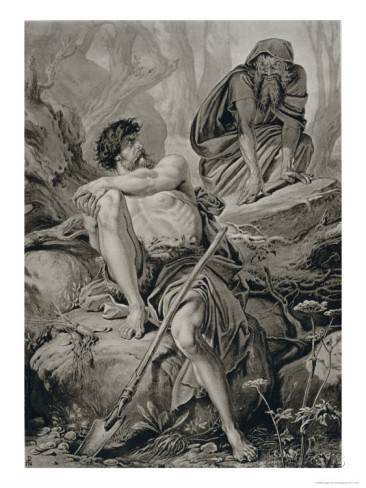
    The image is from an anonymous 19th century artist, showing the gadfly Apemantus confronting Timon of Athens with some desperately needed truisms.


  • Sunday Sonnet – 06 March 2016

    sonnet 151

    A case can be made that Queen Elizabeth I ushered England into the Renaissance. That said, despite the Elizabethan explosion of Art, Science and Thought, it was an incredibly repressive society. And it was sexually repressive–to the point where it was dangerous to be too risqué. Shakespeare, though, knew just how far he could push it.

    151

    Love is too young to know what conscience is;
    Yet who knows not conscience is born of love?
    Then, gentle cheater, urge not my amiss,
    Lest guilty of my faults thy sweet self prove:
    For, thou betraying me, I do betray
    My nobler part to my gross body’s treason;
    My soul doth tell my body that he may
    Triumph in love; flesh stays no father reason;
    But, rising at thy name, doth point out thee
    As his triumphant prize. Proud of this pride,
    He is contented thy poor drudge to be,
    To stand in thy affairs, fall by thy side.
    No want of conscience hold it that I call
    Her ‘love’ for whose dear love I rise and fall.

    This verse is all about how the Poet’s spiritual inclinations succumb to his bodily lust for the Dark Lady. Where it gets risqué–especially for Elizabethan society–is in its second half, where the Poet is reduced to nothing but a phallus, rising and lowering to the Dark Lady’s bidding. You see, it wasn’t permissible in the Elizabethan world of poetry to express sexual desire. But here Shakespeare takes it on. Re-read the start of the second half, it’s really quite explicit:

    But, rising at thy name, doth point out thee
    As his triumphant prize. Proud of this pride,
    He is contented thy poor drudge to be,
    To stand in thy affairs…

    With Sonnet 151, is Shakespeare perhaps also addressing the conventions of the day? In the opening lines Shakespeare seems to be referring to Cupid, who’s too naïve to really understand the way of the world. I think this Sonnet might be taking aim at the Petrarchan ideal of Romantic Love as idolized in most love poetry of the day: grow up, kids, the way of the world is a lot different than what you’re writing about. This is what it’s like: Soul and lust and pleasure and guilt, all mixed up together.

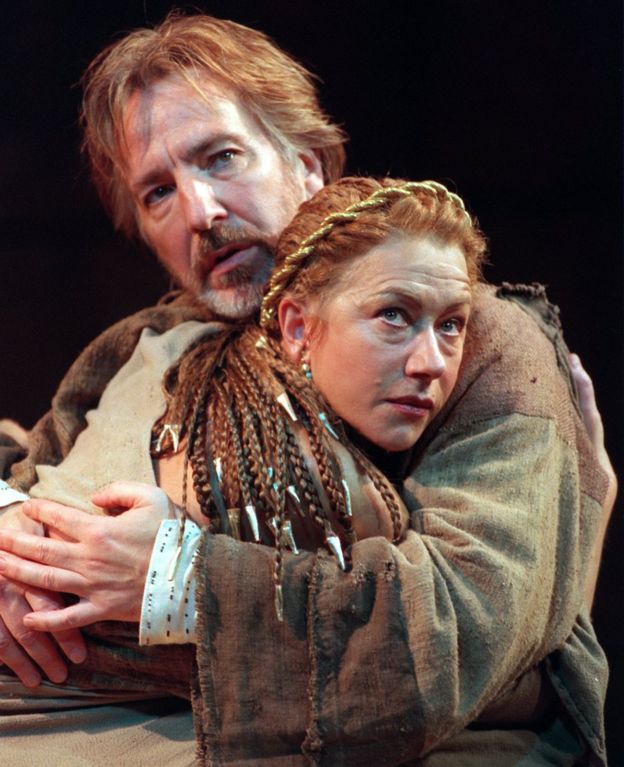
    Shakespeare’s plays were full of lovers, usually unhappy and always complicated. Today’s images is of the great Allan Rickman and Helen Mirren as Antony and Cleopatra from a live performance: certainly sexual, most definitely troubled.